Field Notes · October 30, 2026 · 20 min read
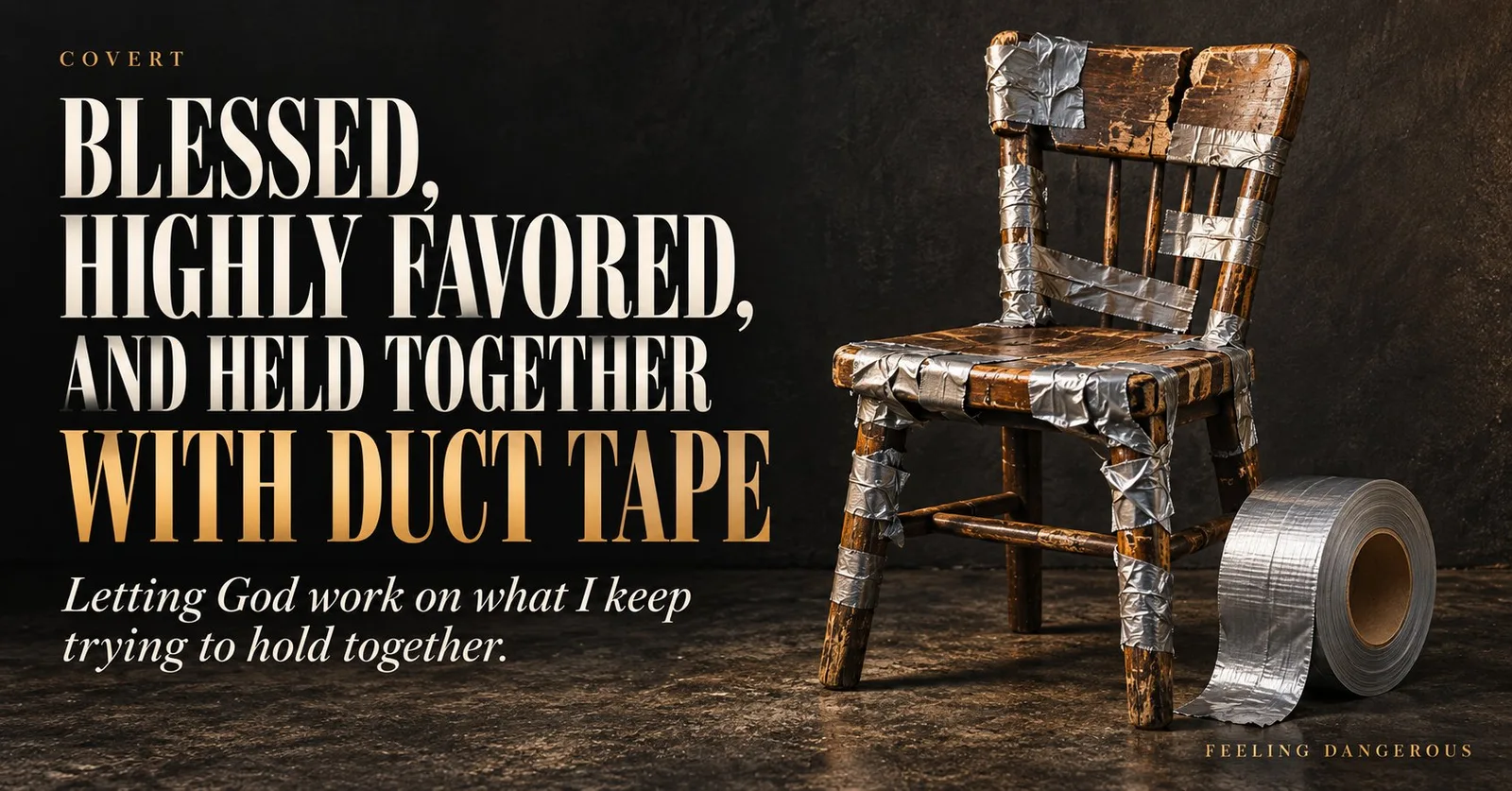
Blessed, Highly Favored, and Held Together with Duct Tape
I believe in prayer. I also believe some of us have developed the remarkable ability to end a conversation, postpone an apology, and avoid a spreadsheet using the exact same sentence. Apparently, spiritual duct tape comes in a family-size roll.
AI-generated narration · Adjust playback speed in the player.
Available in Silver, Black, and Blessed
I have a great deal of respect for duct tape.
Few products have done more to support the confidence of people who should probably have called someone qualified.
There is a specific satisfaction in looking at something broken, wrapping it six times, and stepping back like you have just completed an engineering degree.
It might not work correctly.
It may now weigh considerably more.
But it is together, and that is the standard we have chosen for this afternoon.
You can recognize the moment a temporary fix becomes a lifestyle. Somebody asks when you plan to repair it, and you say, “Well, it's holding.”
That sentence can postpone a surprising amount of work.
I understand the appeal. I like solving problems. I like forward motion. I like seeing something that wasn't working become something I can move past.
But there is a difference between repairing something and making it stop demanding my attention.
That difference gets expensive when I apply the same thinking to my marriage, my children, my business, or my relationship with God.
The spiritual version of duct tape rarely looks like duct tape. It looks respectable. It has encouraging words printed on it. Sometimes it has a Scripture reference.
“God's got this.”
“I'm just trusting Him.”
“We're blessed.”
All potentially sincere. All things a person can say with real faith.
Also, apparently, an extremely versatile collection of materials for covering whatever I would prefer nobody inspect.
I can put a Bible verse over a leak and still act surprised when the carpet is wet.
At some point, I need to consider whether I have mistaken my ability to describe God's faithfulness for my willingness to cooperate with it.
The Problem Is What I Am Using the Words to Do
A short prayer can be powerful. A verse can steady someone in a terrible moment. An encouraging sentence can help a person take the next breath when a long explanation would be useless.
I want those gifts in my life.
The question is what I am doing with them. Am I turning toward God and the responsibility in front of me? Am I using a true statement to avoid an uncomfortable truth?
The exact same sentence can serve either purpose.
I can say I am trusting God while opening the books, admitting the mistake, or having the conversation. I can also say I am trusting God while quietly hoping the conversation gets canceled and the mistake develops the courtesy to disappear.
That second approach has excellent branding and very little structural integrity.
Spiritual duct tape, as I mean it here, is religious language used to cover something that needs attention. The words create the appearance of resolution while the underlying situation continues.
Sometimes the situation is pain I don't know how to express. Sometimes it is fear. Sometimes I am protecting an image. And sometimes I know exactly what I need to do, but I would prefer a spiritual exemption.
God could certainly do a miracle.
I would especially appreciate one where I become a more honest, disciplined, attentive man without changing any of my preferred arrangements.
Perhaps there is a package that leaves my favorite excuses under warranty.
The Inspection I Keep Trying to Reschedule
Psalm 139:23 begins with a request that deserves more consideration than I sometimes give it:
“Search me, God, and know my heart.”
That is an invitation with consequences.
It is easy to ask God to search me in a general, inspirational way. It gets more uncomfortable when the search reaches my defensiveness, my spending, the promises I haven't kept, or the story I tell myself about why the same problem keeps happening.
My ego would prefer to issue Him a visitor badge. Main areas only. Please stay out of the storage room. We are aware of the noise coming from behind that door.
But God already knows what is there. My willingness to name it doesn't provide Him with information He was missing. It gives me a way to stop negotiating with what He is showing me.
That matters because I can spend a great deal of energy managing how a problem appears without addressing how it operates.
I can explain my temper as intensity. I can explain avoidance as waiting for clarity. I can explain an appetite for more as ambition. Sometimes there is truth in those descriptions. Sometimes the vocabulary has simply been selected by the defendant.
I need room for God to challenge my preferred explanation.
Proverbs 28:13 connects concealing wrongdoing with failure to prosper and connects confession and turning away from it with mercy. That includes movement. I bring the truth into the open, then begin changing my relationship to it.
The inspection is an opportunity for repair. I don't have to keep treating every exposed problem as a threat to my entire identity.
It may be the place where grace is asking me to begin.
Marriage: A Prayer Is a Terrible Disappearing Act
Picture a marriage conversation that has become uncomfortable.
One person is trying to explain a recurring problem. The other person hears the opening sentence, recognizes the subject, and begins looking for the nearest available exit.
Unfortunately, the room has walls. Fortunately, there is a religious phrase within reach.
“We just need to pray about it.”
Prayer belongs in that conversation. It can help both people become honest, receptive, and less interested in winning. But if I use it to shut down the discussion, I have made a strange request of God: please be the reason I don't have to participate in loving this person right now.
I don't think that is the direction He was taking the marriage.
In my marriage to Danielle, a spiritual answer still needs to reach the way I behave. If there is a pattern I need to change, I need to deal with the pattern. If a promise needs a place on the calendar, I need to put it there and keep it.
I cannot pray for greater connection while giving my attention to everything that arrives with a notification sound.
At least, I can. But it does raise questions about my contribution to the situation.
There are practical ways to pull back the tape. Admit what has been happening without making the admission somebody else's fault. Agree on one change that can actually be observed. Revisit the conversation after there has been time to practice it.
Love has to travel that far.
The marriage doesn't become stronger because I delivered an impressive closing sentence. It becomes stronger as the person I love experiences what I said becoming dependable.
And if I get defensive about that, I can ask myself why I am so committed to preserving a maintenance system that keeps generating the same repair request.
Parenting: The Lobby Smile Does Not Fix the Car Ride
There is a familiar family comedy about the transformation that happens between a stressful car ride and a public entrance.
In the vehicle: frustration, raised voices, somebody losing patience with a problem that has apparently occurred during every departure since the invention of shoes.
At the entrance: smiles, cheerful greetings, everybody suddenly appearing ready for a family photograph.
The transition is impressive. It should probably come with its own dashboard setting.
But the children experienced the ride, too.
I can teach my children how to behave in public while remembering that my behavior in private is also teaching them something. The polished moment doesn't erase the earlier one.
The temptation is to use authority to avoid looking at myself. I can point to their responsibility, which is real, while giving very little attention to mine.
There are rules to enforce and behavior to correct. I still have to parent. But a command about respect cannot do the work of admitting that Dad handled something badly.
The tape comes off when responsibility becomes specific.
I was harsh. I made an assumption. I didn't follow through. I need to handle this differently.
Then I need to practice handling it differently. My children should not have to become experts in interpreting an apology that never changes the next interaction.
With Madison, Charlotte, Titus, David, Kennedy, and Emma, there are plenty of relationships for me to keep learning inside. A larger family does not qualify me for a bulk exemption from personal growth.
It mostly increases the number of witnesses.
I want them to see faith that can admit something went wrong and then do the work of repair. That gives them a much more useful example than an adult who always has a verse ready and never has anything to own.
Business: Apparently, the Invoice Still Needs Paying
Business offers almost unlimited applications for spiritual duct tape.
You can put purpose in the mission statement, faith in the branding, and generosity in the social media caption. You can sound exceptionally committed to serving people.
Eventually, somebody will ask what happened to the thing you promised to deliver.
This is a difficult moment for the tape.
I care about business. I enjoy building, solving problems, and helping clients move forward. I also know that my ability to create an inspiring explanation does not remove the need for a clear agreement, honest numbers, and work that matches what I sold.
Apparently, writing “God's got this” in the project plan does not cancel the client's expectation that I finish the project.
Faith in business has to reach the unglamorous places. Tell the truth about capacity. Explain a delay before the client has to chase you for an answer. Correct an error. Pay what you owe. Be clear when an idea is an estimate rather than a promise.
Those decisions can be uncomfortable. They can also cost money.
The alternative may cost trust, which is considerably harder to replace than a paragraph on the website.
Religious symbols aren't the problem. A company can express faith sincerely. The question is whether the operating decisions are willing to live under the same values as the marketing.
If the fish on the truck is the most accountable member of the organization, we have work to do.
I want my faith to make me more willing to face the facts. More responsible with what belongs to others. More careful about the commitments that affect a team, a client, or a family.
A business can need a difficult restructuring. It can need better controls. It can need a smaller promise and a more accurate spreadsheet.
I can pray over all of that while doing it. The prayer doesn't become less spiritual because I also picked up a calculator.
Community: Fine Is Doing a Lot of Heavy Lifting
“How are you?”
“Fine.”
It is one of the most impressive load-bearing words in the English language.
Fine can mean I am genuinely doing well. It can mean I am having a rough day and don't want to discuss it in the grocery store. That is fair. Nobody owes a complete emotional inventory to a person reaching past them for shredded cheese.
But sometimes fine means I have become so committed to looking okay that I have stopped giving anybody a chance to know me.
There are days when my “I'm fine” could use its own construction permit.
The danger comes when every relationship receives the same edited version. Everyone knows I am busy, optimistic, and moving forward. Nobody knows where I am frightened, stuck, or tempted to return to something destructive.
I can start calling that strength. It may be isolation wearing a clean shirt.
Galatians 6:1–2 describes gentle restoration and shared burdens. That requires relationships where truth can be spoken and received with care. It asks something of the person struggling, and it asks something of the person being trusted.
If someone tells me something vulnerable, I need to do more than collect information. I need to respect their privacy, listen, and consider what help is appropriate. Their struggle is not material for my next interesting conversation.
And when I need support, I can choose someone trustworthy and be specific enough to let them respond.
I am overwhelmed. I am avoiding a conversation. I am embarrassed about a decision. I am having a hard time with an old habit.
One honest sentence can give a relationship somewhere real to begin.
The Habit Under the Habit
An especially durable form of spiritual duct tape is changing the outside of a pattern while protecting the arrangement underneath it.
I can stop doing one obvious thing and continue making all the decisions that kept leading me toward it. Same secrecy. Same refusal to hear correction. Same belief that one more attempt will solve what honesty would require me to face.
Then I add a few encouraging declarations and wonder why the situation still feels fragile.
I know the appeal of wanting another outcome badly enough to keep pushing for it. Persistence can be useful. It can also become a respectable description for refusing to stop.
With destructive habits, I need to look beyond the last visible decision. What am I allowing to build before that moment? What am I hiding? What kind of access have I preserved because I would prefer to keep my options open?
Prayer can reach those questions. So can practical changes made honestly: a different routine, a boundary I actually keep, a conversation before the pressure has become a crisis.
The point is to participate in freedom instead of merely announcing it.
And if temptation returns, I can respond honestly without declaring the entire journey a fraud. Struggle is information I can bring into the light. I don't have to cover it with exaggerated confidence or turn it into a verdict on whether God loves me.
Grace gives me somewhere to turn. It also gives me a reason to stop protecting the conditions that keep hurting me and the people around me.
James Brought a Very Practical Question
James 2:14–17 describes a person lacking food and clothing. Someone offers a pleasant spiritual farewell and leaves the physical need unanswered.
James asks what good that response does. Then he writes that:
“faith by itself, if it is not accompanied by action, is dead.”
That reaches directly into the duct tape problem. Good words can be offered while something within our ability to address remains untouched.
I can understand that easily when someone needs a meal. The application gets more personal when the need is honesty, a completed commitment, or the apology I keep trying to replace with an explanation.
I don't earn God's love by becoming a more impressive repair project. I receive His grace, and that grace has somewhere to go in my conduct.
If I pray for wisdom, I can listen to counsel. If I pray for restored trust, I can become more trustworthy. If I ask God to help my family, I can examine how I am treating them.
None of that gives me control over every outcome. It gives me responsibility for the part that is mine.
Sometimes the next step will be small and inconvenient. It may lack the dramatic quality I was hoping for. My spiritual breakthrough could involve sending an accurate update before lunch.
I was hoping for thunder. Apparently, we are starting with the overdue email.
Forgiveness Reaches Further Than My Relief
There is another patch I have to watch for: using forgiveness to hurry past the effects of what I have done.
I want mercy. I believe in it. But receiving mercy doesn't mean every damaged relationship instantly becomes trusting or every unfinished responsibility disappears.
If I owe someone the truth, I need to tell it. If I have caused damage I can repair, I need to begin. If a person needs time and boundaries, I need to respect those without accusing them of interfering with my growth.
My relief is one part of the story. Their experience matters, too.
That can be hard on an ego that would prefer a quick redemption announcement followed by everybody returning to the previous arrangement.
People may have questions. They may want evidence. They may remain cautious longer than I would like.
I can keep doing what is right while they decide what they can trust.
Faithfulness has room for that patience. Spiritual duct tape tries to force a finished appearance onto work that still needs time.
I would rather let the repair become real than demand everyone admire the label I put on it.
Jesus Was Willing to Look Beneath the Finish
In Mark 7:6–8, Jesus confronts outward religious devotion that is disconnected from the heart. He also challenges the way human traditions can displace God's commands.
That should make me examine my own use of religious language before I become too interested in diagnosing everybody else's.
I can know the vocabulary. I can recognize the songs. I can explain a principle with enough confidence to make it sound thoroughly installed.
Then a small inconvenience arrives and demonstrates that the installation is still pending.
There is a difference between knowing something belongs in my life and letting it govern my decisions. I can write about humility and still bristle at correction. I can write about generosity and still be possessive about my time. I can write about surrender while privately presenting God with a detailed list of acceptable outcomes.
Writing gives me an opportunity to confront that distance. It doesn't erase it automatically.
I need to ask whether the truth I am sharing is also being allowed to interrupt me.
Would I welcome it if it arrived through a person I hadn't planned to learn from? Would I follow it if it cost me convenience, recognition, or the pleasure of being right?
That is where the finish starts to reveal what is underneath.
God Knows Where the Tape Is
The image of letting God work on my life appeals to me right up until the work affects something I wanted to keep.
My preferred version of transformation includes a dramatic improvement in peace, wisdom, and outcomes, with minimal disturbance to my existing habits.
My ego hears renewal and immediately asks whether we can preserve the floor plan.
But honest change often requires examining the arrangement itself. Why do I keep agreeing to things I resent? Why do I wait until I am angry to admit I need help? Why do I make promises from excitement and then expect someone else to absorb the gap between my enthusiasm and my capacity?
Those are questions God can meet with grace and truth. I can bring them to Him instead of trying to hide the exposed area until I have made it presentable.
He isn't learning the condition of my life from the photograph I would choose to post.
And He doesn't need me to turn every painful experience into proof that He deliberately caused damage for a lesson. Some things come from my choices. Some come from other people's choices. Some are losses I don't understand.
I can seek His help in all of them without pretending I know the explanation for each one.
The invitation is to let Him guide what I do next. Sometimes that will involve comfort. Sometimes correction. Sometimes a process I would very much like to accelerate.
I can receive those differently shaped forms of care without reaching for a phrase that keeps everything exactly as it was.
Holding On Is Still Faith
I want to leave room here for the person who is barely getting through the day.
Maybe a short prayer is all you have right now. Maybe you can't explain what hurts. Maybe you are still deciding who is safe enough to tell.
That does not make your faith fake.
Temporary support has a real purpose. A person in crisis may need help getting through the next hour before they can think about a larger change. An encouraging verse can be part of that support. So can a meal, a quiet presence, or help with an ordinary responsibility.
The problem is turning a temporary way of coping into a permanent refusal to address what needs attention.
And appropriate privacy still matters. You can be honest without giving everybody access. You can tell a trusted person something difficult without publishing a full report. The world does not need a live camera inside your renovation.
It would mostly capture dust, frustration, and someone insisting they thought this would take one weekend.
Take the step you can take honestly. Let support be support. Let a boundary protect you. Let time be part of the work where time is needed.
God's care for you does not depend on how quickly you can produce a polished account of your healing.
The House Still Has to Meet the Weather
In Matthew 7:24–27, Jesus describes two builders. Both hear. The distinction is whether His teaching becomes something they practice. When the storm comes, the foundations matter.
That picture reaches further than appearances.
A calm day can make almost any arrangement look adequate. Pressure reveals where I have relied on presentation instead of practice.
I don't need to go looking for a storm to prove I have grown. Ordinary life supplies enough pressure to give me useful information.
A deadline. A disagreement. A disappointing result. A tired evening. Someone asking me a question I would prefer to avoid.
What do I do then?
I can reach for the familiar phrase and hope it ends the inspection. I can also pause, tell the truth, and respond in a way that reflects what I say I believe.
That may be less impressive than a dramatic declaration. It is also something a relationship can stand on.
I want more of that kind of faith in my life. Faith that reaches the decision while the decision is still mine to make.
Keep the Roll. Change the Job.
Duct tape still deserves a place in the toolbox. I am not trying to destroy the entire rural economy with one Field Note.
But I want to become more honest about the jobs I keep assigning it.
I can trust God with something difficult and still admit it is difficult. I can receive encouragement and continue the conversation. I can pray for restoration and take responsibility for what needs to change.
The faith is real when I bring my actual life to Him. The fear, the mess, the confession, the unanswered questions, the practical responsibility I have been hoping would find another address.
I don't have to arrive as a finished man to begin cooperating with God.
I can stop offering Him a presentation and start giving Him my attention.
And when I say, “God's got this,” I want to mean that I am willing to trust Him enough to do the next thing He puts in front of me.
Even if that thing is an apology.
Even if it is a boundary.
Even if, after all my impressive spiritual language, the next act of obedience is opening the spreadsheet I would prefer to avoid.
Apparently, the Master Craftsman is comfortable working in Excel.
Closing Prayer for True Statements.
Father,
Thank You that I can bring You the condition of my life as it actually is. You already know what I am afraid to admit, what I keep trying to explain away, and where my words have moved further than my actions.
Help me recognize when I am using a true statement to avoid a needed response. Give me humility to confess, courage to change what belongs to me, and patience for work that takes time.
Let my faith reach my marriage, my children, my business, and my community. Help me keep promises, repair what I can, respect the people affected by my choices, and receive correction without making excuses.
Give me trustworthy people to walk with, and help me become trustworthy with what others share. Teach me to offer care that includes practical help where I can give it.
For the person reading this who is barely holding on, provide comfort and support. Help them take an honest step without feeling they must solve everything at once.
Search my heart. Bring truth into the places I have covered, and help me respond to Your grace with a willing life.
In Jesus' name,
Amen.
Join the conversation
Comments
Be the first to leave a comment.