Field Notes · October 25, 2026 · 21 min read
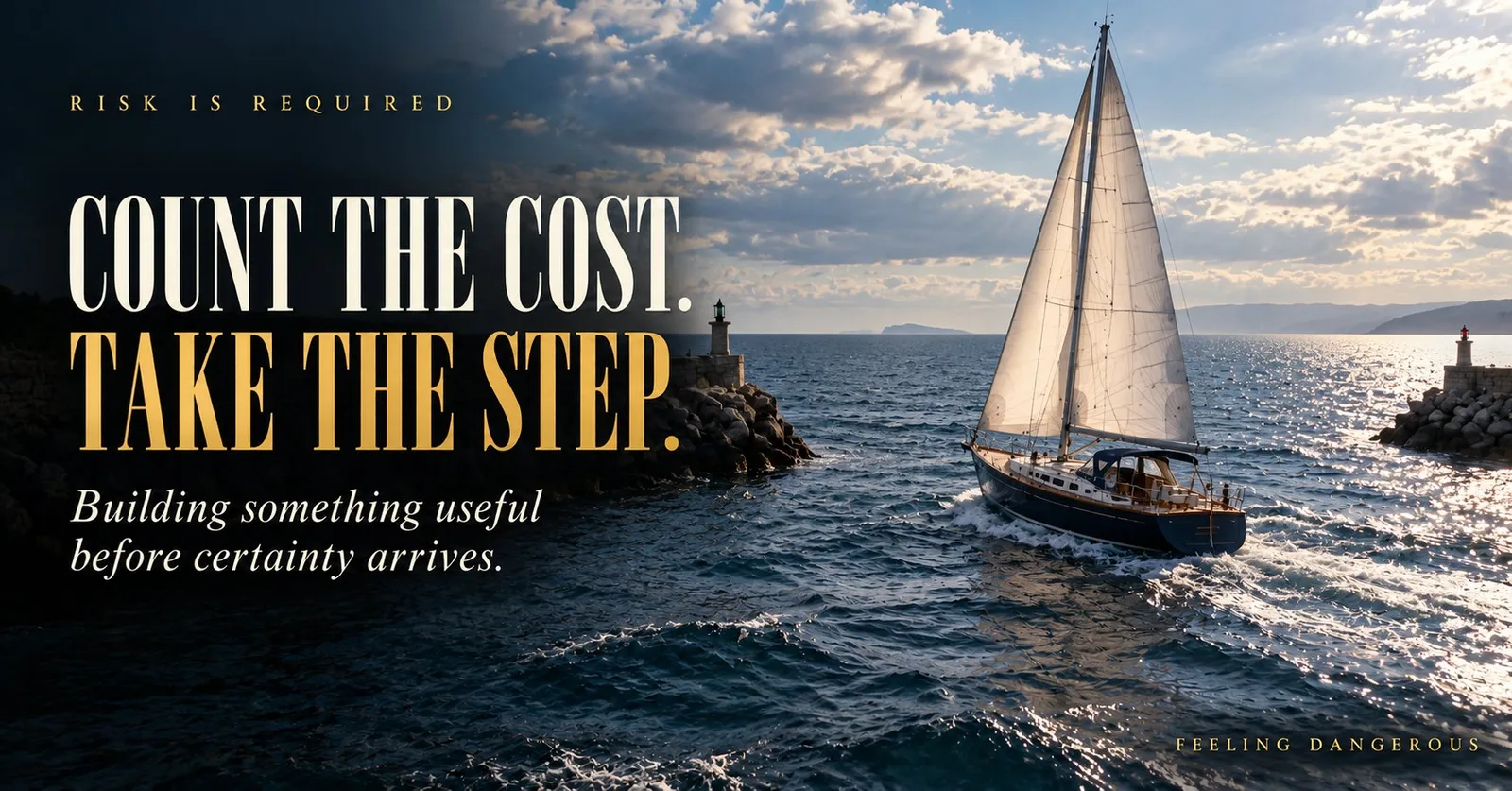
Count the Cost. Take the Step.
A guarantee would make the decision easier. Growth rarely provides one. The work is to prepare honestly, understand the risk, and take a responsible next step.
AI-generated narration · Adjust playback speed in the player.
The Guarantee Must Have Gotten Lost in the Mail
Business would be considerably easier if opportunities arrived with a certificate explaining exactly how they were going to turn out.
Congratulations.
This hire will work.
This customer will pay.
This product will sell.
This expansion will justify the time you spent convincing yourself it was a good idea.
Unfortunately, the certificate seems to be missing from most of the opportunities I have encountered.
There is usually a decision, some information, a few things I do not know, and the uncomfortable realization that waiting longer may still leave me without a guarantee.
That is where risk enters the conversation.
I have never needed much help understanding the appeal of moving forward. Give me a problem to solve, an idea to build, or an opportunity to make something work better, and I can usually find a reason to get interested.
My imagination does not require a lengthy onboarding process.
But willingness to move and readiness to make a sound decision are different things. I can be excited before I understand the work. I can see a possibility before I have considered the obligations. I can mistake how vividly I picture an outcome for evidence that it will happen.
I have learned enough about the consequences of that confusion to take it seriously.
Still, the answer cannot be to spend the rest of my life demanding certainty before participating.
A business needs decisions. Useful ideas need a chance to be tested. Skills need somewhere to be used. People with real problems need somebody willing to attempt a solution.
So the question becomes: how do I move into uncertainty with courage and responsibility in the same decision?
That is the version of risk I want to keep learning.
Staying Where I Am Is a Decision Too
It is easy to recognize the risk attached to doing something new.
A new offer might fail. A new employee might need more support than expected. A new market might not respond. A different process might expose problems that were easier to ignore when everybody was doing things the familiar way.
Those possibilities deserve attention.
But the familiar way has consequences too.
If the way I price work does not cover the real cost of delivering it, keeping the price unchanged is a decision.
If customers cannot understand what I offer, leaving the message alone is a decision.
If one exhausted person holds all the knowledge needed to keep the business operating, doing nothing about that dependence is also a decision.
The absence of a dramatic move does not mean the absence of exposure.
Sometimes the larger risk is allowing a known problem to keep collecting interest while I wait to feel more comfortable addressing it.
That does not make every change wise. It means I need to compare actual alternatives instead of comparing an uncertain new idea with an imaginary version of the present where nothing can go wrong.
The present has a few moving parts of its own.
Customers change. Costs change. People leave. Tools become inadequate. A process that once served the business can stop serving it well.
I want to be attentive enough to notice before necessity makes every decision urgent.
There is a useful kind of stability built through dependable work, sound relationships, and preparation. I value that. It gives people room to think and businesses room to improve.
I also need to recognize when I am calling something stable simply because I have become accustomed to its problems.
Familiar trouble can feel surprisingly comfortable.
It still needs attention.
The Farmer Did Not Get a Weather Guarantee
Ecclesiastes 11:4 says:
“Whoever watches the wind will not plant; whoever looks at the clouds will not reap.”
The surrounding passage acknowledges how much we do not know and encourages sowing without knowing which effort will succeed.
There is movement and humility in the same picture.
I find that helpful because I can turn preparation into an indefinite assignment if I insist that it remove every possible disappointment.
One more report. One more opinion. One more reason to believe the timing might be better later.
Eventually I have to ask whether the next piece of information could actually change the decision or whether I am using research to postpone the discomfort of making it.
That question has an uncomfortable ability to find me.
The farmer still needs to understand the work. Seed matters. Ground matters. Conditions matter. The passage does not turn ignorance into a farming strategy.
But perfect foresight is unavailable.
At some point, the work requires putting something into motion while the result remains unknown.
That applies to an idea I want to test, a conversation I need to have, and a business improvement I keep postponing because I cannot guarantee a smooth introduction.
I can prepare responsibly without pretending preparation will remove every uncertainty.
I can also start with a step small enough to learn from.
The field does not need another presentation about the possibility of planting. Eventually somebody needs to do something useful with the seed.
Risk Needs a Reason Beyond Being Risky
There is a version of entrepreneurship that treats discomfort as proof of greatness.
If the decision is frightening, expensive, and difficult to explain to the people affected, apparently that means the vision is big enough.
I need a better standard than that.
A worthwhile risk begins with a worthwhile purpose.
What problem am I trying to solve? Who needs the solution? What evidence suggests this approach could help? What would improve if the idea worked?
Those questions give the risk a job.
Without them, I can become interested in the sensation of doing something bold. The announcement. The momentum. The identity of being the person who sees what everybody else missed.
That identity can become expensive to maintain.
Sometimes the courageous move will look impressive. Sometimes it will look ordinary: changing a process, testing an offer, asking for honest feedback, or admitting that I need expertise I do not have.
A useful decision does not need to be entertaining.
It needs a purpose strong enough to examine.
If my explanation falls apart the moment somebody asks how the customer benefits, I probably need to spend more time on the idea and less time imagining the launch.
I want to build things that solve problems. Risk is part of that work because I cannot know everything in advance.
It should not become the product I am secretly selling to myself.
Count the Cost While the Idea Is Still Exciting
In Luke 14, Jesus uses the example of somebody building a tower who first considers whether there are sufficient resources to finish it. His subject is the cost of discipleship. The illustration takes preparation seriously.
I take a practical lesson from that picture: enthusiasm about starting should not prevent an honest look at what finishing requires.
That is a useful question to ask while the idea still looks beautiful in my head.
What will it cost to begin? What will it cost to continue? When would money need to leave, and when could it realistically arrive? What skills, people, equipment, or time would the work require?
What happens if the first attempt takes longer than expected?
I can make an idea look quite respectable in a spreadsheet. Change the headings to a serious shade of blue, and suddenly the whole thing appears to have attended business school.
The numbers still need to be grounded in reality.
A forecast deserves assumptions that can be explained. A schedule deserves capacity that actually exists. A plan deserves room for the ordinary things that go wrong without asking permission first.
This is where counting the cost can strengthen courage.
I may discover that the whole idea is beyond what I can responsibly carry right now. I may also discover a smaller version I can begin, an additional skill I need, or a resource that makes the next step practical.
Preparation can reveal a way forward.
It can turn a vague, intimidating possibility into a decision I understand well enough to make.
And if the examination shows that the idea does not work, finding that out before committing everything is useful information.
I do not need to prove my courage by refusing to read it.
Who Is Standing Inside My Decision?
One of the most important questions in business is easy to skip when I am excited.
Who else carries this risk?
A decision may use money I am responsible for managing. It may affect employees who depend on consistent work, customers who have trusted a promise, a partner whose name is attached, or family members who will experience the time and pressure involved.
My willingness to endure the consequences does not mean I am the only person who will endure them.
I have made choices involving entrusted resources that harmed other people. I cannot use the phrase risk is required to make those choices sound more admirable than they were. The responsibilities attached to them remain real.
That lesson belongs inside the way I think about business now.
Authority to make a decision has limits. Agreements matter. Honest disclosure matters. So does whether the action is lawful, ethical, and within what I have actually been entrusted to do.
Enthusiasm cannot provide permission on someone else’s behalf.
If the idea requires pretending a resource belongs to me in a way it does not, I need to stop and address that truth before proceeding.
The same care applies at home. Danielle deserves a real conversation about decisions that affect our household. A plan that spends family time cannot be fully evaluated by looking only at the business calendar.
I want the people affected to understand what is being considered, what is uncertain, and what could be required of them.
Their questions can improve the decision.
And their limits deserve attention before my plans become their emergency.
That kind of responsibility does not prevent every risk. It makes the risk more honest.
Make the First Step Useful Enough to Teach You Something
An idea does not always require the largest possible commitment on day one.
Often, the most useful first move is a clear, limited test.
In the work I do around marketing and business systems, that distinction matters. There are many things a business could change. The challenge is understanding which change addresses the actual problem.
If a company wants more customers, increasing advertising may be one possibility. But more inquiries will not necessarily help if the company responds slowly, cannot explain the offer, or lacks the capacity to deliver the work.
I can spend more money making a problem louder.
That does not mean I have improved it.
A useful test begins with a question specific enough to answer. Would a clearer offer generate more suitable inquiries? Would a different follow-up process lead to more conversations? Would a small campaign reach people who actually need the service and can be served responsibly?
Then define the scope.
Choose an amount the business can responsibly commit. Decide what will be measured, who will do the work, and when the results will be reviewed. Include the cost of delivery, not just the excitement of getting a response.
If the test fails, examine why. If it works, consider what must be true before expanding it.
The same approach can apply to a new service, a different territory, or a technology tool.
A new tool can be tried on a limited, appropriate task before becoming responsible for essential work. A service can be offered within a manageable scope before the business promises it everywhere.
This is still action. The idea is meeting reality.
It also gives me something more useful than an argument about whether I am optimistic enough.
It gives me information.
Four Places Where Courage Needs Details
The word risk can cover so many different problems that it becomes difficult to discuss any of them clearly.
I need to name what could actually go wrong.
The strategy may be wrong. I might be solving a problem customers do not consider important, offering something they do not understand, or assuming demand that has not been demonstrated. That calls for listening and testing, not simply a louder sales pitch.
The cash may not arrive when the bills do. Revenue on a report does not necessarily mean money is available for the next obligation. Payroll does not give a damn how inspiring the vision is. Friday still arrives. I need to understand timing, costs, commitments, and what happens if payment is delayed.
The operation may not be ready. Selling work creates responsibilities. If scheduling, training, communication, staffing, or delivery is weak, growth can expose the weakness quickly. The answer may involve building capability before adding volume.
Trust may be at stake. A promise I cannot support, a result I exaggerate, information I handle carelessly, or a rule I disregard can damage people and the business. That is not a category I can dismiss because the opportunity looks profitable.
Different risks call for different responses.
I may be able to reduce one through preparation, training, or a smaller commitment. Some exposures can be shared or transferred in limited ways through appropriate agreements or insurance, but those arrangements have terms and do not erase my responsibilities.
Some uncertainty can be accepted knowingly.
Some opportunities should be declined.
The work is to understand which decision I am making.
Calling everything a leap of faith would save time in the meeting. It would also leave several important questions unanswered.
Invite Somebody Who Can Say No
Proverbs 15:22 connects sound planning with counsel.
That asks something of me before the advice even arrives: I have to be willing to hear information that does not flatter the idea.
It is easy to gather people who enjoy my excitement. It is more useful to include people who understand the work, recognize the exposure, and are free to disagree.
I need somebody willing to ask what I have assumed.
My gut can have a vote. It does not need every seat on the board.
What would have to happen for this to work? Which part depends on a result I cannot control? What evidence would change my mind? Am I prepared for the downside, or have I only rehearsed explaining the upside?
Those are helpful questions.
They may also arrive without the emotional warmth I would have preferred.
I cannot ask for honest counsel and then treat every concern as a personal attack on my ability to build something.
If the advisor must compliment the vision for ten minutes before being allowed to mention the arithmetic, I have made the meeting unnecessarily difficult.
I want relationships where a concern can be raised early.
That includes the people doing the daily work. They may see a constraint I miss because I am focused on what the business could become.
Proverbs 27:23–24 urges close attention to the condition of the flocks and reminds the reader that wealth and position are not permanent. I hear a practical challenge in that: know what is actually happening in the responsibilities under your care.
The plan in my head needs regular contact with the operation on the ground.
Good counsel helps maintain that contact.
What the Talents Ask Me to Remember
In Matthew 25:14–30, a master entrusts resources to servants and later returns to settle accounts. Two put what they received to work; another hides it out of fear. The two faithful servants receive the same commendation despite having different amounts.
The story places entrustment, action, and accountability together.
I need all three in view.
The parable is about faithfulness before the returning master. It does not promise that every investment will produce a profit or give me permission to gamble with what belongs to somebody else.
It does challenge me to consider whether fear is preventing me from using what has been entrusted to me faithfully.
I have abilities I can develop. Work I can do. Relationships I can honor. Opportunities to solve problems and serve people.
Hiding everything until I can guarantee that nobody will criticize me is not the future I want.
Neither is using the language of multiplication to excuse careless decisions.
I want to become more trustworthy with what is in my hands.
Sometimes that will require a new attempt. Sometimes it will require improving the way I carry an existing responsibility.
The size of somebody else’s assignment does not tell me what faithfulness requires in mine.
That thought gives me room to begin without needing to look impressive first.
Faith Does Not Make Me the Author of Tomorrow
James 4:13–17 speaks directly to people making plans to travel, conduct business, and earn money. It confronts the arrogance of speaking as though tomorrow belongs to them.
The passage includes this posture:
“If it is the Lord’s will”
I can make a plan while remembering that I do not control every condition necessary for it to succeed.
That humility changes the way I speak.
I can describe an opportunity without pretending the outcome is guaranteed. I can explain why I believe an approach is worth trying while remaining honest about what I do not know.
I can pray for wisdom and still need to check the numbers.
My faith does not exempt the people around me from needing truthful information.
I also need to resist making the result the entire verdict on the decision.
A responsible effort can encounter circumstances that prevent the hoped-for outcome. A careless decision can occasionally produce a favorable result. Neither outcome, by itself, tells the whole story about the judgment involved.
I need to examine the purpose, preparation, authority, conduct, and response to what happened.
Success should make me grateful and attentive.
Disappointment should make me honest and willing to learn.
Neither should persuade me that I have stopped needing wisdom.
An Exit Can Be Part of a Responsible Plan
Persistence has helped me in many areas of life. I value the willingness to keep working when something is difficult.
But persistence becomes less useful if I refuse to recognize that the facts have changed.
An experiment needs a review point. A project needs an honest assessment. A commitment may need to be revised when continuing would create harm the original decision did not account for.
I can decide in advance what information would justify continuing, adjusting, or stopping.
That gives the plan a way to respond to reality before my pride becomes responsible for interpreting every update.
Otherwise I may keep increasing the commitment simply because I dislike admitting that the first decision needs correction.
The money already spent can become an emotional argument for spending more. The announcement already made can become a reason to avoid a necessary conversation. The work already invested can make a change of direction feel like a statement about my worth.
It is a statement about the decision.
I need enough humility to keep those separate.
Stopping can be painful. It can involve obligations that still need to be honored and people who deserve a clear explanation.
It can also prevent a difficult situation from becoming a much larger one.
I want to be persistent about serving the purpose. That gives me permission to change a method that is no longer serving it.
And it gives the people working with me a better reason to trust the next step.
The Risk May Look Ordinary From the Outside
If you are reading this and do not own a company, the question still belongs to you.
Your next responsible risk may be applying for a position before you feel completely confident. It may be asking a question in a room where you usually stay quiet.
It may be telling the truth about a mistake while there is still time to address it. It may be requesting help before the pressure becomes an emergency.
For a parent, it can mean changing an approach that feels familiar because it is not helping the child learn. For a spouse, it can mean beginning a difficult conversation without controlling how the other person responds.
For somebody rebuilding after a failure, it may mean accepting a modest responsibility and carrying it well.
None of those steps requires a dramatic announcement.
They require willingness to participate while the outcome remains partly outside your control.
Your circumstances also matter. A person carrying financial strain, illness, grief, or substantial family responsibilities may need a different pace and a smaller first step. That does not make their courage less real.
The most useful question is what can be responsibly attempted from where you actually are.
There may be a conversation to have, a skill to practice, an application to submit, or a small version of an idea to test.
A step does not become insignificant because somebody else is making a larger one.
You need a decision that fits your responsibility and purpose.
I Still Want to Build
My mistakes do not remove the need to use what I know responsibly now.
They do give me reasons to examine my motives, welcome questions, and become more deliberate about the way I move.
I still want to solve problems. I still want to help build useful businesses. I still enjoy seeing an idea become something real that serves people.
I want those efforts to be shaped by what I have learned.
That means being willing to begin before certainty arrives and being willing to explain the risk without dressing it up. It means respecting limits on what I can commit. It means treating the people affected as participants whose understanding matters.
There will be decisions I get wrong. I cannot honestly promise otherwise.
What I can work toward is a better process for deciding, a more truthful way of communicating, and a quicker response when new information requires a change.
That is a future worth participating in.
I do not want fear to have the final word on what I can contribute.
I also do not want excitement to have the only word on how I contribute it.
There is work to do between those two impulses.
Some of that work looks like preparation.
Some of it looks like listening.
And eventually, some of it looks like taking the step.
Count the Cost. Take the Step.
There is no certificate coming that will remove every unknown.
I can keep waiting for one. I can also look carefully at what is in my hands and decide how to use it faithfully.
That requires courage. It requires preparation. It requires a willingness to hear the difficult question before the decision becomes difficult to reverse.
It requires accepting that action and accountability belong together.
I want to make room for all of that.
The goal is to build something useful, honor the people involved, and remain honest enough to learn as the work unfolds.
So count the cost.
Ask the questions.
Invite the counsel.
Understand what you have the authority and capacity to carry.
Then, when the next responsible step is clear enough to take, take it.
The outcome may remain uncertain.
Your willingness to begin does not have to.
Closing Prayer for the Future Blessings.
Father,
Thank You for the abilities, opportunities, relationships, and responsibilities You have placed in my hands.
Give me courage to use them faithfully. Show me where fear has kept me waiting for a guarantee that was never promised. Help me recognize a useful next step and become willing to take it.
Give me wisdom before I commit. Help me examine the purpose, understand the cost, and seek counsel from people who can see what I am missing.
Keep me honest about what I know and what I do not know. Do not let excitement become an excuse to exaggerate, hide a concern, or make a promise I cannot responsibly support.
Help me respect the people affected by my decisions. Teach me to listen before I spend their time, depend on their labor, or expose resources that are not mine to use freely.
Where my past choices have caused harm, keep me accountable and attentive to what remains mine to make right. Let what I have learned change the way I move forward.
When a plan needs adjustment, give me humility to adjust it. When an effort needs patience, give me endurance. When a direction needs to end, give me courage to face that truth and honor the responsibilities involved.
For the person reading this, bring clarity to the decision in front of them. Meet them in the real limits and pressures of their life. Help them find wise support and a responsible way to participate again.
Let our work serve people well. Let our ambition remain teachable. Help us prepare carefully, act courageously, and trust You with the parts of tomorrow we cannot control.
In Jesus’ name,
Amen.
Join the conversation
Comments
Be the first to leave a comment.