Field Notes · September 23, 2026 · 26 min read
The Breath We Waited For
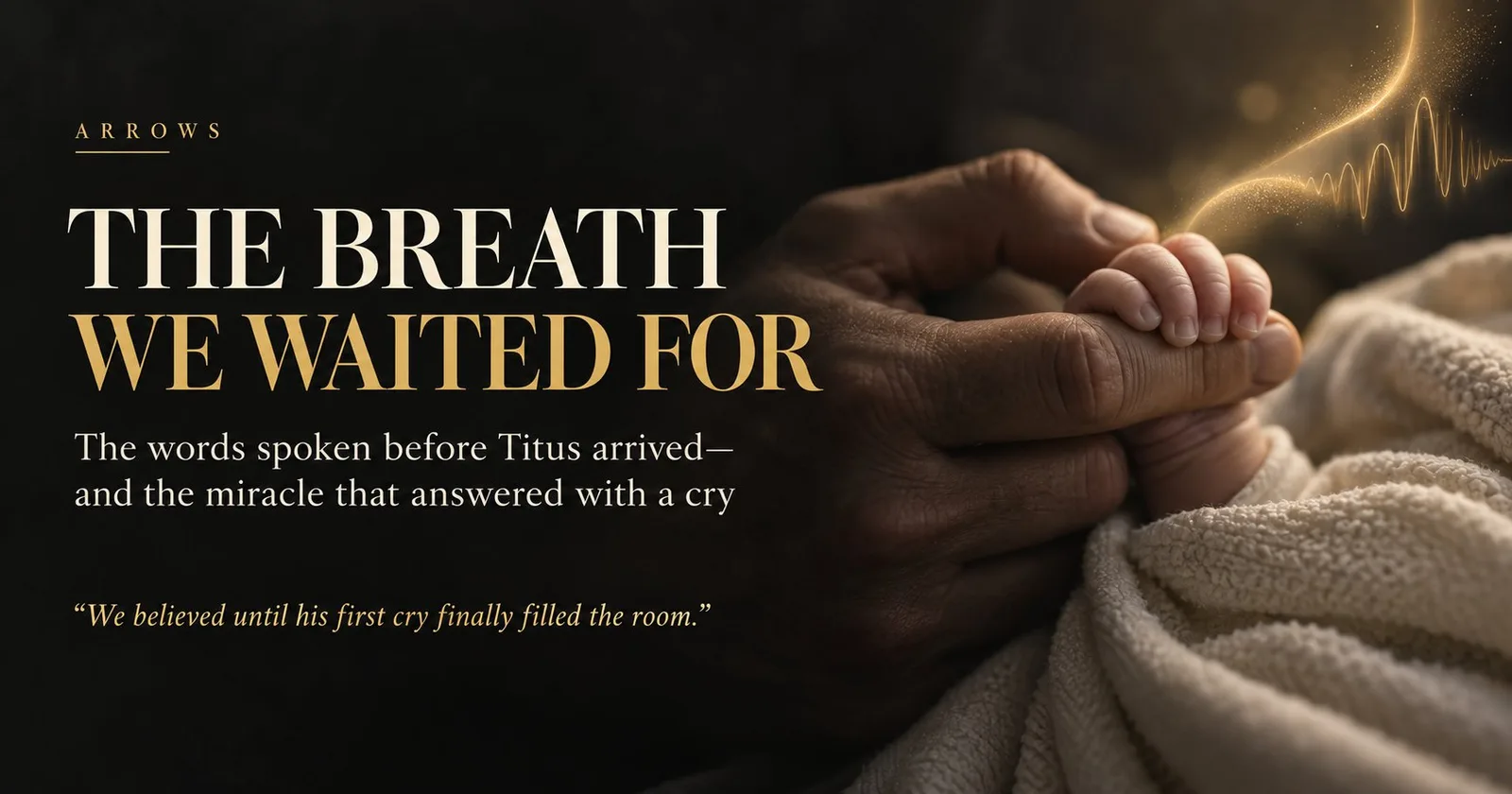
Before Titus ever took a breath, words had already been spoken over his life. Some had to be broken. Others helped us believe until his first cry finally filled the room.
AI-generated narration · Adjust playback speed in the player.
Seven Years Later
Today, Titus is seven years old.
He is loud.
He is funny.
He is wild.
He is bold.
He carries enough energy to power a small town and enough confidence to volunteer himself as mayor of it.
He is the kind of boy who can turn a quiet house into a full-contact sporting event before breakfast. He can create laughter, chaos, competition, questions, noises, injuries, negotiations, and an entirely new set of household rules in the time it takes me to finish a cup of coffee.
He is our firstborn son.
And every once in a while, I stop and listen to him laugh.
Not because the joke is always funny.
Sometimes the joke does not even make sense.
Sometimes the punchline is just him making a noise... sometimes its the way he is laughing at a situation that doesn't always make sense.
But I listen because there was a moment when we did not know whether we would ever hear that sound.
There was a moment when the entire world narrowed to one room, one tub, one gray-blue baby, one silent mouth, and one question nobody wanted to ask out loud:
Would he breathe?
Seven years later, the boy rarely stops.
He talks.
He laughs.
He shouts.
He argues.
He tells stories.
He fills every room he enters with evidence that the silence did not win.
To understand why that first breath mattered so much, however, I have to begin long before the day he was born.
I have to begin with the words that were spoken before he existed.
The Estrogen Ocean
Before Titus, our home was filled with women.
There was Danielle.
There was Madison.
There was Charlotte.
And then there was me... floating alone in what I affectionately called the estrogen ocean.
That line usually got a laugh. It was supposed to.
Humor has always been one of my favorite ways to tell the truth without having to admit how much the truth matters.
I loved my daughters completely. Madison and Charlotte were answers to prayer. They were healthy, beautiful, strong, hilarious little girls who changed every part of my life.
Wanting a son did not make them less wanted.
It did not make them a disappointment.
It did not mean our family was incomplete because daughters somehow counted less.
But beneath the joke, I desperately wanted a boy.
I wanted a son I could raise.
I wanted to experience the father-son relationship from the other side.
I wanted to teach him the things I had learned, protect him from some of the things I had lived, and watch him become his own man.
I wanted someone else in the house who might...just maybe....understand why walking through a hardware store without buying anything still counts as quality time.
So when we learned that Danielle was pregnant again, my prayers became focused.
I tried to sound surrendered.
“God, we just want a healthy baby.”
That part was true.
Then, somewhere beneath the holy voice, another prayer kept surfacing:
“But also… a boy would be great.”
I began looking at boy names.
I imagined a son.
I pictured the relationship.
I focused so intensely on what I wanted that, in a way, I was trying to will a boy into existence.
It turns out that fathers have been attempting to influence biology through concentrated wishing for a very long time. The scientific success rate remains questionable.
Still, I prayed.
And while I was praying for a son, there was another sentence traveling through our family.
My Mother’s “Curse”
My mom had only boys.
My brother and I were ranch boys... wild, feral, creative, destructive, and apparently committed to ensuring she never experienced a boring day. We were born with freedom in our blood and very little interest in risk assessment.
My mom had wanted a little girl.
She never had one.
So before Danielle and I began having children, a line started appearing in family conversations:
“My mom curse is that you will only have little girls.”
It was a joke. At least, that was how it was delivered.
I do not believe my mother sat somewhere designing a spiritual attack against our family. I do not believe she wanted harm for us. I think the sentence came from humor, disappointment, memory, and perhaps a little satisfaction at imagining her son surrounded by the daughters she never had.
But words can be jokes to the person speaking them and agreements to the person receiving them.
That sentence stuck. I did not consciously build a theology around it. I did not wake up every morning and declare that my mother controlled the gender of our future children.
But somewhere inside me, the idea found soil.
Baby number one arrived.
Madison—a happy, healthy baby girl.
Baby number two arrived.
Charlotte—another happy, healthy baby girl.
Both were blessings.
Both were exactly who God designed them to be.
But the pattern made the sentence feel more powerful.
That is how limiting beliefs often grow. Something is spoken. Then something happens that appears to confirm it. Then the sentence moves from being a possibility to becoming an expectation.
Then the expectation begins influencing what we imagine, what we ask for, how we interpret events, and what future we believe is available.
The words may not control biology.
But they can influence belief.
And belief influences the way we live.
What Words Can—and Cannot—Do
This distinction matters.
I do not believe my mother’s sentence biologically caused us to have daughters.
I do not believe Danielle’s response later changed chromosomes or functioned like a spiritual gender-selection spell.
That is not what this story means.
God did not give us daughters because we failed to cancel the correct sentence. And families who only have girls—or only boys—or who struggle with infertility—are not experiencing evidence that someone spoke the wrong words over them.
Children are not rewards for mastering the right vocabulary.
Pregnancy is not a formula. Faith is not magic. But words still matter.
Proverbs 18:21 says:
“The tongue can bring death or life; those who love to talk will reap the consequences.”
Words can create courage or fear.
Words can invite hope or close imagination.
Words can form identity.
Words can shape the emotional atmosphere of a marriage, home, business, church, or family.
Words can become repeated family scripts:
“People like us never get ahead.”
“All the men in this family leave.”
“Every marriage eventually becomes miserable.”
“Addiction is just in our blood.”
“You have always been the difficult child.”
“You are exactly like your father.”
“Nothing good ever lasts for us.”
“You will only have little girls.”
One sentence does not mechanically create every outcome that follows.
But a sentence repeated long enough can become a fence around the future.
Eventually, nobody tests the boundary because everyone has agreed that the fence belongs there.
The spiritual battle is not always about whether words possess supernatural control over circumstances.
Sometimes it is about whether those words gain control over you.
The Day Danielle Drew the Line
Before we knew we were expecting our third baby, my mom visited us in Chicago.
She was spending time with the girls when the familiar line began making its way into the conversation.
I could feel it coming.
She started to say it again.
And this time, something in me was different.
The sentence no longer sounded harmless.
It sounded like an agreement I did not want to continue making.
Inside my head, I responded:
No more.
That does not work here anymore.
I do not agree with it.
The only problem was that all of this courage remained safely stored inside my skull. My lips were sealed.
I wish I could tell you I stood up, planted both feet, looked my mother in the eyes, and delivered a speech that caused three generations of limiting words to collapse on contact.
I did not.
I thought it.
Danielle said it.
The words I could feel building inside me suddenly came out of my wife’s mouth.
She stopped the sentence.
She made it clear that we no longer received it, no longer agreed with it, and no longer wanted it spoken over our future children.
There are moments when marriage looks like romance.
There are moments when marriage looks like friendship.
There are moments when marriage looks like two exhausted people debating who last changed the diaper.
And then there are moments when your wife looks across the room at her mother-in-law and draws a spiritual boundary that you were still rehearsing internally.
My counterpart is a badass.
She saw what needed to be confronted.
She accepted the temporary discomfort.
She protected the future we were responsible for building.
She did not attack my mother.
She attacked the agreement.
That is an important difference.
We can reject a sentence without rejecting the person who spoke it.
We can forgive intent while still confronting impact.
We can love our parents without giving every inherited belief permanent residence in our home.
After that day, I felt relief.
The words had finally been answered. The sentence had finally met a boundary. The agreement had ended. And my mother never spoke that line over us again.
The Surprise We Refused to Open Early
Not long after that visit, we discovered that Danielle was pregnant with baby number three.
Just as we had done before—and as we have continued doing—we chose not to learn the baby’s sex before birth.
There are not many true surprises left in life.
Technology can tell us almost everything early.
We can track the package, preview the menu, read the spoilers, study the reviews, inspect the street view, and know what time someone arrived before they ring the doorbell.
But this was one mystery we wanted to protect.
I still hoped for a son.
Deep down, I believed this baby was a boy.
I had no ultrasound confirmation.
I had no envelope hidden in a drawer.
I had no blue cake waiting in a bakery refrigerator.
I had hope.
I had prayer.
And then our daughter said something that stopped both of us.
“Thank You for My Baby Brother”
A few weeks before the birth, we were praying together at bedtime.
Madison was still little. There was no reason for her to know whether the baby was a boy or girl. Yet in the middle of her prayer she said:
“Thank You for my baby brother who is coming.”
Danielle and I looked at each other.
It was one of those moments when two people have an entire conversation without saying anything.
Did you hear that?
Why did she say that?
Does she know something?
Was that just a child expressing what she wanted?
Or had she somehow reached ahead of us and touched something God had not yet revealed?
I cannot prove what happened in that prayer.
I can tell you that the sentence lodged itself in our memory.
My mother’s words had once created a ceiling:
You will only have girls.
Now our daughter’s words opened a window:
Thank You for my baby brother.
One sentence attempted to define what could never happen. The other expressed gratitude as if the answer were already on the way. Before Titus ever took a breath, his sister had already thanked God for him.
Somewhere Between Twenty-Four Hours and Twenty-Four Minutes
Every birth had taught us something different.
Madison’s labor lasted roughly twenty-four hours. It was long, exhausting, and demanding.
Charlotte arrived with the opposite strategy.
She came so quickly during an ice storm that help could not arrive in time, and I ended up delivering her.
For the rest of that day I carried enough adrenaline to lift the house and check underneath it.
Afterward, I knew one thing: I did not want a repeat performance.
For the third birth, we prayed for something between an endurance race and an emergency launch.
We wanted enough time for the birth team to arrive.
We wanted peace.
We wanted the tub prepared.
We wanted help present if help became necessary.
We wanted to welcome this baby in our home.
It was May, so unlike the day Charlotte arrived, the roads were not covered in ice. Our doula made it. The tub was filled. The room carried the music, diffusers, prayers, and atmosphere we had hoped to create.
This time, we were not racing the weather.
This time, support was in the room.
This time, we believed we had received the peaceful middle ground we had requested.
Then the baby began to arrive.
The Warning Before We Needed It
Before the birth, our doula told us she had received a dream or warning involving the umbilical cord around the baby’s neck.
We believed she was part of our birth team for a reason.
We had prayed for the right people to enter our lives... the kind of people who carried practical competence, spiritual awareness, calm judgment, and the willingness to act when a moment required it.
Her warning stayed with her.
Then, as the baby crowned, the cord appeared around his neck.
She had Danielle pause long enough for one loop to be moved.
Then another loop became visible.
The cord was wrapped twice.
Medically, this is called a double nuchal cord... two loops of umbilical cord around the baby’s neck. Nuchal cords are not rare, and most do not cause lasting harm. However only about 2% of births happen with a double wrap cord. A tight or compressed cord can affect blood flow and oxygen delivery and require immediate attention.... a double wrap increases those risks dramatically.
The umbilical cord does not carry air. It carries blood between the placenta and baby, including oxygenated blood flowing toward the baby. After birth, a still-pulsing cord may continue placental transfusion for a short period when circumstances allow.
That is the medical language.
In the room, it did not feel clinical.
It felt like time had stopped.
The cord of life looked like it had become a noose.
One loop came away.
Then the second.
The birth continued.
The son I had prayed for entered the world.
And the room remained silent.
No Cry
I do not remember every detail of that day.
Some of the memory feels redacted.
Danielle will need to fill in parts of the timeline someday because fear has a strange way of changing how memory records time. I remember the image more than the sequence.
A grayish-blue baby.
Little movement.
No immediate cry.
No obvious celebration.
No sound announcing that everything was okay.
The baby was guided to Danielle in the tub while the cord was still attached.
Hands began rubbing him.
We watched.
We prayed.
We waited.
I cannot tell you with certainty whether the silence lasted seconds or longer. Memory stretched it into an eternity. Every instant contained enough emotion to fill an hour.
First came excitement. The baby was here.
Then fear. The cord was around his neck.
Then relief. The loops were removed.
Then terror. He was not responding the way a newborn should.
Then faith. We began speaking life.
Then doubt tried to enter.
Then prayer pushed back.
The entire emotional range of a lifetime crashed into one concentrated moment beside that tub.
We did not pray quietly. We prayed with urgency. But what stands out to me is that we did not only plead for something we feared we had lost.
We thanked God for what He had delivered.
We thanked Him for the baby.
We thanked Him for life.
We thanked Him for our son.
We spoke to the future while the present remained silent.
Maybe those prayers were shaking.
Maybe they were loud.
Maybe fear was attempting to speak between every sentence. But life was the language we chose.
The First Gasp
Then he gasped. And so did we.
He cried. And I think all three adults cried with him.
The sound broke the pressure in the room. I remember collapsing to my knees beside the tub. The breath we had waited for had arrived. The cry we needed filled the house.
The silence lost.
God was good.
The first sound from our son was not merely noise to me.
It was an answer.
It was relief.
It was the physical confirmation of what Madison had thanked God for weeks earlier.
Her baby brother was here.
He was breathing.
He was crying.
And for the first time in my life, a screaming newborn sounded exactly like peace.
Titus Gabriel
We named him Titus Gabriel.
Titus is an ancient Roman name carried by a trusted companion of Paul in the New Testament... a leader entrusted with responsibility, order, teaching, and the development of other leaders.
Gabriel means “God is my strength” or “strong man of God.” In Scripture, Gabriel appears as a messenger entrusted with announcements that changed families, futures, and history.
I see leadership in our son.
I see boldness.
I see strength.
I see a boy who someday will lead leaders.
I believe there is a calling on his life.
Part of me has wondered whether the struggle surrounding his first breath reflected resistance against that calling.... whether the enemy wanted to stop something before it began.
But I need to hold that interpretation with humility. I cannot prove that the cord was a spiritual attack.
What I can say is that we experienced the moment as both physical danger and spiritual battle.
What I can say is that people were positioned, a warning had been received, prayer filled the room, and our son began to breathe.
What I can say is that his life has felt protected from the beginning.
And what I must remember as his father is that calling should never become pressure.
Titus does not owe me a public ministry because I have a dramatic birth story.
He does not have to perform my interpretation of his name.
He does not need to carry the burden of proving why he survived.
He is first our son... not our sermon illustration.
Our responsibility is to shape the arrow faithfully, not to force it toward the target of our ego.
We can speak life over him.
We can teach him.
We can protect him.
We can notice his gifts.
We can prepare him to hear God for himself. Then, when the time comes, we must trust the Archer with the direction.
The Miracle Was Not That We Finally Got a Boy
There is another distinction I need to make. The miracle was not that God finally upgraded us from daughters to a son. That sentence is ridiculous.
Madison and Charlotte were never placeholders.
They were never failed attempts. They were never evidence that a curse was working. They were—and remain—miracles of their own.
The miracle was life.
The miracle was timing.
The miracle was the warning our doula carried.
The miracle was the calm and action in the room.
The miracle was our silent baby taking a breath.
The miracle was that the son we had hoped for became a boy we could hold.
The miracle was that seven years later, the breath we waited for has become laughter echoing through our home.
God did not answer our prayer for a son by diminishing the value of our daughters.
He expanded the family.
He added a new voice to the choir. Admittedly, it is not always a choir. Some days it sounds more like a cage fight being hosted inside a zoo.
But it is alive. It is our zoo. And it is good.
The Agreements We Inherit
I sometimes wonder what would have happened if Danielle had never interrupted that sentence. Not because I believe my mother’s words controlled the biology of every future pregnancy.
I wonder what would have happened inside us.
Would I have continued giving the phrase authority?
Would I have interpreted every daughter through it?
Would I have carried resentment I was too ashamed to name?
Would I have stopped asking God honestly for what I wanted because I had already accepted what someone else said was inevitable?
Would a joke have become part of our family identity?
We will never know and I am thankful.
Because the sentence was confronted before it could travel any farther.
Every family carries words.
Some are blessings:
“We always show up for each other.”
“In this family, we tell the truth.”
“You can always come home.”
“God has been faithful to us.”
“We finish what we start.”
Some are wounds disguised as identity:
“You are the irresponsible one.”
“She has always been dramatic.”
“He will never change.”
“Our family is cursed with addiction.”
“The women in this family always choose the wrong men.”
“The men in this family do not know how to love.”
“Money never stays with us.”
“Every good thing gets taken away.”
The danger is not merely that someone once said those things.
The danger is that generations may begin organizing their behavior around them.
A child hears a label.
The child begins looking for evidence.
The family notices every moment that confirms it.
The child eventually performs the role everyone assigned.
Then the family points to the outcome and says:
“See? We told you.”
The sentence becomes a prophecy only because everybody kept rehearsing the script.
That cycle can end.
But someone has to become willing to interrupt the line.
Break the Sentence Before It Becomes a Sentence
Some words spoken over you may have felt like a life sentence.
Maybe they came from a parent.
Maybe from a teacher.
Maybe from a coach, pastor, spouse, doctor, judge, friend, enemy, or former version of yourself.
Maybe the words were intended to be funny.
Maybe they were spoken in anger.
Maybe they were delivered as a prediction.
Maybe they were presented as prophecy.
Maybe they described something true about a season and you accidentally adopted them as truth about your identity.
Today, I want you to examine the agreements those words created.
Not every painful sentence is a supernatural curse.
Not every negative prediction requires a dramatic ceremony.
Sometimes freedom begins with a clear decision:
That may have been spoken to me, but it will no longer speak for me.
Words Are Wind Behind the Arrow
Psalm 127 describes children as arrows in the hands of a warrior. An arrow is shaped before it is released. Its shaft is straightened. Its point is sharpened. Its feathers are placed with intention. Then it is aimed toward a future the arrow cannot yet see.
Our words become part of that shaping.
Words can steady an arrow. Words can also bend one. Words can call out courage. Words can create shame. Words can help a child understand that failure is an event. Words can convince a child that failure is an identity. Words can say, “You made a dishonest choice.”
Or words can say, “You are a liar.”
Those are not the same message.
One confronts behavior.
The other names the child after it.
As parents, we cannot control every force our children will encounter.
We cannot guarantee that every arrow lands exactly where we imagined.
We cannot eliminate suffering, resistance, mistakes, temptation, or free will.
But we can pay attention to the wind we create inside the home.
We can decide whether our language pushes our children toward truth or constantly reminds them of the direction they once missed.
Titus’s first breath taught me that words cannot replace action, preparation, skilled help, or God’s grace.
But words can fill the room while we wait.
Words can keep fear from becoming the only voice.
Words can remind us what we believe when circumstances have not yet agreed.
Words are not the Archer.
Words are not the bow.
Words are wind behind the arrow.
We should choose their direction carefully.
The Joy That Followed the Silence
When I watch Titus now, I do not see the gray-blue baby first.
I see joy.
I see the laughter of our firstborn son.
I see the answer to a prayer I tried to hide beneath jokes.
I see the brother Madison thanked God for before the rest of us knew.
I see a boy who arrived through a doorway of fear and immediately began teaching us about life.
I see the wildness of the ranch boys who came before him, mixed with his mother’s strength, his sisters’ influence, and a personality that belongs entirely to him.
I see a future leader who is still allowed to be seven.
That last part is important.
He does not need to understand the full weight of his birth story yet.
He needs room to laugh.
He needs room to play.
He needs room to make mistakes.
He needs room to become.
Someday, when he is old enough, I will tell him about the room.
I will tell him about the cord.
I will tell him about the silence.
I will tell him about the people positioned around him.
I will tell him about the prayers.
I will tell him about the gasp.
I will tell him that his first cry brought his father to his knees.
But I hope the story never makes him feel that his life must be spectacular to justify surviving.
Life is already the gift.
Calling is not proven only from a stage.
Leadership may look like serving a family, telling the truth, protecting someone vulnerable, building something good, or becoming a faithful man in a world filled with counterfeits.
Whatever God asks of him, I pray Titus becomes strong enough to obey and humble enough to remain teachable.
I pray that “God is my strength” becomes more than the meaning attached to his middle name.
I pray it becomes the foundation beneath his life.
Choose Life in the Room You Are Standing In
You may not be waiting beside a birth tub.
You may not be waiting for a newborn’s first breath.
But you may be standing in a room where death has become the loudest language.
Your marriage may feel silent.
Your business may appear lifeless.
Your child may be struggling.
Your recovery may feel fragile.
Your faith may feel gray-blue and unresponsive.
You may be surrounded by circumstances that are not doing the things you expected life to do.
This is not an invitation to deny reality.
If something needs emergency help, get emergency help.
If something needs medical care, seek medical care.
If something requires repentance, repent.
If restitution is owed, make it.
If the relationship needs counseling, ask for it.
If the addiction needs treatment, enter treatment.
Speaking life does not mean pretending danger is not present.
It means refusing to let fear become the only authority interpreting it.
Deuteronomy 30:19 says:
“I have set before you life and death, blessings and curses. Now choose life, so that you and your children may live.”
Choose life in your words.
Choose life in your actions.
Choose life in the people you invite into the room.
Choose life by breaking agreement with the sentence that says nothing can change.
Choose life by becoming accountable for the things you can change.
Choose life while remaining honest about the things only God can do.
Sometimes the miracle arrives as an instant gasp.
Sometimes it arrives one counseling session, one sober day, one apology, one payment, one repaired conversation, or one obedient decision at a time.
Either way, keep making room for breath.
Final Reflection
Titus’s birth was a collision of words.
A joking sentence had been repeated over our future.
Danielle interrupted it.
Our agreement with it ended.
A little girl thanked God for her baby brother before she knew he was a boy.
A birth worker carried a warning before the cord appeared.
A silent child entered the world.
Three adults spoke life while waiting for his body to answer.
Then the breath came.
Then the cry came.
Then the joy came.
Seven years later, the cry has become laughter.
The laughter has become personality.
The personality is becoming purpose.
And the son I once tried to pray into existence is now one of the clearest reminders in my life that words matter—but God remains the Author.
We do not control outcomes by arranging the perfect sentences.
We do not manipulate heaven with vocabulary.
We do not blame every hardship on a curse or claim every victory as proof that we finally prayed correctly.
But we do guard our agreements.
We do confront inherited lies.
We do speak life when fear offers us a different script.
We do shape our arrows with words that prepare them for truth, courage, love, and obedience.
We do thank God for breath.
And when that breath becomes laughter running through the house, we stop long enough to remember the silence that came before it.
The breath we waited for arrived.
His name is Titus.
And our home has not been quiet since.
Thank God.
Todays Prayer.
Father,
Thank You for the gift of life.
Thank You for every child, every breath, every warning, every person You position, and every moment Your grace reaches us before we understand what we will need.
Today, we bring You the words that have been spoken over us and the agreements we have made with them.
Show us the sentences we have accepted as identity.
Show us the jokes that became limitations, the labels that became roles, the failures that became names, and the family patterns we began treating as destiny.
We forgive the people who spoke from pain, ignorance, fear, anger, disappointment, or their own unhealed history.
We refuse to build our future around resentment toward them.
But we also refuse to continue agreeing with words that oppose truth, life, freedom, faithfulness, healing, responsibility, and the future You are calling us to build.
In Jesus’ name, we break agreement with every lie that says our family cannot change.
We break agreement with addiction as identity.
We break agreement with rage as inheritance.
We break agreement with abandonment as inevitability.
We break agreement with failure as our name.
We break agreement with the belief that our children must repeat our wounds.
Replace those words with truth.
Teach us to speak life without denying reality.
Teach us to combine prayer with action, faith with wisdom, hope with accountability, and spiritual discernment with humility.
Guard the words spoken inside our homes.
Help us correct behavior without condemning identity. Help us shape our children without forcing them to carry our ego, ambition, or unfinished dreams.
Make our homes places where truth can be spoken, mistakes can be repaired, calling can grow, and every person can breathe.
Thank You for Titus.
Thank You for the breath we waited for.
Thank You for the cry that broke the silence and the laughter that still reminds us life won in that room. May he become everything You designed him to become—not merely what we imagine for him.
May all our children fly toward the purposes You prepared for them, straightened by truth, strengthened by love, and released in faith.
In Jesus’ name,
Amen.
Join the conversation
Comments
Be the first to leave a comment.