Field Notes · September 6, 2026 · 21 min read
The Cell Without Walls
Growing up, we had a horse who would remain inside the barn or corral even when the gates were left open. We also had dogs that stayed close even after the chain was removed. The physical restraints were no longer holding them, but their familiar boundaries remained. For approximately four years, I have done something similar: long before any court imposed a sentence, I built a cell in my mind and began serving the worst outcome I could imagine.
AI-generated narration · Adjust playback speed in the player.
The Gate Was Open
Growing up, we had a horse named Teton.
You could leave the gates to the barn or corral open, and Teton would stay. There did not need to be a locked gate across the opening. He knew the area that belonged to his daily life, and an open path did not automatically cause him to expand it.
We also had a dog named Duke. Even when Duke was taken off his chain, he would remain close to his dog run. The chain could be lying on the ground while Duke continued living within the same familiar radius.
I cannot tell you exactly what either animal thought. I do not know whether training, habit, comfort, attachment, familiarity, or some combination kept them close. I do not need to invent a story of mistreatment or fear to make the memory useful.
The truth is simpler.
The gate was open, and Teton stayed.
The chain was off, and Duke stayed close to the run.
The external restraint had been removed, but neither animal immediately expanded the boundary of its world.
I saw that pattern growing up, long before I could recognize it in myself.
My circumstances are not identical, and I am not suggesting that every external restriction in my life has disappeared. My legal situation is real and unresolved. But the deeper picture is familiar: fear can establish a perimeter so thoroughly that a person continues obeying it even when he still has room to move.
An open gate does not automatically create a free life.
The Sentence Before the Sentence
Years ago, Danielle and I were sitting in bed talking about worst-case scenarios.
I had always done my best to shield her and the kids from what I was doing. In my head it was safer with them not knowing.
The investigations had begun. Questions were accumulating faster than answers. We talked about what could happen, what it might mean for our family, how much time could be lost, what we would tell the children, and what life could look like if my physical freedom were taken away.
I do not remember every word from that conversation.
I remember the weight of it.
I remember trying to think far enough ahead to protect Danielle and the children from every outcome while knowing I could not control the outcome in front of us.
Something happened inside me that night that I did not recognize until this morning.
I began serving the sentence.
No judge had imposed it.
No prison had received me.
No door had locked behind me.
I could still leave the house, drive the car, take my children somewhere, sit across from a client, attend church, travel, work out, write, pray, laugh, or reach for Danielle in the dark.
But the conversation gave fear enough material to construct a future, and my mind began living inside it.
I thought I was preparing for the worst.
I did not realize I had already moved into it.
My Name in the Concrete
I can see the cell now.
My name is carved into the concrete wall. There is a familiar place on the bunk where I have spent years sitting in silence. Pictures of experiences I missed are taped beside me. There are tear stains on the pillow and tally marks recording time no court ever ordered me to serve.
The cell has no physical walls, but it has a routine.
Wake up and remember the investigation. Go to bed in regret.
Imagine the worst outcome before breakfast. Have dinner in depression.
Read meaning into every delay.
Treat an unanswered question as evidence of approaching disaster.
Sit with the family while mentally rehearsing the day I may have to leave them.
Avoid fully enjoying the moment because joy feels irresponsible when punishment may be coming.
Keep part of myself unavailable so separation will not hurt as much later.
That is how a physically free man begins practicing captivity.
For approximately four years, I have lived with the uncertainty of civil and criminal investigations. The legal process is real. The actions beneath it are real. The people affected are real. The responsibility to tell the truth, cooperate, make restitution where possible, receive counsel, and accept lawful consequences is real.
The mental sentence was also real, but it was not the same thing.
It was punishment I added in advance... the familiar perimeter I continued honoring because its limits felt more predictable than the freedom still available beyond it.
Visitation in My Own Home
I used prison language without noticing how accurate the metaphor had become.
There were moments when I allowed myself out for visitation. I could sit with Danielle or be surrounded by our children, friends, and family. Physically, I was there. Mentally, emotionally, and spiritually, part of me remained behind the wall.
I told myself the withdrawal was protection.
If I prepared for separation now, perhaps it would hurt less later.
If I kept some distance, perhaps the people I loved would become less dependent on my presence.
If I refused to settle fully into joy, perhaps the future could not take as much from me.
But fear cannot protect a family by removing a man before anyone has required him to leave.
Danielle and the kids did not receive a safer version of me.
They received a divided version: a husband and father who could be in the room while part of him lived years ahead, inside an outcome that had not happened.
I cannot speak for what Danielle saw or how she would describe those years. I do know she would probably talk about the heaviness, the darkness... the emptiness.
I can only tell the truth about what I now recognize in myself. The moment we discussed the worst-case scenario, I began organizing my emotional life around it.
I was not preparing only documents, plans, money, relationships, or responsibilities.
I was preparing to disappear.
The Little Judge Within
In college, I remember learning about punishment, group behavior, and a phrase that stuck with me: “little Stalins.” As I remember the classroom discussion, people .... especially children... could propose consequences for themselves or others that were dramatically harsher than an authority figure might choose.
I have not been able to verify that phrase as an established term in child psychology or locate the specific study I remember.
I may be combining more than one classroom idea but the childhood picture still feels familiar as a father.
One of our younger children can make a small mistake and immediately volunteer to give up everything.
An older child can describe punishment in terms of weeks or months for something I might have addressed with a weekend, a conversation, restitution, or a much shorter consequence.
Children do not always understand time, proportion, restoration, or what a parent is actually trying to teach.
Then I place myself in their shoes with God as my Father.
When I have sinned or done something seriously wrong, I have often reached for absolute language: never, always, forever. I have sentenced the entire future from the emotion of one moment. I have treated the size of my proposed suffering as evidence that I understood the seriousness of my actions.
Part of me seemed to be saying, “God, You do not have to prove how serious this is. I will prove it for You. I will punish myself more severely than anyone else could.”
The voice sounded like remorse.
It was also trying to take control of the judgment.
What Self-Punishment Buys
Self-punishment can feel morally serious because it hurts.
Psychological research has found a connection between guilt and the desire to punish oneself. In experimental work, participants made to recall guilt-inducing experiences accepted or inflicted more discomfort on themselves, and greater discomfort could temporarily reduce reported guilt. Other research on real-world self-punishment describes it as an emotion-regulation strategy that can sometimes feel like reflection but can also become normalized avoidance.
That helps me understand the cell.
If I suffer enough, perhaps the scales will feel balanced.
If I sentence myself first, no outside judgment can surprise me.
If I imagine the maximum punishment every day, I can call the anxiety preparation.
If I deprive myself of joy, presence, rest, hope, and freedom, perhaps I can demonstrate remorse without facing the slower work of living differently.
Self-punishment offers a strange form of control. I become the accused, prosecutor, judge, jailer, and prisoner. I set the charges, predict the verdict, choose the sentence, and deny parole. No one else gets to surprise me because I have already imposed the harshest outcome I can imagine.
The control is an illusion. The suffering is not.
Suffering Is Not the Same as Repair
I need to say this carefully because I am not trying to make light of what I have done.
I made decisions that caused financial harm.
Other people experienced consequences they did not choose. My family has lived under pressure created by my actions. Repentance cannot become another word for feeling terrible while avoiding responsibility.
But suffering is not automatically restitution.
Shame is not repayment.
Anxiety is not cooperation.
Missing a family moment does not repair someone else’s loss.
Rehearsing prison in my mind does not make me more honest with investigators, more useful to counsel, more dependable in restitution, more present with Danielle, or more faithful as a father.
Self-imposed suffering can even become selfish when it consumes the attention and energy that should be directed toward truth, repair, service, and the people still in front of me. That does not mean every anxious thought is chosen or that mental distress is a moral failure. It means I can recognize when I have turned pain into a private payment plan that no harmed person asked for and no legal authority imposed.
Godly sorrow produces repentance, Paul wrote.
Repentance changes direction.
It produces earnestness, a desire to clear what can be cleared, indignation at the wrong, concern for those affected, and readiness to make things right. Condemnation simply keeps repeating the verdict that I am irredeemable.
One leads to responsible action.
The other locks the door and calls the isolation justice.
No Condemnation Does Not Mean No Consequences
Romans 8 begins with one of the clearest declarations in Scripture: there is now no condemnation for those who are in Christ Jesus. The Spirit’s law of life has set believers free from the law of sin and death.
That freedom is deeper than a favorable legal outcome, but it is not permission to deny earthly consequences.
First Peter places freedom and civil responsibility in the same passage.
Believers are told to live as free people, not to use freedom as a cover for evil, and to show proper respect for human authority. Hebrews describes God’s discipline as painful but directed toward holiness, righteousness, and peace.
Scripture therefore gives me categories that my inner jailer collapses into one word.
There is condemnation: the final guilty standing from which Christ rescues those who belong to Him.
There is conviction: the Spirit bringing sin into truth so it can be confessed and abandoned.
There is discipline: a Father forming His child toward holiness.
There are consequences: relational, financial, physical, and legal results that may remain after confession and forgiveness.
There is restitution: repairing what can be repaired rather than merely feeling pain about it.
There is self-punishment: suffering imposed in an attempt to reduce guilt, regain control, or prove remorse.
Those are not interchangeable.
Christ’s sacrifice means I cannot earn forgiveness by hurting myself.
It does not mean I am exempt from lawful accountability, obligated repair, disciplined change, or the earthly effects of my choices.
Grace does not erase responsibility. It makes truthful responsibility possible without the lie that my worst action has become my final identity.
Paul and Silas at Midnight
This morning, I woke up thinking about Paul and Silas.
Acts 16 says they were beaten and thrown into an inner cell in Philippi, with their feet secured in stocks. Around midnight they were praying and singing hymns while the other prisoners listened. Then a violent earthquake shook the prison’s foundations. The doors opened, and everyone’s chains came loose.
No visible angel is identified in that account. The text describes an earthquake. Peter’s separate prison escape in Acts 12 explicitly includes an angel, step-by-step instructions, chains falling away, guards passed, and an iron gate opening by itself.
Paul and Silas’s story contains a detail I had not fully appreciated.
The doors opened, but they stayed.
The jailer woke, saw the open doors, assumed the prisoners had escaped, and prepared to kill himself.
Paul shouted for him to stop because everyone was still there. The miracle opened the prison, but freedom did not require Paul and Silas to abandon the person whose life was suddenly in front of them.
Their imprisonment was unjust. Mine involves accountability for my own decisions, so I will not use their story to claim their innocence as my own.
What their story shows me is that spiritual freedom can exist before physical circumstances change. They prayed and sang before the earthquake. When the doors opened, they remained governed enough to protect another life. The next day, Paul also required the magistrates who had beaten Roman citizens without trial to face their conduct publicly.
They did not confuse freedom with panic, escape, passivity, or denial.
They were free enough to worship in confinement, stay when love required it, leave when the proper time came, and speak truth to authority.
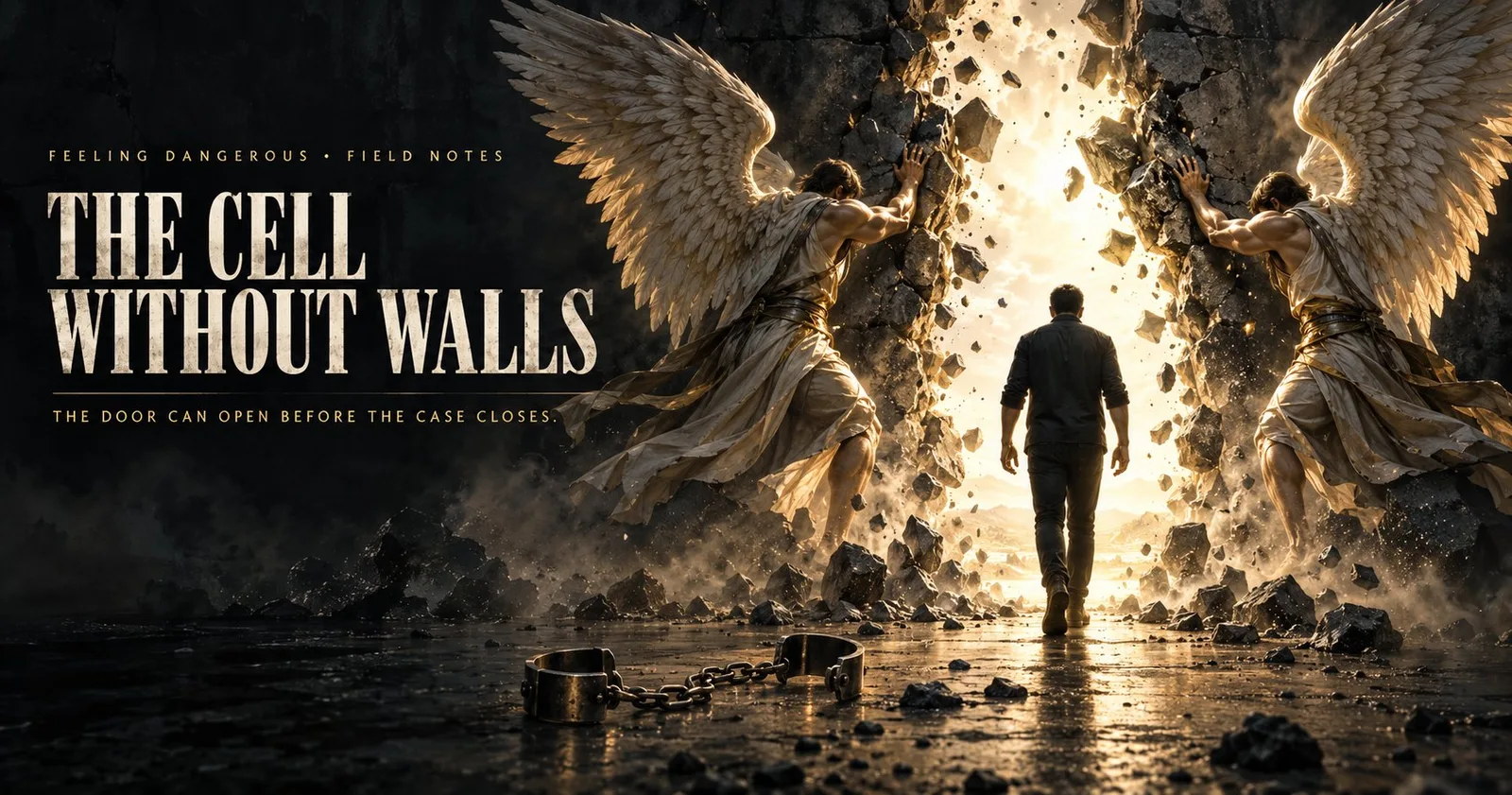
The Door Can Open Before the Case Closes
I have spent years assuming that freedom would begin when the investigations ended.
The case would close. The decision would arrive. The sentence would be known. The danger would become measurable. I would finally understand what years remained mine, what would be taken, and what life would require next.
Until then, I treated freedom like a verdict someone else had to hand me.
But Paul and Silas were worshiping before the door opened.
That does not mean they enjoyed the beating or pretended the stocks were imaginary. It means the prison did not receive authority over the deepest part of them. Their circumstances restricted their movement without becoming the master of their worship, identity, obedience, or attention.
The legal process around me may continue. A court may still make decisions that change my physical life and my family’s daily reality. Walking out of the mental cell does not mean predicting acquittal, demanding leniency, declaring the investigation unjust, or refusing responsibility.
It means I stop requiring the case to end before I become present again.
The external door can remain uncertain while the internal door opens today.
Put On Your Sandals
Peter’s escape offers another picture.
An angel entered the cell and woke him. The chains fell away, but Peter still received instructions: get up, put on your clothes and sandals, wrap your cloak around you, and follow. The gate opened, but Peter had to stand, dress, and walk through it.
Freedom was given.
Movement was still required.
That resembles other changes in my life. When I began working out, someone told me in plain language that my “before” picture was complete and it was time to begin. I started, and consistency followed. When I faced my daily drinking, sobriety required a decision that I was no longer going to negotiate with alcohol every morning.
I need to avoid turning my experience into a universal formula. Addiction recovery is not effortless for everyone after one decision.
Dependence can require medical care, treatment, community, accountability, and repeated choices; suddenly stopping alcohol or some drugs can also require medical supervision. Anxiety does not disappear simply because a person commands it to leave.
For me, a real decision did something important: it made the next faithful action clearer.
The decision did not complete the journey. It ended the daily debate over whether I intended to begin.
Today, walking out of the mental jail cell begins the same way.
Stand up.
Get dressed.
Put on the sandals.
Follow the next instruction.
What Walking Out Is Not
Walking out is not denial.
It is not pretending the investigations do not exist. It is not refusing counsel, avoiding a difficult conversation, minimizing harm, hiding assets, changing a story, demanding that people forgive me, or placing spiritual language over legal facts.
It is not claiming that Christ’s forgiveness requires a court to remove every consequence. It is not declaring that my anxiety caused the case or that positive thinking will determine its outcome. It is not assuming God must preserve my physical freedom because I have finally found peace.
Walking out means I cooperate without living every hour inside an imagined punishment.
It means I prepare responsibly without rehearsing catastrophe as worship.
It means I allow qualified legal counsel to handle legal strategy while I attend to the responsibilities that are mine today.
It means I continue making restitution where possible, telling the truth, organizing what my family may need, and accepting that preparation can be faithful without becoming a residence.
It means I stop withdrawing love from Danielle and the children as if absence today could protect them from absence tomorrow.
It means fear no longer gets to make my decisions.
A Cell Other People Recognize
My mental prison is tied to the possibility of an actual loss of liberty, but invisible cells appear in many forms.
A person can postpone living until a job changes, a relationship is repaired, a number on the scale moves, a debt is paid, an addiction disappears, a diagnosis improves, or a decision finally arrives. The future condition becomes the gatekeeper for peace: when this changes, then I will participate in my own life.
Sometimes we respond with extreme sentences.
I will never eat that again.
I will work every waking hour until the debt is gone.
I will punish my body until it looks acceptable.
I will isolate for thirty days and prove that I can conquer this alone.
I will never trust anyone again.
I will not allow myself to feel happy until the situation is fixed.
The absolute vow feels powerful because it creates the sensation of control. But an extreme sentence is not always the same as a faithful plan. Some situations require boundaries, treatment, safety planning, professional help, or a decisive ending. Others require patient, ordinary obedience that does not produce a dramatic story.
The better question is not, “How severely can I punish myself so everyone—including God—knows I am serious?”
It is, “What does truth, repair, health, love, and obedience require from me today?”
Freedom Has a Purpose
Galatians does not present freedom as unrestricted self-indulgence. Christ sets people free, and Paul tells them to use that freedom to serve one another humbly in love.
That changes what walking out must produce.
If my internal freedom only makes me feel better while I remain dishonest, absent, irresponsible, or self-centered, I have misunderstood it. Freedom should return me to service. It should make me more present with Danielle, more attentive to the children, more responsible in work, more available to tell the truth, and more capable of helping someone avoid a land mine I stepped on.
The four years do not have to become another accusation I use against myself. I cannot recover every missed moment, but I can stop adding new photographs to the wall. I can sit at the table without mentally leaving it. I can listen without calculating the future. I can laugh without treating joy as disrespect toward accountability.
I can write.
Sharing has already become part of the door opening. Silence allowed fear to create an entire world without being challenged. Writing makes me name what happened, separate fact from prediction, distinguish conviction from condemnation, and bring hidden thought into the light.
Freedom has come through telling the truth.
If the Physical Door Closes
The question still frightens me: What if I am physically incarcerated?
The hardest part is not only discomfort or reputation.
It is the loss of freedom to say yes.
It is the inability to move immediately toward Danielle, a child, a client, a person in need, a business problem, a gathering, or an opportunity to serve. It is time that would no longer belong entirely to my preferred assignment.
I do not need to pretend that would be easy or small.
But I am beginning to see the contradiction in believing that a future restriction would end my purpose while I voluntarily surrendered the freedom I still possessed. I feared being unable to stand in front of people and help them avoid the land mines I had crossed. Then fear kept me from standing in front of them while I was still able.
Purpose is not the same as mobility.
Paul wrote, prayed, witnessed, encouraged, and served under confinement. That does not romanticize prison or turn incarceration into a ministry strategy. It means walls can change the form of an assignment without removing God’s presence or a person’s responsibility to obey.
If physical confinement comes, my roles will change. My family will carry costs that deserve honesty and care. I will need to learn what faithful husbanding, fathering, restitution, service, and endurance look like under limits I did not prefer.
But I do not have to practice abandoning those roles before the limits arrive.
Today I Walk Out
Today I am vowing to walk out of the mental jail cell.
That sentence does not mean fear will never return. A door can be opened and still require me to walk through it again tomorrow. Mental habits built across four years may not disappear in one morning, and receiving help from a therapist, pastor, support group, physician, or trusted friend does not weaken the declaration.
Walking out means I will no longer call anticipatory suffering preparation.
I will not confuse self-condemnation with repentance.
I will not use the possibility of future absence as permission to be absent today.
I will not demand that fear leave before I obey.
I will not make the people I love visit me in a cell I built inside a room we already share.
I will face the facts as they arrive. I will follow counsel. I will accept responsibility. I will repair what I can. I will prepare my family wisely. I will refuse to use grace as cover, and I will refuse to use guilt as a second savior.
The court may still determine a sentence.
Fear does not get to backdate it.
For years, I believed I was protecting myself from the moment my freedom might be taken. In reality, I was surrendering it in advance.
No more.
I am not declaring the case over.
I am declaring the cell open.
The gate is in front of me, the chain is no longer defining the edge of my world, and fear does not get to tell me that the old perimeter is the only place I am allowed to live.
I feared losing my freedom while spending years refusing to live inside it. Today I will use the freedom I still have to love, serve, repair, and obey.
Prayer
Father, I have spent years living inside outcomes that have not happened.
I have called anxiety preparation, withdrawal protection, and self-punishment repentance. You know the wrong I have done, the harm it caused, the consequences that may remain, and every part of my future that I cannot control.
Thank You that freedom in Christ does not require me to deny the truth. Teach me to confess without condemning myself, accept accountability without surrendering my identity, and make repair without believing pain can purchase forgiveness.
Show me the difference between Your discipline, lawful consequences, godly sorrow, and the suffering I impose because I am afraid to release control.
Forgive me for being absent while sitting beside the people I love.
Restore my attention to Danielle and our children. Help me use the freedom I possess today to love them, prepare them wisely, serve them humbly, and remain present without forcing them to live inside every fear in my mind.
Give wisdom to my counsel and every authority involved. Bring truth into the light. Protect the people affected by my decisions. Lead me toward restitution, honesty, cooperation, and changed behavior. Do not let me use grace as a cover for wrong, and do not let shame become another prison after Christ has opened the deeper door.
If my circumstances change, show me how to obey inside them.
If physical walls come, do not allow them to become spiritual ownership.
If freedom remains, teach me not to waste it.
Today, help me stand, put on my sandals, and follow the next instruction.
In Jesus’ name, amen.
Join the conversation
Comments
Be the first to leave a comment.