Field Notes · September 12, 2026 · 18 min read
The Dynamite in My Hands
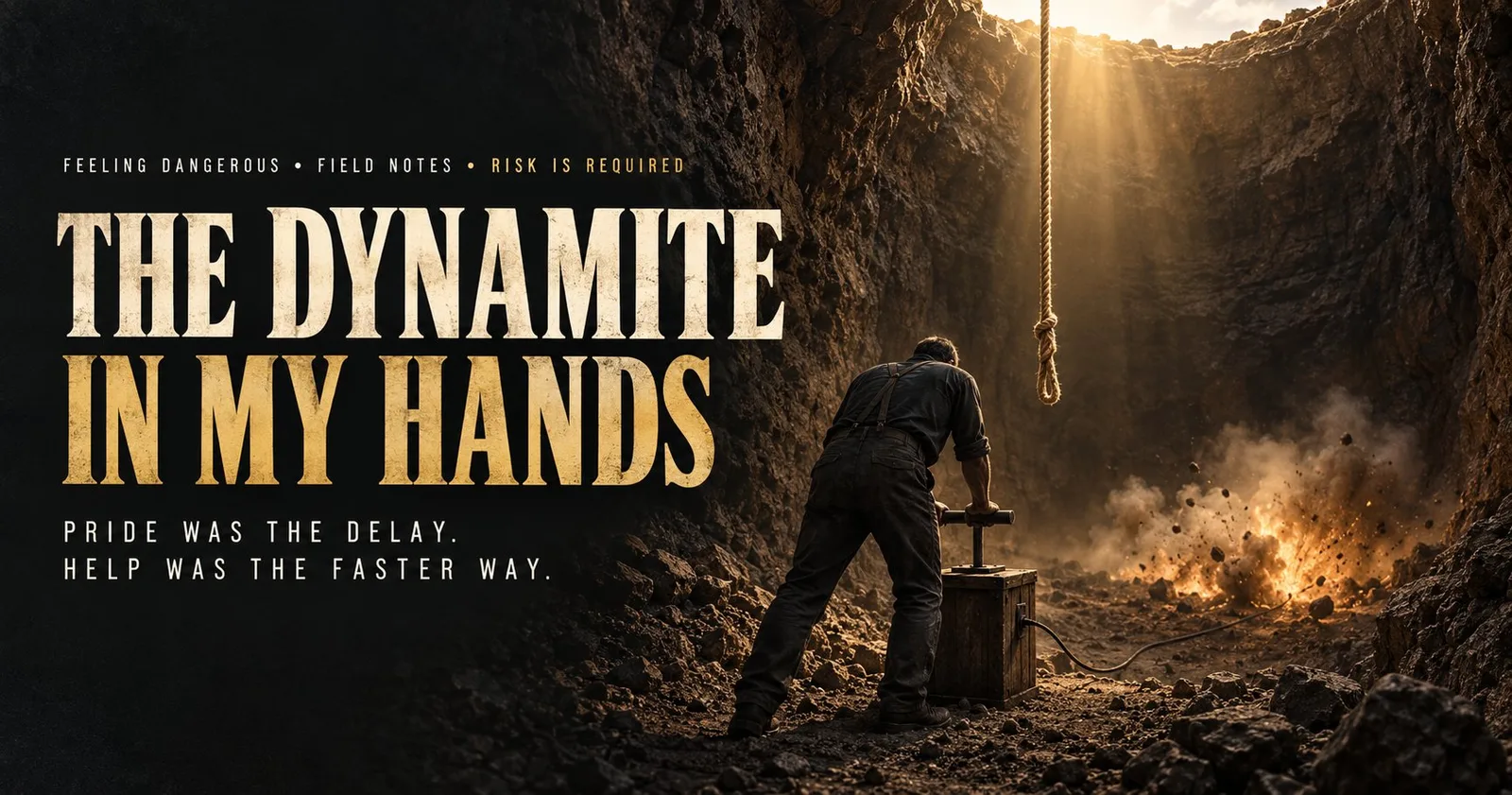
There were times I could have stopped digging by asking for help. Instead, pride handed me dynamite and convinced me I could blast my way out.
AI-generated narration · Adjust playback speed in the player.
Three Words
There are three words that could have saved me years, money, relationships, energy, consequences, and pain.
Three words that could have helped me move faster.
Three words that could have helped me grow sooner.
Three words that could have stopped small problems from becoming major ones.
Three words that could have created a shorter path toward making things right.
I need help.
That sounds simple.
For me, it was not.
I have spent most of my life becoming the person other people call when they need help. I solve problems. I take action. I figure things out. I walk toward the mess while other people are still discussing who should clean it up.
That ability has been a gift.
It has also been one of my greatest traps.
There were plenty of times when the easiest way to stop digging a deeper hole would have been to ask someone for help.
Instead, I grabbed another shovel.
When the shovel was not moving fast enough, pride handed me dynamite.
Then it convinced me that one more explosion would finally create the way out.
The Person Who Figured It Out
Growing up on a ranch taught me to be resourceful.
If a fence was down, it needed to be repaired. If an animal was loose, it needed to be brought back. If equipment broke, someone had to use what was available and get it working. Weather did not care whether we felt prepared. Animals did not stop needing food because the temperature dropped below zero.
You learned to act.
You learned to improvise.
You learned that complaining did not complete the work.
I became the person who could be trusted to go out and get it done.
That identity followed me into school. In a group project, I could take over and produce the grade. It followed me into business. If a company had a sales, marketing, technology, positioning, or growth problem, I believed I could learn it, solve it, and create a result.
The world rewarded that version of me.
Every solved problem reinforced the belief that I should be able to solve the next one too.
The problems became larger.
The checks became larger.
The expectations became larger.
The number of people looking to me became larger.
As the visible evidence of my capability grew, my willingness to admit limitation shrank.
Eventually, I stopped seeing help as something I was allowed to need.
Help was something I provided.
Answers were something I carried.
Strength meant being the last person in the room who needed to say, I do not know what to do.
That was not strength.
It was pride wearing boots.
The First Shot
Sports taught me to take the shot.
Coaches, posters, and motivational speeches repeated versions of the same message: the person afraid to miss will never win.
I carried that into my first business.
I was in college and needed extra money. The honest version is that I wanted beer money. I did not know web design, coding, digital marketing, search-engine optimization, or most of the other things someone should probably know before selling those services.
But I saw a problem.
Business owners around me understood their industries, but many did not understand how the internet was changing the way customers found and selected companies. I believed I could learn the missing skills and help them.
So I took the shot.
Then I taught myself what I needed to know.
That risk changed my life. It created a career, income, opportunities, relationships, and knowledge that could never be taken from me. It proved that I did not need perfect preparation before taking the first faithful step.
But success can teach the wrong lesson if we do not examine it carefully.
The right lesson was:
I can learn difficult things and move before fear gives me permission.
The lesson my ego heard was:
I can figure out anything by myself.
Those are not the same statement.
One creates courage.
The other creates isolation.
When the Hole Became My Project
Some problems require persistence.
You keep working. You adjust the plan. You learn from the miss. You bring more energy, better tools, clearer thinking, and another attempt.
Other problems become worse because the person responsible refuses to pause and ask what he cannot see.
I have lived both.
There were decisions where asking an expert earlier could have revealed a boundary I did not fully understand.
There were seasons where inviting wise counsel into the room could have exposed a flaw before the flaw became damage.
There were situations where honesty could have made the repair smaller, faster, and more complete.
There were times when asking a team member to carry part of the work could have helped us grow faster instead of making my capacity the ceiling for everyone.
There were moments when admitting fear to Danielle could have created connection instead of silence.
There were struggles where saying the truth out loud could have interrupted the isolation that allowed the struggle to keep growing.
But asking for help threatened the identity I had built.
If I needed help, maybe I was not the problem solver.
If someone else saw the answer first, maybe I was not the smartest person in the room.
If I admitted the problem early, someone might question the confidence with which I had started.
If I showed the whole situation, they might see that my intention and the actual impact were moving in different directions.
So I kept working.
Then I worked harder.
Then I worked faster.
Then I started using the very problem-solving ability that had rescued me in the past to protect me from the truth I needed in the present.
I turned the hole into another project.
I told myself that because I had helped create the problem, I had to fix it alone.
I told myself that asking for help would slow everything down.
In reality, refusing help was often the slowest and most expensive path available.
One More Explosion
A shovel makes a hole deeper one scoop at a time.
Dynamite makes progress look faster.
That was the attraction.
When the pressure increased, I did not always become more patient. I became more determined to produce a result quickly. A faster answer felt like the solution to the damage created by the previous fast answer.
One more opportunity could restore the lost money.
One more client could relieve the pressure.
One more deal could repair the last deal.
One more promise could buy enough time to fulfill the promises already made.
One more heroic effort could keep everyone from discovering that the person they trusted to carry the weight needed someone else to help lift it.
This is how pride can disguise itself as responsibility.
It says: You created this. You fix it.
That sounds honorable until “fixing it” becomes another excuse to hide, control, rush, or create more damage.
Responsibility tells the truth and accepts the cost of repair.
Pride tries to control how the truth is discovered and how the repair makes us look.
Responsibility asks what the people affected actually need.
Pride asks how quickly we can get back to appearing capable.
Responsibility welcomes lawful, wise, accountable help.
Pride lights another fuse.
What Jethro Saw
Moses understood responsibility.
He had led Israel out of Egypt. People depended on him. They brought their disputes and questions to him, and he sat as judge from morning until evening.
From the outside, that could have looked like extraordinary leadership.
One man serving everyone.
One man carrying the answers.
One man willing to work longer than anyone else.
Then Jethro watched the system.
He did not congratulate Moses for his work ethic.
He told him plainly: “What you are doing is not good.”
Moses was trying to help people.
His intention was service.
But the system built around that intention was exhausting both Moses and the people waiting for him. Jethro warned that Moses would wear himself out.
Then he gave him a structure:
teach the people, appoint capable and trustworthy leaders, let them handle the ordinary matters, and reserve the most difficult cases for Moses.
Moses listened.
That may be the most important part of the story for me.
He did not defend his sacrifice.
He did not explain that no one else understood the responsibility.
He did not turn his exhaustion into proof of importance.
He accepted help.
The answer was not for Moses to care less.
The answer was to stop confusing personal control with faithful leadership.
Help Is Not Rescue From Responsibility
I need to make an important distinction.
Asking for help is not asking someone else to carry the consequences of my choices.
It is not transferring accountability to a spouse, employee, adviser, attorney, pastor, customer, or friend.
It is not hiding half the facts and asking someone to approve the version that makes me look best.
It is not waiting until the building is on fire and then blaming the people who could not extinguish it fast enough.
It is not using spiritual language to avoid professional responsibility.
Real help begins with the truth.
Galatians tells believers to carry one another’s burdens. Only a few verses later, it says each person should carry his own load. Those instructions belong together. Some weight is mine to carry. Some weight becomes survivable because another person places a shoulder beneath it.
No one can repent for me.
No one can make my decisions honest for me.
No one can complete the apology I owe.
No one can take the next obedient step in my place.
But someone can help me see what I have missed.
Someone can bring expertise I do not possess.
Someone can hold me accountable to what I said I would do.
Someone can carry part of the work without carrying away my responsibility.
Someone can stand beside me while I face what pride told me to hide.
Help does not remove ownership.
It removes isolation.
Walking by Faith, Asking by Faith
Second Corinthians says we walk by faith, not by sight.
I have spent much of my life focusing on those two things: what I could see and how much faith I could summon to move beyond it.
Sometimes that is the exact tension.
The evidence is incomplete, but God asks for obedience. The outcome is invisible, but the next instruction is clear. The path cannot be guaranteed, but faith takes the step.
Yet sometimes my problem was not a lack of faith.
Sometimes the answer was much less dramatic.
Remove the pride. Lower the ego. Ask for help.
Walking by faith does not require me to pretend I possess everything the assignment requires. Faith may be trusting that God has placed part of the answer inside another person.
It may be believing that my weakness does not disqualify me from leadership.
It may be opening the complete books to an adviser before the numbers force the truth into the open.
It may be telling my wife what is happening inside me instead of calling silence protection.
It may be receiving correction without turning the conversation into a defense of my intentions.
It may be asking God for wisdom and then recognizing His answer when it arrives through a person who disagrees with me.
Faith is not merely believing I can overcome the problem.
Faith is also believing I do not have to overcome it alone.
The Risk of Being Seen
Asking for help sounds easy when no identity is attached to the answer.
For a lifelong problem solver, it is a genuine risk.
It risks being seen before the solution is ready.
It risks admitting that confidence carried us farther than clarity.
It risks allowing another person to inspect the decisions, the numbers, the motives, and the damage.
It risks hearing that the next move is not another move but a stop.
It risks giving someone permission to say no.
It risks sharing credit.
It risks surrendering control.
It risks discovering that what I called protection was actually secrecy.
It risks saying:
I was wrong.
I do not know.
I cannot carry this by myself.
I need help.
Risk is not limited to starting the company, signing the contract, investing the money, entering the market, or walking into the unknown. Sometimes the greatest risk is letting another person see us without the armor of an answer.
Asking Earlier
Most people eventually ask for help.
The question is what remains by the time they ask.
Do we ask when the problem is still a problem—or after it becomes a crisis?
Do we ask when the relationship is strained—or after trust is broken?
Do we ask when the numbers are drifting—or after the money is gone?
Do we ask when temptation starts speaking—or after addiction takes control?
Do we ask when the team is confused—or after the best people leave?
Do we ask when fear begins building a wall—or after we have spent years inside the cell?
Early help creates options. Late help often arrives carrying triage equipment.
That does not mean it is ever too late for truth, repentance, repair, recovery, or grace.
It means delay has a cost.
There are situations in my life where asking for help would have been the fastest way forward. It would have created better outcomes, made wrong things right sooner, and allowed healthy growth to happen faster.
Instead, my ego told me the fastest path was another private solution.
I wish I had understood this earlier:
The strongest leaders do not wait until everyone can see the smoke before admitting they are holding dynamite.
The People God Placed Around Me
God has repeatedly placed people in my path.
Danielle sees parts of me I cannot see from the inside. She has watched my patterns under pressure: solve, control, work harder, or go quiet. Her perspective does not make every decision for me, but refusing to hear it would mean rejecting one of the clearest forms of help God has placed beside me.
Mentors have carried experience I could not manufacture quickly.
Advisers have understood laws, structures, risks, and consequences outside my expertise.
Team members have known what execution actually required after the strategy left my mouth.
Clients have shown me whether the problem I wanted to solve was the problem they truly had.
Friends have recognized isolation before I was willing to name it.
My children have reminded me that being present matters more than performing invincibility.
None of those people replace God.
But I should not ask God for help and then reject every human being through whom help might arrive.
Proverbs says plans fail for lack of counsel but succeed with many advisers.
Counsel is not a weakness added to leadership.
It is one of the ways God protects leadership from itself.
People Want to Help
Here is the part that seems crazy to me now:
People want to help.
They want to be part of the solution.
They want to use their experience, relationships, resources, perspective, faith, and ability to help someone they care about move forward.
They want to see you win.
Pride created an imaginary version of those people in my mind. It told me they would be disappointed if they knew I needed help. It told me my problem would become their burden. It told me they would think less of me, lose confidence in me, or use the weakness against me.
There are people who are unsafe. Discernment still matters. Not everyone has earned access to every part of the story.
But I allowed the possibility of the wrong person responding badly to keep the right people from responding at all.
I made their decision for them.
I called it protection.
In reality, I was protecting my pride from the risk of being seen.
I was protecting people from a burden they were already willing to help me carry.
Think about how most of us feel when someone we love finally calls.
We are not angry that they trusted us.
We are grateful they did not keep facing it alone.
We may not have the entire answer. We may not be able to erase the consequence or guarantee the outcome. But we can listen. We can pray. We can bring what we know. We can make an introduction. We can challenge a bad assumption. We can help carry the work. We can stand close enough that the person no longer has to confuse isolation with responsibility.
Asking for help also gives another person the dignity of contribution.
For years, I found purpose in being the person who helped. Yet I sometimes denied that same sense of purpose to the people God had placed around me. I wanted to give, solve, provide, and protect—but I was uncomfortable receiving those things from anyone else.
That is not community.
Community is not one strong person surrounded by people who need him.
Community is people taking turns being strong enough to tell the truth, generous enough to carry weight, and humble enough to receive what someone else was equipped to give.
The person I ask may have survived the exact problem I am hiding.
They may possess the missing expertise.
They may have been praying for a way to help.
They may see one simple opening from outside the hole that I cannot see while standing at the bottom of it.
They may not resent the request.
They may feel honored by it.
The request does not guarantee a yes, and no single person should be expected to become my savior. But refusing to ask guarantees that willing people never receive the opportunity to participate in the solution.
Sometimes God’s provision is not another private burst of strength.
Sometimes it is the person already standing nearby, waiting for me to stop performing and tell them what I actually need.
A Different Victory
For years, victory looked like solving the problem.
I wanted the answer.
I wanted the result.
I wanted to be the person who moved faster, saw farther, carried more, and found the path nobody else could see.
There is nothing wrong with solving problems.
There is nothing wrong with taking action.
There is nothing wrong with moving by faith before every visible piece falls into place.
But sometimes victory looks different.
Victory can be asking the question before announcing the answer.
Victory can be calling the adviser before signing the agreement.
Victory can be telling the team that the original plan is not working.
Victory can be admitting to a spouse that the weight has become too heavy.
Victory can be confessing the entire truth while the repair is still possible.
Victory can be asking someone to teach what we pretended to understand.
Victory can be accepting help without resenting the fact that we needed it.
Victory can be laying down the shovel.
Victory can be handing over the dynamite before another explosion convinces everyone that the hole is progress.
The Fastest Way Forward
I once believed asking for help would slow me down.
Now I can see how often pride was the delay.
Help could have accelerated the learning.
Help could have improved the decision.
Help could have reduced the damage.
Help could have protected the relationship.
Help could have exposed the legal or ethical boundary before I crossed it.
Help could have separated the good intention from the wrong method.
Help could have allowed the company to grow beyond my individual capacity.
Help could have made the path toward restoration shorter.
The irony is that asking felt inefficient only because I measured the cost of the conversation and ignored the cost of staying alone.
The conversation might have taken an hour.
The consequences of avoiding it could last years.
Risk Is Required
I still believe in risk.
I still believe faith moves.
I still believe we can bury gifts by demanding guarantees before using them. I still believe fear can disguise itself as caution and keep a person trapped inside a life designed by default.
But the risk I see today is different.
It is the risk of surrendering the identity of the self-made problem solver.
It is the risk of letting the expert teach me.
It is the risk of letting counsel interrupt momentum.
It is the risk of letting my wife see the fear before I package it as a plan.
It is the risk of allowing God to answer my prayer through someone I would rather impress.
It is the risk of admitting that being responsible does not require being alone.
Walking by faith is not refusing to see the problem.
Walking by faith is trusting God enough to tell the truth about it.
Sometimes faith takes the shot.
Sometimes faith asks someone else to show us where to aim.
Sometimes faith puts down the weapon entirely.
The three words I hated to say may be the three words that keep everything I love from breaking:
I need help.
Today, that is what victory looks like.
Prayer
Father, I need Your help.
Remove the pride that makes isolation feel like strength and the ego that tells me I must carry every answer. Show me where I have kept digging because I was afraid to be seen without a solution.
Give me the courage to tell the complete truth, the wisdom to ask the right people, and the humility to receive correction without defending myself.
Help me distinguish responsibility from control.
Teach me to carry what belongs to me, accept help with what was meant to be shared, and surrender what only You can hold. Protect my family, my work, and the people affected by my decisions from the explosions caused by hidden fear and hurried solutions.
Make me faithful enough to ask before the problem becomes a crisis.
Amen.
Join the conversation
Comments
Be the first to leave a comment.