Field Notes · October 16, 2026 · 20 min read
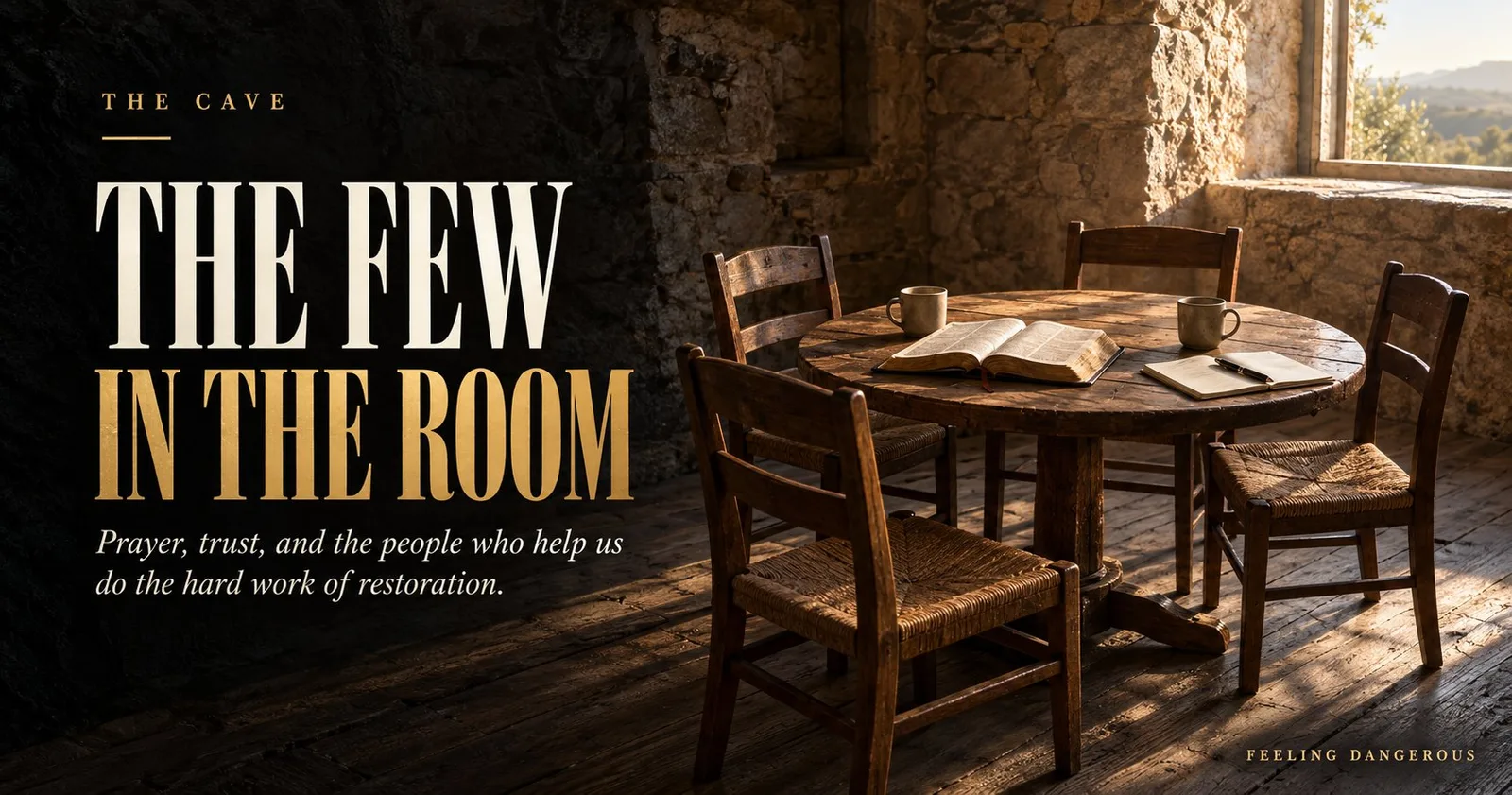
The Few in the Room
Restoration has taught me to value a few trusted people who pray, keep confidence, and love me enough to hold me accountable for change.
AI-generated narration · Adjust playback speed in the player.
The Smallest Room Can Hold Something Significant
I have been part of inner circles and business mastermind groups.
I have received real value from them.
The right people can help you see a problem differently, challenge a decision, and find a way forward you had not considered.
I have also experienced something that deserves its own kind of attention: a tiny group of people aligned with my healing, willing to pray, and willing to hold me accountable for doing the hard work that healing requires.
That experience has made me think about who receives access to the most vulnerable parts of my life.
We tend to recognize the importance of a carefully chosen business room. We consider who is attending, what they know, whether they can be trusted, and whether the conversation will help us grow.
Then a personal crisis arrives, and suddenly the selection process can become whoever answers the phone or whoever has the strongest opinion and an unlimited texting plan.
Some people care deeply and do not know how to help. Some know how to speak confidently without knowing much about the situation. Others can hear a painful truth, pray with you, keep your confidence, and return to ask how you are doing after the first emotional conversation has passed.
Those are the people I am learning to value more deliberately.
This belongs in The Cave because restoration often asks us to become quiet enough to face what is happening inside us. It also asks us to receive help. There can be solitude with God and trusted people who know enough to walk alongside the work.
I want to be thoughtful about that access.
I want people who can hold hope without requiring a performance from me.
People who can pray specifically without pretending they control the outcome.
People who love me enough to ask whether my choices agree with the restoration I say I want.
That is a significant amount for a small room to hold.
I Have Paid to Sit in Some Good Rooms
The business world has developed an impressive vocabulary for putting people together. Inner circle. Mastermind. Elite access. Strategic proximity. There is usually a landing page, a photograph of a luxury hotel, and a button inviting you to discover the investment.
Apparently, the price becomes more spiritual if we stop calling it a price.
I can laugh at that because I have participated, and because those groups can be genuinely useful. Expertise takes work to develop. Good coaching can save time, expose a blind spot, and improve decisions. Paying for skilled help can make sense.
But some needs reach beyond the question of how to produce a better business result. I may need to tell the truth about a habit. I may need someone to pray with me while I face something painful. I may need help following through when there is no impressive update to share.
A sales funnel audit has its place. It is limited help when the real issue is that I keep using success to avoid looking at myself.
The small prayer circle does not need to compete with professional expertise. It has a different responsibility. These people know something of my vulnerability, care about my life, and are willing to remain involved without making themselves the center of it.
That care can be ordinary. They listen. They remember. They ask a direct question. They pray after the conversation ends. They encourage me to get appropriate help when what I need is beyond what friendship alone can provide.
There may be no membership portal. No quarterly summit. No upgraded tier where the prayer gets priority routing.
There can still be a depth of support that deserves gratitude and careful stewardship.
I want to recognize the value of those people while they are doing the quiet work. Their importance does not depend on whether their names ever appear in my public story.
Who Can Hear the Whole Prayer?
There is a difference between telling someone I could use prayer and entrusting them with the details of why.
I can appreciate prayer from a wide community while keeping intimate information within a smaller circle. Privacy gives me room to speak honestly without asking everyone I know to become involved in everything I am carrying.
For me, selective prayer means being intentional about whom I invite into that work and what we bring before God together. It can include a specific struggle, a relationship that needs repair, or a part of life where I need strength to change.
Specificity makes it harder to hide behind a polished summary. I can say I want peace, but the more honest prayer may concern how I respond when I feel challenged. I can ask for freedom while avoiding the choices that keep inviting the old pattern back.
The people close enough to hear that prayer need discretion. They should not need to distribute my details to prove they are involved in something important.
A prayer request can travel through a community at a speed normally reserved for bad weather alerts. Sometimes it arrives dressed as concern while carrying information the person never agreed to share.
I want to handle another person’s confidence more carefully than that. If I need help understanding how to support them, I can seek it responsibly without casually turning their pain into an identifying story.
I also want prayer to remain something we enter with respect. Ask what the person wants prayer for. Ask before sharing it. Ask before touching them. Listen to the answer.
A person who feels vulnerable should have a voice in what happens around them. Care becomes more trustworthy when it honors that voice.
Prayer and Honesty Belong in the Same Room
James 5 brings trouble, prayer, care for the sick, confession, and mutual intercession into one passage. It calls people toward God and toward one another. Verse 16 includes this instruction:
“pray for each other so that you may be healed.”
It then says:
“The prayer of a righteous person is powerful and effective.”
I take encouragement from the seriousness with which James treats prayer. I also notice the honesty and relationship surrounding it. There are people involved, needs acknowledged, and something being brought into the open.
That speaks directly to the kind of circle I need. I want to be able to name the struggle accurately. If I have caused harm, I need room to acknowledge it. If I need help, I need to ask without first producing an explanation that makes me look better.
I have written about addiction, anger, secrecy, and the distance that can grow between what I claim to believe and how I act under pressure. Those lessons make accountability part of restoration for me.
The people praying with me need freedom to ask what I am doing about the thing we keep praying about. Am I receiving help? Am I honoring the boundary? Am I following through on the conversation I said I would have?
They can ask with care. They do not need to humiliate me to be honest. But I should not treat every difficult question as a failure to support my healing.
If my circle can only confirm what I already want to hear, I have given it a very limited job. A trustworthy friend can pray for my freedom and notice when I am defending the behavior that keeps me stuck.
I want enough humility to receive that kind of love. It may be one of the ways the support I prayed for actually arrives.
Agreement Has More Depth Than Everyone Saying Yes
Matthew 18:19–20 gives powerful encouragement about agreement and Christ’s presence among those gathered in His name. It comes within Jesus’ teaching about addressing wrongdoing and restoring relationships in the community of believers.
That context matters to me. It keeps agreement connected to truth and responsibility. I cannot recruit two people to approve my preferred conclusion and treat their agreement as an obligation God must now fulfill on my schedule.
The Greek verb used for agreement, often written symphoneo, conveys agreeing or being in accord. Harmony is a useful picture. People can bring different voices while sharing a purpose.
For the circle I want, that purpose includes seeking God, praying for restoration, telling the truth, and remaining open to correction. We may need to discuss how to proceed. We may have different questions about a situation while still caring deeply about the person in it.
I want people aligned with my healing strongly enough to challenge my interpretation of what healing requires.
If I say I want a restored marriage but refuse to listen to Danielle, the circle should notice. If I say I want recovery but keep negotiating private exceptions, the circle should be able to question those exceptions.
That kind of agreement has substance. It reaches beyond enthusiasm for a desired outcome into a shared willingness to take the next honest step.
And sometimes it means changing the prayer as we understand the situation more clearly. We can keep asking for restoration while recognizing a need we had overlooked, a responsibility we had avoided, or a form of help we should receive.
There is room for courage and humility in the same conversation. I need both.
Why Jesus Limited the Room
In Mark 5, Jesus goes to the home of Jairus after news arrives that his daughter has died. People laugh when He speaks about the child. He puts them outside and enters with her parents and Peter, James, and John. He raises the girl, then tells them to give her food.
The story centers His authority and care. It gives me a picture of a moment held within a smaller room, without making the room’s size the cause of the miracle.
I can draw a practical lesson about protecting a vulnerable situation from mockery and commotion. Someone’s suffering does not need to become a public argument. There are times when a quieter environment allows care and attention to remain with the person who needs them.
That requires discernment. A person mocking someone’s pain is doing something different from a person asking a careful question. A friend expressing concern may be trying to help me see what I have missed.
I want to know the difference before deciding whom to hear.
Acts 9 offers another important picture. Peter arrives after Tabitha has died. Widows show him clothing she made, grieving someone whose life mattered to them. Peter sends everyone out, kneels, and prays. After she is raised, he brings the believers and widows back in to see her alive.
The passage does not describe those grieving women as enemies of the miracle. Their sorrow reflects love and loss. Peter’s private prayer leads back into the community that cared about her.
That helps me think about the room more carefully. I can protect quiet without treating every tear as unbelief. I can value a small circle while remaining grateful for the larger community around it.
The person at the center deserves care throughout the process, including when the people nearby are too overwhelmed to find polished words.
God Does Not Need Me to Get the Math Right
Two or three people gathering in Jesus’ name can be a deeply meaningful expression of faith. So can a congregation praying together. So can one exhausted person praying alone.
Matthew 6:6 directs a person to private prayer with the Father. I can receive the encouragement of shared prayer without imagining that God is unavailable until somebody else answers my call.
Sometimes the first prayer I need to offer is the one I can finally say honestly by myself. Then I can ask someone trustworthy to join me.
I also want to be careful with spiritual arithmetic. Deuteronomy 32:30 is sometimes used to suggest a numerical multiplier for prayer. In its setting within the Song of Moses, the question about one chasing a thousand and two putting ten thousand to flight concerns defeat and the Lord’s sovereignty. It does not give me a formula for increasing the power of a prayer group.
The practical strength of a few people praying together is significant enough to value without inventing a calculation. They can pay attention, remember the request, notice a change, offer help, and return to pray again.
I can trust God with the part I cannot measure. I do not need a spreadsheet proving that three intercessors outperform two by a spiritually acceptable margin.
The person praying with me is a person to love and trust, with limits of their own. They are not an additional battery I plug into the restoration project.
I want the small circle to deepen relationship with God and one another. That is already a substantial reason to gather.
A Warrior Can Still Be Tired
When I use the phrase prayer warrior, I mean someone willing to intercede faithfully. Someone who takes another person’s need seriously and returns to prayer with care.
That does not require a particular age, personality, or volume. A quiet person can pray with deep conviction. Someone who speaks boldly can also carry love and wisdom. I need to pay attention to character and consistency rather than assume intensity tells me everything.
It can be easy to imagine the ideal prayer circle as a group that never feels discouraged and never admits uncertainty. But people carrying painful situations may become tired. The person asking for help may have a morning when faith feels difficult to express.
Romans 8:26–27 describes the Spirit helping in weakness and interceding when we do not know what to pray. It gives me reason to bring that weakness to God rather than hide it from Him or from every person trying to help.
I want a circle where somebody can say they are frightened and still be welcomed into prayer. Where tears do not disqualify them. Where the person who has been encouraging everyone else can receive encouragement, too.
For me, persistence means continuing to turn toward God through those realities. It means staying honest enough to receive support when I have run out of the confident sentences.
There is strength in a friend who can sit with an unanswered question without rushing to fill the silence. There is care in the person who remembers to check back instead of requiring a better report before the next conversation.
I want to learn that kind of steadiness. I want to offer it as well as receive it.
The Work Between the Prayers
My own experience of a small circle has included accountability to do the hard work of healing. That part deserves emphasis because it can be less appealing than the moment everyone gathers to pray.
After the conversation ends, I still have a day to live. There are choices to make, responsibilities to honor, and old habits that may feel familiar enough to defend.
If I want freedom from addiction, I need to take recovery seriously in the decisions available to me. If I want a healthier relationship, I need to participate in honest conversation and changed behavior. If I am seeking physical healing, appropriate care and the practical steps agreed with qualified professionals belong in that process.
The friend praying with me can support the next step. They can ask whether I made the appointment, had the conversation, or honored the boundary. They can help me think through what is making follow-through difficult.
Those questions can be uncomfortable when I was hoping the meeting itself had completed my participation.
It turns out a prayer circle can contain people who pray for my breakthrough and remember what I promised to do on Monday. A dangerous combination for a man who occasionally prefers the inspiring part over the inconvenient part.
That is part of the gift. Someone cares enough to notice whether I am moving toward the restoration we keep talking about.
They also need room to respect my responsibility. They cannot live the day for me, monitor every choice, or carry blame for what I decide. I want support that helps me become more honest and capable, rather than making another person permanently responsible for keeping my life together.
Prayer can accompany the work. Encouragement can help me return to it. Accountability can keep my preferred explanation from replacing it.
I remain responsible for taking the next available step.
Protecting the Circle While Keeping the Door Open to Help
I want peace and privacy around vulnerable work. I also want the circle to remain open to wisdom that may come from outside it.
A trusted friend may know my history well and still lack the knowledge needed for a particular problem. Mature support can recognize that limit. It can help me reach the appropriate pastor, counselor, clinician, recovery resource, or other qualified person instead of trying to become every form of help itself.
I do not need to make everybody an intimate confidant to receive their expertise. Different people can have different roles. Some may know only what is necessary to provide the help I am asking for.
The same care applies when a group has been close for a long time. Familiarity can make it easier to speak honestly, and it can also make certain assumptions go unexamined. I want relationships where correction remains possible as we grow.
If I have misunderstood something, I need room to reconsider it. If my behavior is affecting someone else, I need to hear about that impact. A circle organized around my restoration should help me face those truths with humility.
This is one reason I value people who can encourage without flattering. They can recognize progress and still see work remaining. They can respect my faith without agreeing with every conclusion I attach to it.
I want to offer that respect in return. The people close to me need permission to rest, name their limits, and receive care themselves. Their love should not become an expectation that they are available every hour I feel unsettled.
Healthy boundaries can protect the friendship that makes the support possible. They give us a way to remain involved with honesty about what we can carry.
When Restoration Takes Longer
A small circle may begin with a clear request and then enter a season nobody expected. The desired change may come slowly. A struggle may return. A situation may remain painful despite earnest prayer.
That is a significant moment for the people involved. Will the person still feel welcome to tell the truth? Can the group keep caring when the update is difficult to hear?
I want to pray boldly for healing. I also want to be faithful to the person whose circumstances have not changed as hoped. Continuing suffering should not become evidence I use to accuse them of praying poorly or choosing the wrong friends.
There are questions I cannot settle by offering a confident explanation. I can still listen, pray, help with practical needs, and remain present. I can acknowledge grief without deciding that hope has ended.
That belongs in Winning Faith as well as The Cave. Faith asks something of us when the testimony is still unfolding. There is a way to keep trusting God while admitting that today is hard and the outcome remains beyond our control.
The circle can make room for both. It can celebrate a genuine improvement without demanding that every difficulty now disappear. It can recognize a needed change in direction without treating it as betrayal.
I am learning to value people whose commitment reaches into that ordinary, unfinished place. The person who asks again next week may be offering something more costly than the person who knows exactly what to say at the start.
I want my gratitude to reach them, too.
Your Circle May Already Be Closer Than You Think
You may already know someone who has shown you this kind of care. A friend who kept a confidence. A family member who followed up. A person from church who could listen without making your situation about their own experience.
Consider what their actions have shown over time. Can they hear a difficult truth? Do they respect a boundary? Are they willing to ask a careful question? Can they acknowledge what they do not know?
You can begin with a small, clear request. Ask whether they would be willing to pray about a particular struggle and check in at a time you agree on. Explain what is private and what kind of support would help.
If you are recovering from a habit, that might mean an honest conversation about the part of the day when you are most tempted to return to it. If your marriage is strained, it might mean asking for prayer while also arranging the help needed to work through the problem fairly.
If you are grieving, support could include somebody who allows you to speak about the loss without requiring a lesson at the end. If you are caring for a family member, prayer may come alongside a meal, help with an errand, or a chance to rest.
For the business owner, it could be someone who cares enough to ask whether the pressure to rescue the company is leading toward another harmful shortcut. They can pray for provision and help you stay honest about the choices involved.
You may also be the person another individual needs. You do not need to arrive with a complete explanation of their pain. Ask what would be helpful. Keep your word. Pray. Respect their privacy. Follow up with care.
Sometimes a circle begins with one trustworthy conversation and grows through the way both people handle what was shared.
The right circle can hold my pain, pray with faith, and still ask me to do the hard work.
Closing Prayer for My Inner Circle
Father, thank You for hearing us in private and for the gift of people who will pray with us.
Give us wisdom about whom we invite into the vulnerable places of our lives. Help us recognize mature faith, trustworthy care, and the kind of love that can hold a confidence and speak honestly.
We ask for restoration. Bring healing to bodies, freedom where habits have held us, repair where relationships have been wounded, and comfort where grief remains heavy. Help us bring specific needs before You with courage and humility.
Show us the work that is ours to do. Give us strength to tell the truth, receive appropriate care, honor boundaries, and follow through on the next faithful action. Keep us open to correction, including when it comes through someone who loves us enough to ask a difficult question.
Where we are tired or uncertain, help us pray honestly. Let our circles make room for weakness, tears, and questions. Give us patience when change takes longer than we hoped and compassion for those whose suffering continues.
Teach us to protect another person’s privacy and respect their voice. Help us offer care without seeking recognition or taking control of their story. Give us wisdom to recognize when more help is needed and humility to receive it.
Bless the people who have prayed for us quietly. Refresh those who have grown weary while caring for others. Help us notice their needs and show gratitude through the way we love them in return.
Let the people gathered in Your name grow in truth, faith, and love. Hold us close to You as we seek healing, accept responsibility, and learn how to walk together.
In Jesus’ name, Amen.
Join the conversation
Comments
Be the first to leave a comment.