Field Notes · November 24, 2026 · 15 min read
The Guy with the Tiny Hammer
The old story says the engineer charged a dollar for tapping the engine and the rest for knowing where to tap. I understand that distinction better now. My gift is helping a business owner see where growth is getting stuck, then connecting the marketing, sales, people, and systems that help the business move. I am especially drawn to people who manufacture, build, repair, and keep the world working. AI can help carry some of the business around their craft. Their skill still belongs at the center.
A Very Small Hammer and a Very Uncomfortable Invoice
There is an old teaching story about a ship that will not start.
It gets told in different versions, with different engineers and increasingly impressive invoices. For this one, picture a large ship sitting at port while a very expensive clock keeps running.
The crew has tried everything they know. The engine remains silent. Everybody has an opinion. Nobody has a departing ship.
Finally, they call an experienced engineer.
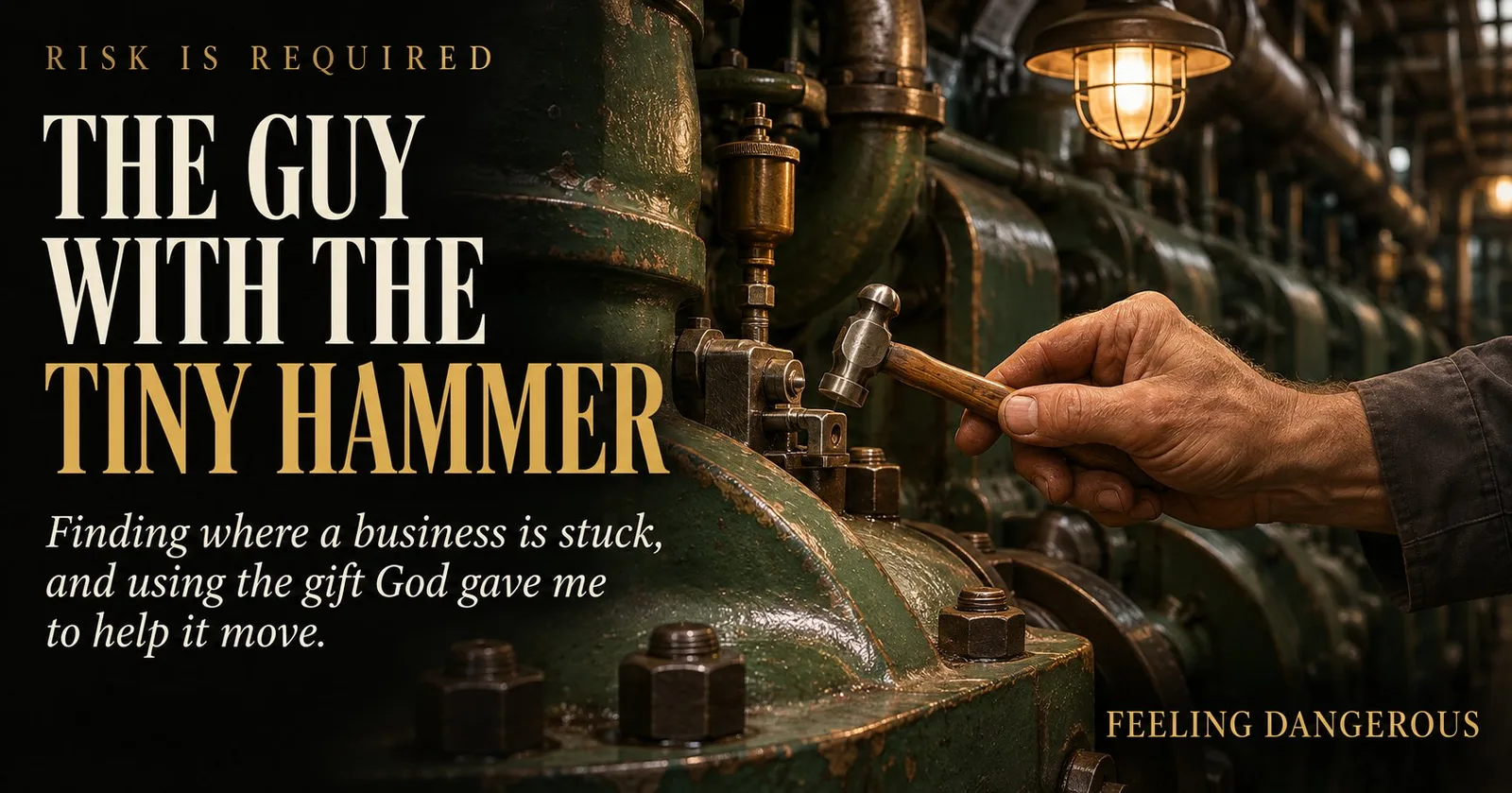
He enters the engine room, listens, studies what is happening, and feels the pipes. Then he reaches into his bag, takes out a small hammer, and taps one particular spot.
The engine starts.
You can imagine the relief. The machinery is running, the ship can move, and everyone is delighted with the expert.
Then the invoice arrives for ten thousand dollars.
Suddenly, the enthusiasm requires an itemized explanation.
After all, the owner watched him. He barely did anything. A couple of taps. A few minutes. The hammer was not even particularly large.
The engineer sends the breakdown:
Tapping with the hammer: $1.
Knowing where to tap: $9,999.
It is a parable, and the point survives whatever number ends up on the bill. The visible action was small. The judgment behind it was doing considerable work.
Anyone could have brought a hammer into that room. The value was recognizing what needed attention and knowing how to address it.
I like that story.
I also appreciate that the engineer listened before he started swinging. A surprising amount of business advice appears to have skipped that part.
I Recognize Something About My Own Gift
I am becoming clearer about where my abilities belong.
I like helping a business owner grow and scale a company. I enjoy the connection between marketing, sales, technology, people, and the systems that allow those things to work together.
More specifically, I like finding where the business is getting stuck.
Where does an inquiry disappear? Why does the owner have to answer the same question repeatedly? What happens after the estimate goes out? Where does information stop moving between the office and the people doing the work?
Those questions interest me because there is usually a real person living with the consequences. An owner is staying late. A customer is waiting. A team member is trying to do a good job without the information they need.
Helping connect those pieces is a gift I believe God has given me.
I want to say that plainly. There is room to recognize an ability with gratitude and confidence. I can also acknowledge that the ability needs development, correction, and the contribution of other people.
I am the guy with the tiny hammer when it comes to helping a business grow.
The hammer is a metaphor. Please do not hand me the actual tools and ask me to repair your production equipment. We are trying to improve your business, and I would like the insurance company to remain uninvolved.
God Gave a Craftsman Wisdom
Exodus 31:1–5 says:
“And the Lord spake unto Moses, saying,
“See, I have called by name Bezaleel the son of Uri, the son of Hur, of the tribe of Judah:
“And I have filled him with the spirit of God, in wisdom, and in understanding, and in knowledge, and in all manner of workmanship,
“To devise cunning works, to work in gold, and in silver, and in brass,
“And in cutting of stones, to set them, and in carving of timber, to work in all manner of workmanship.”
God is equipping a particular craftsman for the work of the tabernacle. Wisdom, understanding, knowledge, and workmanship appear together.
That matters to me. Scripture gives skilled, practical work a place of dignity. The hands that shape material and the judgment that directs those hands matter in the assignment.
I think about that when I consider the people I want to serve. They know how to build something, repair something, or make something function properly. Their understanding may be expressed through a finished cabinet, a repaired machine, an electrical system, or a crew that knows how to execute the work.
My contribution belongs alongside theirs. They bring knowledge of the craft. I bring a different set of abilities to the business around it.
There is room for both gifts to become more useful when we work together.
The People I Want to Work Alongside
My focus is becoming more intentional: manufacturing businesses, service businesses, and the trades.
The people who make, build, install, repair, maintain, and keep things running.
I like the connection between the work and the result. Something gets built. Equipment works. A customer gets the service they needed. A team can look at what they accomplished and point to it.
I also respect what it takes to build a company around that skill.
Knowing a trade and running the business surrounding the trade involve different responsibilities. Someone can be excellent at the actual work and still need help with marketing, sales, scheduling, communication, or understanding the information scattered across the company.
That does not make the owner less capable. It gives us a place to collaborate.
I am comfortable with a conversation that gets directly to the problem. We do not need to spend half the meeting translating a plain sentence into impressive business language.
If a customer is waiting three days for a return call, we can say that. We do not have to call it a strategic gap in the relationship engagement ecosystem.
The customer has probably called someone else by the time we finish naming it.
A Colorful Past Does Not End the Conversation
Some of the owners I want to work with may have colorful pasts.
Some have had to start again. Some learned difficult lessons through experience. Some are more comfortable explaining what they can build than making their history sound polished.
I can relate to having parts of a story that require an honest explanation.
That is one reason I want to meet people with respect and pay attention to how they are living and leading now. Their current responsibilities, willingness to be honest, and treatment of other people matter.
I have a past of my own. I also know that having made mistakes does not automatically turn those mistakes into wisdom. Learning requires accepting responsibility and changing how I make decisions.
That same honesty belongs in the work I do with an owner.
We can acknowledge a difficult history and still ask useful questions about the present. What are we building? Who depends on it? What needs to work differently? What are we willing to do consistently?
I am interested in helping someone build a business they can operate with integrity and a life they can actually participate in.
That leaves room for people whose stories have needed revisions. It also gives those revisions somewhere practical to show up.
Swinging Harder Is Sometimes the Expensive Part
Ecclesiastes 10:10 says:
“If the iron be blunt, and he do not whet the edge, then must he put to more strength: but wisdom is profitable to direct.”
The picture is practical. A dull edge demands more effort. Wisdom helps direct the work.
I see a connection to the way a business can respond when growth gets difficult. Work longer. Buy more leads. Add another person. Purchase another piece of software. Apply more force.
Sometimes those responses are appropriate. Sometimes the business needs someone to look at the point where the work is being held up.
A larger advertising budget will bring more pressure if the team cannot respond to the inquiries already arriving. Another system may add confusion if nobody knows which information belongs where.
The owner can end up working harder to compensate for something that deserves a different kind of attention.
That is where I want to be useful. Look closely. Understand the flow. Find the problem that is making the rest of the work more difficult.
The hammer is small because the thinking has to be specific.
What a Tap Can Look Like in a Business
Consider a service company where inquiries arrive through phone calls, messages, and website forms. The owner believes the business needs more leads.
Before spending more, I would want to understand what happens to the inquiries already there. Does someone receive them? Is responsibility clear? Are customers getting a response? Is there a next step after an estimate?
If the inquiry is getting lost during the handoff, that is a useful place to work. A clearer process and reliable follow-through may allow the company to make better use of the interest it has already generated.
Now picture a manufacturer whose sales team promises delivery dates without an accurate view of production commitments. The salespeople and production team may each be doing their best with different information.
The work could involve giving them a shared view of capacity, defining who confirms a date, and making changes visible to the people who need them. The owner’s manufacturing knowledge is essential to making that arrangement realistic.
Or consider a contractor whose projects keep expanding through informal customer requests. The crew does the extra work, but the office does not consistently receive the details needed to discuss and document the change.
That business may need a clearer way to capture requests, agree on changes, and keep the team informed.
These are illustrations, and each would require its own investigation. They show the kind of question I enjoy asking: where would a well-chosen improvement help the rest of the business work better?
Sometimes the answer is a small adjustment. Sometimes it reveals substantial work that needs to happen. Recognizing where to begin is valuable in either case.
AI Belongs in Service of the Work
This is also why I am drawn to businesses that can use AI to become stronger while their skilled people remain central to the work.
I want to help people build, repair, manufacture, and serve with better support around them.
That might mean using AI to help organize information, prepare a first draft of a customer response, summarize notes, or make it easier to find a procedure. It might mean helping an owner examine business information before deciding what needs attention.
The useful question is what a particular tool can do for a particular problem, with someone responsible for checking the result.
A service technician still brings knowledge of the equipment and the conditions in front of them. A fabricator understands the material and the work. A builder carries responsibilities that extend far beyond producing a convincing explanation of the plan.
I want technology to support that expertise.
AI can help draft the follow-up. The furnace is still waiting for someone with the right tools. It has shown very little interest in being repaired through a compelling paragraph.
I also want to keep a distinction clear: some improvements need a straightforward process or ordinary automation. AI does not have to be inserted into every available opening.
Giving every problem an AI label would be a strange way to demonstrate good judgment about tools.
The goal is a business where useful information reaches the right person, routine work creates less friction, and skilled people have better conditions in which to do their jobs.
The Tool Is Only Part of the Value
The ship story makes the invoice memorable. But the more useful business lesson concerns the judgment behind the action.
An experienced person may identify something quickly because they have spent years learning to recognize it. The visible minutes do not contain the whole history of the ability.
The same respect belongs to the tradespeople I work with. A technician who recognizes a fault quickly, a craftsperson who spots a problem before material is wasted, or a crew leader who anticipates a difficult handoff brings value that a stopwatch alone will struggle to describe.
That does not remove the need for fair, clear agreements about the work and its price. The owner should understand what is being provided and what success will be evaluated against.
It does help explain why judgment matters alongside effort.
I want the value of my work to become visible in the business: clearer decisions, better follow-through, useful systems, and improvements we can actually examine.
If I build something, the people using it should have a better way to work. A beautiful dashboard that requires everybody to maintain a separate spreadsheet in order to understand it has developed an identity crisis.
The owner already has a business to run. My contribution should help.
A God-Given Gift Comes with Responsibility
First Peter 4:10–11 says:
“As every man hath received the gift, even so minister the same one to another, as good stewards of the manifold grace of God.
“If any man speak, let him speak as the oracles of God; if any man minister, let him do it as of the ability which God giveth: that God in all things may be glorified through Jesus Christ, to whom be praise and dominion for ever and ever. Amen.”
The gift is connected to service, stewardship, and God’s glory.
That gives me a way to examine how I use what I believe He has given me. Am I listening? Am I preparing? Am I honest about what I understand and what still needs investigation? Am I doing the follow-through after the interesting part of the problem has been identified?
The tiny hammer does not exempt me from doing the work.
There may be setup, testing, training, and adjustment. People need to understand what is changing. The improvement needs to survive an ordinary busy day.
Calling an ability God-given makes me responsible for the care with which I use it. The owner, their employees, their customers, and their families are real people. I want that reality to shape both my ambition and my attention to detail.
Confidence Needs a Willingness to Learn
Romans 12:3 says:
“For I say, through the grace given unto me, to every man that is among you, not to think of himself more highly than he ought to think; but to think soberly, according as God hath dealt to every man the measure of faith.”
That is a helpful passage for a person writing an entire Field Note about his own hammer.
Confidence in an ability should help me contribute. It should also leave room for a better question, a different perspective, or someone who knows an aspect of the business I have not understood.
The owner’s experience matters. So does the person answering the phone, the employee preparing the estimate, and the team member who has been working around a problem for months.
Listening to them is part of the diagnosis.
I may see something useful. I may also need to change my first impression. The work benefits when I care more about understanding the business than defending my opening theory.
That is the kind of confidence I want to keep developing: willing to help, willing to take responsibility, and willing to learn.
Find Where Your Gift Can Serve
There is a question here for you, too.
What do people regularly come to you for help with? What do you notice that others find difficult to see? Which responsibilities become clearer when you get involved?
Your answer may involve building, repairing, teaching, organizing, listening, creating, or bringing calm to a difficult situation. It deserves honest attention.
Then ask who needs that ability and what would help you use it more responsibly.
For a business owner, begin with one recurring problem. Follow it through the company. Talk to the people involved. Notice where information, responsibility, or work stops moving.
Define what an improvement would look like before selecting the tool. Then make a manageable change, test it, and listen to the people who have to live with it.
For someone helping that owner, learn enough about the craft to respect its demands. Bring your own expertise without pretending you possess theirs. Agree on the work, explain the decisions, and stay engaged long enough to learn whether the change helped.
Those are practical ways to develop judgment. Over time, they can make the next well-chosen tap possible.
Built to Help the Builders
This is where my focus is becoming clearer.
I want to work with manufacturing businesses, service businesses, and tradespeople. I want to help owners who are good at their work build a business that supports that work more effectively.
I am comfortable meeting someone whose story has difficult chapters. I want to know what they are willing to build responsibly now.
I want to bring AI where it is useful, connect systems where information is getting lost, and help owners see what deserves attention. The people doing the skilled work belong in that conversation from the beginning.
This is a place where my abilities can serve.
I believe God gave me a gift for recognizing how a business can move forward. I am grateful for it. I want to keep sharpening it, using it with care, and learning from the people I work alongside.
Some people know where to weld. Some know where to cut. Some know what a machine is trying to tell them before anyone else recognizes the sound.
My work is finding where the business around them needs attention.
I am the guy with the tiny hammer.
Let’s take a look at what is stuck.
Closing Prayer
Father,
Thank You for the abilities You give us and for the people whose skills keep so much of daily life working.
Help me recognize where my gift can serve. Give me patience to listen, wisdom to understand the problem, and humility to learn from the people beside me.
Teach me to use technology with good judgment and to treat every owner, employee, and customer with care. Help me follow through on the responsibilities that come with the opportunities I receive.
Let the work I do help others do their work well. Keep developing the ability You have entrusted to me, and let the way I use it honor You.
In Jesus’ name, amen.
Join the conversation
Comments
Be the first to leave a comment.