Field Notes · October 19, 2026 · 21 min read
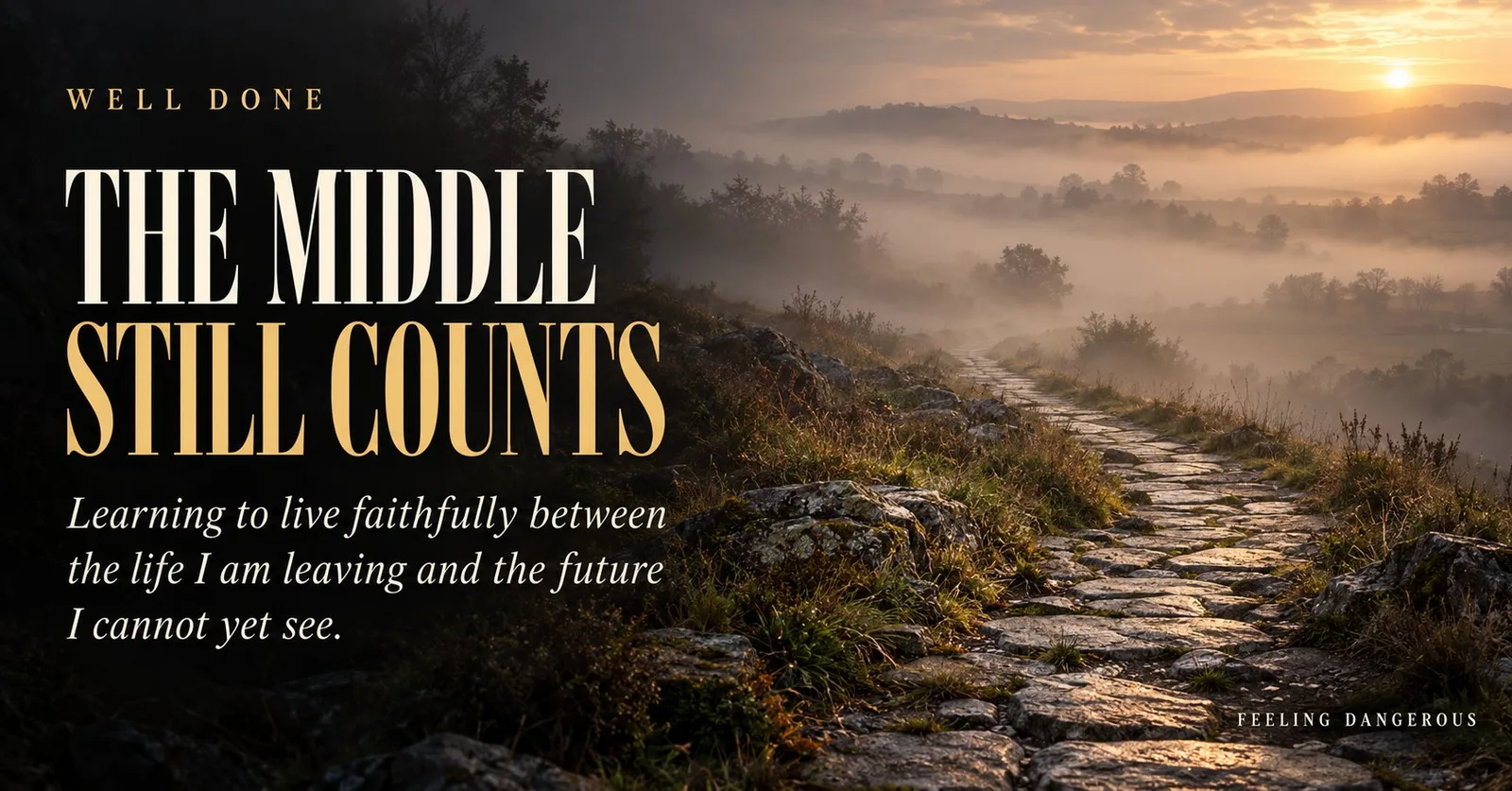
The Middle Still Counts
The old way no longer fits. The next chapter is still unclear. What I do in the middle is already becoming part of the life I will leave behind.
AI-generated narration · Adjust playback speed in the player.
Could We Please Skip This Part?
I like a target.
Give me something to pursue, a mountain to climb, a number to beat, or a problem to solve, and I can usually find some energy for the assignment.
I may even find a way to make it competitive when absolutely nobody asked me to.
But give me an undefined stretch of time where the old way of living no longer works and the new way is still taking shape? Suddenly, I have questions. Several questions. Possibly a presentation.
Apparently, I trust God... provided He supplies a schedule, an explanation, and an outcome I have had an opportunity to review.
I can laugh at that because I recognize it. I want direction, but I would also appreciate knowing how the next five decisions turn out before I have to make the first one. I want to let go of control while keeping a small amount of control over how the letting go happens.
Very spiritual. Very convenient.
There is a place between what was and what is next that does not give me those conditions. I can see enough to know something needs to change. I can recognize the cost of continuing the old pattern. But I cannot yet point to a finished version of my life and say, “There. That is how all of this works out.”
That is the middle.
It is uncomfortable because leaving something does not instantly teach me how to live without it. Admitting a problem does not resolve everything it caused. Changing direction does not mean everyone immediately trusts where I am going.
There is still a day to live. A family to love. Work to do. A conversation to return to. Something I need to face even though I do not have the satisfying ending ready.
I would love to turn this part into a movie montage. Ninety seconds, a good song, a few shots of intense personal growth, and suddenly everybody is healed and the beard looks better.
Unfortunately, some parts of becoming a different man take longer than the chorus.
And if I am serious about eventually hearing “well done,” I need to take this unfinished part of life seriously too.
The Words Before “Well Done”
Matthew 25 gives me a phrase I can move past too quickly. Before the master returns and commends the faithful servants, verse 19 says:
“After a long time”
There was an interval between receiving responsibility and giving an account of it. The servants had to do something with what had been entrusted to them during that interval. The master’s return brought the reckoning; their stewardship had already been happening.
Then comes the commendation:
“Well done, good and faithful servant!”
— Matthew 25:21
That order gets my attention. I want the finished testimony, but I am living inside the time when my response is still being formed.
What am I doing with what is already in my care? How am I treating people while I wait for clarity? Am I keeping commitments when the situation feels unresolved? Can I serve without knowing whether this particular act will ever become part of a story someone applauds?
I have spent enough of my life being attracted to the big moment.
I understand the appeal of a breakthrough. What I am learning to respect is the person I become between the moments.
This is why I am writing from the angle of Well Done. My legacy is taking shape before I know what every circumstance means. The middle is giving me opportunities to practice the faithfulness I say I value.
If I keep treating these days as temporary, I can overlook the fact that they are still days of my actual life.
What Am I Really Leaving Behind?
It is easy to say I am ready for a new chapter. That sounds hopeful. It also allows me to avoid naming the behavior I want to bring with me under a slightly improved description.
I can leave one opportunity and carry the same hunger for significance into the next one. I can change my environment and continue measuring myself by how much control I have over everybody in it. I can stop an activity while still expecting life to provide the same escape on demand.
The scenery changes. The guy making the decisions may still need attention.
So the first question is specific: what am I leaving behind?
For me, that reaches into the belief that intensity proves direction. The belief that a bigger outcome can repair the cost of the decisions made to pursue it. The assumption that being capable of taking a risk means I am the right person to take it.
I have written about those patterns in different parts of my life. I do not need to retell every example to acknowledge what connects them. I could get moving so fast that motion itself began to feel like evidence I was doing something important.
And slowing down could feel like losing.
That is a difficult belief to surrender when a lot of your identity has been built around refusing to lose. The answer cannot simply be to find a new competition and call it growth. I need a different way to evaluate what I am doing.
Am I being honest? Am I honoring what belongs to someone else? Can the people affected by a decision ask questions about it? Am I willing to hear an answer that interrupts the outcome I want?
Those questions may not produce the immediate excitement of a new plan. They can expose something more useful: the part of the old plan that is still living in me.
I also need humility about what should remain. A new chapter does not erase my obligations. Familiar does not automatically mean unhealthy. My family, my responsibilities, and the work of making things right do not become disposable because I have discovered a powerful new paragraph about transformation.
I do not get to burn the house down and call the smoke a sign of progress.
Egypt Has Excellent Marketing
Uncertainty can make the past look better than it actually was.
Numbers 11 describes the Israelites remembering the food they had eaten in Egypt while becoming dissatisfied with manna. Later, in Numbers 14, their fear leads to talk of returning to Egypt.
The food list gets me. Fish, cucumbers, melons, leeks, onions, garlic. In the middle of the wilderness, the old place is suddenly getting a very generous review.
I am paraphrasing the sales pitch, but apparently the garlic was excellent. The slavery seems like something that should have affected the overall rating.
Before I get too impressed with how obvious their mistake looks, I need to examine my own memory.
I can remember the excitement without giving equal attention to the cost. The feeling of escape without the people left dealing with my absence. The moment something seemed to work without remembering what it encouraged me to do next.
My past does not need help producing a highlight reel. I can edit the footage myself when the present gets uncomfortable.
That is why the middle can be dangerous. The old way offers familiarity. I know how it feels. I know the immediate result it promises. The new direction asks me to remain present without that same familiar relief.
But missing something does not settle whether it was good for me. Feeling awkward in a changed life does not prove the old life deserves another turn.
I need the whole story when I make that comparison. Who paid for the comfort? What did I avoid? Where did the road lead after the part I keep remembering?
Those questions can interrupt a very convincing invitation to go backward.
The Question Mark Is Not an Emergency
When I do not know what comes next, I can become very productive at trying to eliminate that feeling. A new project. Another possibility. More research. More conversations about what I might do.
There can be wisdom in all of those things. There can also be an impressive amount of avoidance wearing business casual.
The difference is whether I am doing what the situation needs or simply trying to stop feeling uncertain.
I have talked about shiny object syndrome before. One of its attractions is that a fresh idea gives me something clear to chase. The old situation remains unresolved, but at least I have a new thing to explain enthusiastically.
I could probably put uncertainty through a sales funnel and come out the other side with three proposals and a domain name.
That still would not answer whether any of them were my assignment.
This is where discernment matters. Not every open door needs my hand on the knob. Not every uncomfortable pause means I should create momentum. Sometimes I need to gather information, ask someone with relevant wisdom, or let a decision remain open long enough to examine it properly.
Other times I already know what is required and am using the search for clarity to avoid doing it.
I do not need a detailed forecast to tell the truth. I do not need a five-year vision before honoring today’s commitment. I may need more information before a business decision, but I probably do not need more information about whether to listen when Danielle is speaking.
There is a difference between an unanswered question and an unattended responsibility. I need to stop treating them as the same thing.
The question mark can remain while I take care of what is clear.
Trusting God Does Not Require Me to Turn My Brain Off
Proverbs 3:5–6 begins:
“Trust in the Lord with all your heart”
The passage calls for submission to God rather than treating my understanding as the final authority. That is a direct challenge to the part of me that can become very confident in an interpretation simply because it arrived with a strong feeling.
Trust requires humility. I can pray, examine Scripture, seek wise counsel, consider the facts, and admit that I may have misunderstood something.
I do not need to present every uncertain decision as a test of whether people believe in my faith. Sometimes they are asking a reasonable question about the plan. I should probably let them finish it.
I have been willing to call something obedience while resisting the scrutiny that could have helped me act more responsibly. That lesson belongs in the middle too. Following God and welcoming accountability need to keep growing together.
Psalm 119:105 describes God’s Word as illumination for the path. I think about that when I want far more visibility than I currently have. I can use the truth available to examine the next step, even while much of the future remains unclear.
And if the next step turns out to be correcting the previous one? I need enough humility for that as well.
Faithfulness includes being teachable. I cannot protect an interpretation so aggressively that there is no room left for God to correct me through truth I did not want to hear.
Learning to Live Without the Old Escape
Leaving an addiction creates a very practical middle. The old behavior has stopped, and ordinary life still contains feelings it once helped me avoid.
I have written about routines and the choices that support a changed day. Here, the question goes a little deeper: who am I becoming when I no longer use the old answer?
A frustrating hour may simply remain frustrating for a while. A disappointment may need to be grieved. Financial pressure may require an honest conversation and patient work. I cannot demand that freedom immediately make every emotion pleasant.
That would be a spectacular deal. Walk away from the destructive habit and receive complimentary emotional comfort for life. Apparently, that package is unavailable.
What is available is a different response. I can acknowledge the feeling, involve someone I trust, and keep the commitment I made when I was thinking more clearly. I can allow a quiet evening to be unfamiliar without declaring it empty.
An old urge showing up does not mean nothing has changed. The choice I make with it can be part of the change.
The middle asks me to practice a life that has not yet become familiar. That takes repetition. It also takes a willingness to have a day where the most important thing I did would sound painfully ordinary if I tried to make it a dramatic testimony.
I stayed present. I told the truth. I did what I said I would do.
Those things matter to the people who used to experience the alternative.
Other People Do Not Have to Catch Up to My Announcement
There is another middle I need to respect: the distance between announcing change and becoming consistently trustworthy.
I can know something has shifted inside me and still need to let the people around me discover that through experience. They have their own history of what my decisions have meant for them.
Danielle does not have to receive a new declaration as though all the previous context has disappeared. The kids do not have to understand every part of my growth before they are allowed to need something from their dad.
Sometimes I want credit for the direction while they are still living with the impact.
That is a hard thing to admit. It is also fair to examine.
I cannot rush someone else’s healing to make my transition feel more complete. I can listen. I can answer questions. I can do the unglamorous work without requiring a progress report on how much more they believe in me this week.
Rebuilding trust is not a package I can track while repeatedly refreshing the delivery date.
There are consequences I may still need to address. There are apologies that need behavior behind them. God’s grace gives me a reason to face that work honestly; it does not make the work somebody else’s responsibility.
This is one place where Well Done becomes intensely personal. What am I giving my family while the larger story remains unresolved? Can they experience patience now? Presence now? A willingness to hear the difficult thing now?
The middle may be teaching me how to love without first being reassured that the loving is producing the response I hoped for.
Let Someone Walk Beside the Unfinished Version
I understand the temptation to wait until I have a better update before involving people.
It would be easier to share the finished lesson. Here is what happened. Here is what God did. Here is the clean paragraph where all the confusion suddenly becomes meaningful.
But I am writing Field Notes while parts of the story are still happening. Some entries are going to contain an honest question that has not yet become a polished answer.
I can let trustworthy people meet me there too.
Someone can help me recognize an excuse I have made respectable. Someone can remember a commitment when I am busy explaining why this week should be an exception. Someone can pray with me without requiring me to pretend I feel confident.
I need to be careful about choosing only people who agree with my preferred ending. Agreement is useful when it is grounded in truth. If nobody in the room is allowed to question me, I have probably built an audience instead of accountability.
And I have plenty of experience making a case. What I need is the humility to let someone examine it.
Receiving help means admitting I am still in progress without making my progress the center of everybody else’s life. I can ask clearly. I can respect what someone can offer. I can also offer care while my own story remains unfinished.
There is no requirement to complete every lesson before I am allowed to listen to somebody else. I simply need enough honesty to avoid presenting myself as the guy who has already figured out the whole road.
The company matters. So does the willingness to be known while I walk.
What Is Mine to Do Next?
Here is the third question, and it is where all of this needs to become useful: what is my next responsibility?
That question brings me back from the version of life where I have to understand everything before I participate in anything.
My next responsibility might be a conversation. It might be finishing the work I already accepted. It might be correcting information, honoring an obligation, asking for help, or taking a deliberate pause before committing resources I should not be risking.
Sometimes it will be waiting. But I need to be honest about what that means. I can wait for an answer while doing the work already in front of me. I can wait for an outcome while treating people well. I can rest without using rest as a way to disappear from accountability.
Sometimes the next responsibility will require action before I feel ready. Courage may come into view as I begin. Other times I need more information before moving. I cannot turn either approach into a slogan that excuses poor judgment.
The point is to respond faithfully to the actual situation.
Hebrews 12:1–3 directs believers toward endurance with their attention fixed on Jesus. That helps me examine what I am carrying and where I keep looking for reassurance.
I do not have to race another person’s timeline. I do not need to create a spectacular crisis to make my next step significant. I can take care of the responsibility within reach and let God keep working beyond what I can currently see.
A small step can still ask a great deal of me. Sometimes telling the truth requires more courage than launching something new.
I am learning to respect the steps that cost my pride even when they do not impress an audience.
Where Are You Living in the Middle?
You may be reading this from a life that looks very different from mine. The question can still be personal.
Maybe you have been offered a new opportunity, but the decision is unclear. You can examine it without demanding that excitement count as confirmation. Ask the difficult questions. Look at the responsibility already in your hands. Be willing to learn that a good possibility belongs to someone else.
Maybe you are changing how you communicate in your marriage. You have stopped one harmful response, but the new response still feels awkward. Let the pause feel awkward. Listen. Return to the conversation as agreed. Your spouse does not need a flawless speech; they need room to be heard.
Maybe you are repairing a relationship and the other person needs distance. Your next responsibility may be respecting that boundary while continuing the changes you said mattered. You do not need access to someone in order to take responsibility for how you treated them.
Maybe your kids are growing into a stage you do not know how to parent yet. The old approach is no longer helping, and you are resisting the possibility that you need to learn something. Ask. Listen. Admit when you were wrong. Authority does not prevent a parent from being teachable.
Maybe you have stopped drinking or gambling, and the life you are rebuilding does not yet feel normal. Tell a trusted person where the pressure is. Give today an honest response. You are allowed to value progress that still requires effort.
Maybe you have lost someone, lost work, or entered a season of physical limitation. The change was not your choice. There may be no helpful lesson you can currently extract from it, and you do not owe people an inspirational explanation. Receiving care, grieving honestly, or resting may be what this day requires.
And maybe the middle includes recognizing that you need to leave an unsafe situation. Endurance is not a command to remain available for harm. Reach toward safety and trustworthy help. The next faithful step may be a boundary that someone else does not appreciate.
For each of us, there are details that matter. That is why I do not want to hand out “just keep going” as though every road deserves more mileage.
Ask what you are leaving. Name what remains unresolved. Then identify the next responsibility that honors truth, love, and the life in your care.
You may still have a question mark at the end of the day. You can also have done something good inside it.
One Collection, Many Unfinished Places
This is why the lesson belongs across the collection. The middle takes a different shape in each part of the story, but it keeps asking me to become more faithful with what is in front of me.
In Feeling Dangerous, it is the distance between receiving direction and understanding how to walk it out. In Winning Faith, it is learning to recognize a win before the circumstances supply a convincing scoreboard. In Free Beer Tomorrow, it is learning how to live in the hours the old escape used to occupy.
In 58 Days, it is the ongoing work of a marriage after the excitement of reaching the altar. In Arrows, it is parenting children who are still becoming while I am still becoming their father. In Covert, it is the private work that has not yet produced something visible for other people to admire.
In Risk Is Required and God Gave Me $12M, it is stewardship when ambition, uncertainty, and consequences all need honest attention. In The Cave, it is the life between an encounter and a fuller understanding of what it asks of me. In Angel Operations, it is bringing discernment and faithful action to experiences I cannot always fully explain.
And in Well Done, all of those unfinished places become part of what I have actually done with my life.
I do not have to force a tidy connection into every experience. Some things remain painful. Some questions remain open. But I can let the lessons I understand change how I live now.
The collection can carry that truth through its transitions: I knew the old way needed to change. I did not yet know everything that change would require. I still had a next responsibility.
The Middle Still Belongs to God
Philippians 1:6 places confidence in God’s continuing work in His people. I need that reminder when I start treating my unfinished life like evidence that He has lost interest.
I am still being changed. There is grace for the work that remains. I can trust God’s faithfulness without pretending I know the timing or shape of every outcome.
“Wait On You” by Elevation Worship and Maverick City Music fits that posture. It gives me a way to turn my attention toward God while the questions remain. Waiting on Him can include prayer, wise action, honest rest, and the willingness to stop forcing an answer.
I do not need to make the waiting theatrical. I need to live the part of the story I have actually been given.
When I write a Field Note, I can put a final sentence at the bottom of the page. That does not mean the lesson has finished working on me. Tomorrow may ask me to practice the same truth in a way I did not expect.
I am learning to accept that without reaching for the old life simply because I know how it works.
There are still people to love today. There is still good to do. There is still an honest step available even if it is smaller, quieter, or slower than the one I had imagined.
I want to hear “well done” at the end of my life. Today, I can take care of what is in my hands.
The middle still counts.
The Closing Prayer for Understanding.
Father,
Thank You for being faithful while my understanding is still incomplete. Thank You that Your love does not depend on my ability to explain what happens next.
Help me release the habits, beliefs, and measures of success that keep drawing me toward a life I know needs to change. Keep me honest about what those things cost. When the past begins looking better than it was, remind me of the whole story.
Give me patience with uncertainty and courage for the responsibilities I already understand. Help me recognize when to act, when to seek counsel, when to wait, and when to rest. Make me willing to receive correction, especially when I have become attached to my own interpretation.
Teach me to care for the people sharing this unfinished part of life with me. Help me listen without demanding reassurance, make amends without demanding access, and let trust grow through truthful experience. Keep me from using a new chapter as an excuse to abandon what remains mine to do.
Surround me with people who will pray, tell the truth, and walk beside me. Give me humility to receive their care and generosity to offer care while my own story is still in progress.
For the person reading from a place of grief, change, fear, or exhaustion, bring comfort and trustworthy companionship. Show them a next step they can take. Help them recognize that quiet faithfulness matters even when nobody else can see what it costs.
I surrender my demand to know the ending before obeying what You have made clear. Keep working in me. Help me participate honestly in that work today.
Make me faithful in the middle.
In Jesus’ name,
Amen.
Join the conversation
Comments
Be the first to leave a comment.