Field Notes · September 10, 2026 · 22 min read
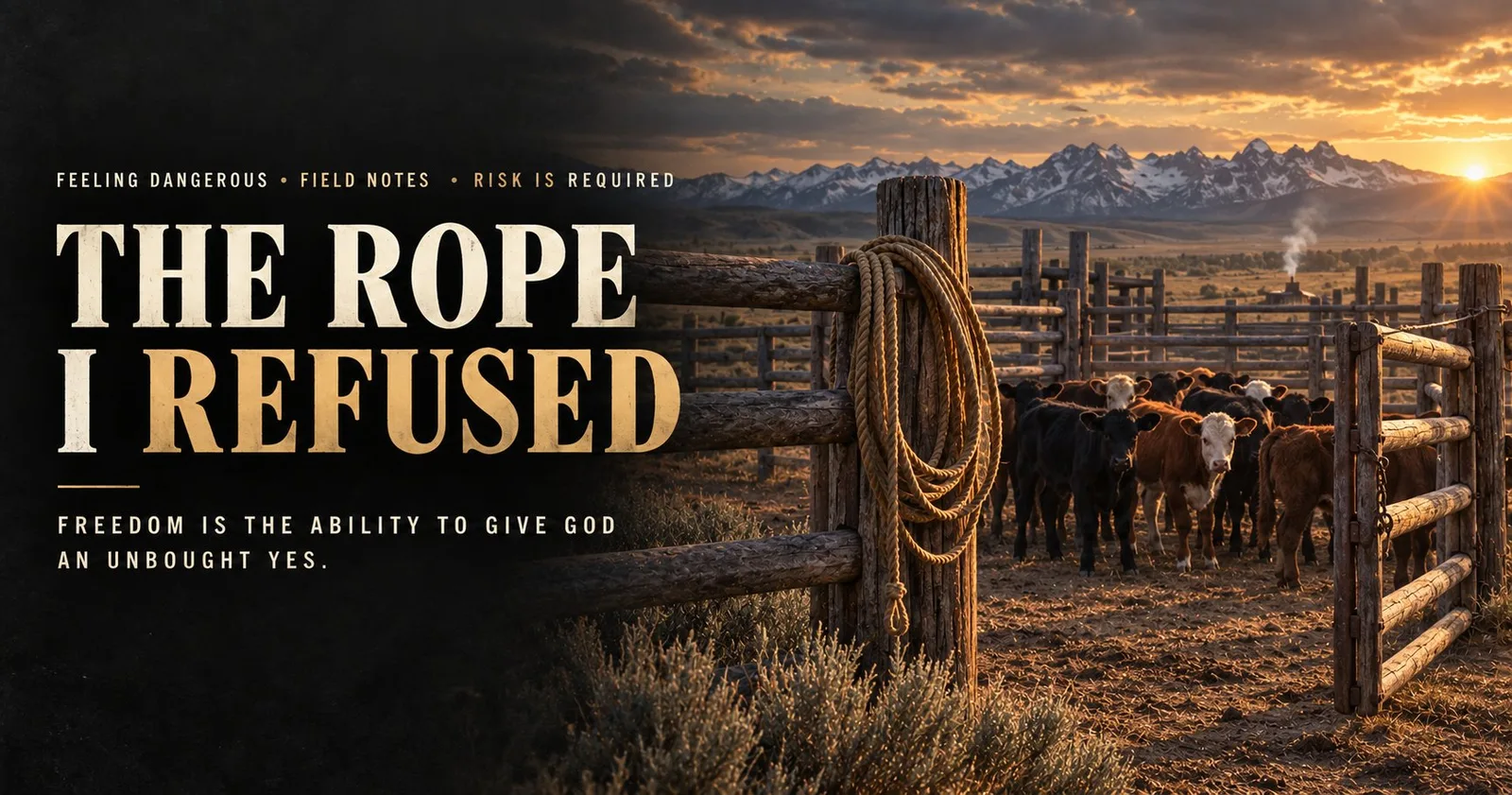
The Rope I Refused
The first risk I remember taking was not starting a business. It was disappointing my father and refusing the future he imagined.
AI-generated narration · Adjust playback speed in the player.
The Rope
My dad wanted me on the horse.
We were at a branding, and he wanted me to rope calves.
Not simply because the job needed to be done. He wanted me to develop the skill. He wanted me to become a team roper, travel with him to rodeos, compete beside him, and carry forward a life that had been carried into him.
Both sides of my family came from ranching.
My dad’s side worked cattle across the Midwest and Rocky Mountains. My mom’s side came from sheep ranching. This was not a hobby somebody had picked up after watching a Western.
Ranching was work, provision, identity, inheritance, and a way of understanding the world.
My dad was trying to pass it down.
He wanted his firstborn son to rope, ride, become a cowboy, and eventually take over. I think he believed that if he exposed me to enough of that life, something inside me would finally recognize it as mine.
The problem was that I already knew enough to know I did not want it.
I could ride. I could rope. I understood the work. I was not refusing because I was incapable of learning. I was refusing because I did not want the destination the rope represented.
So I looked at my dad and said no.
He told me that if I would not rope, I would wrestle calves all day. He did not want to see me stop. When I finished with one, I was to get up and go to the next one, and then the next one, and then the next one. We would see whether I still refused the rope after the other option had exhausted me.
I heard the challenge.
Something stubborn lit up inside me.
I decided I would show him exactly how hardheaded I could be.
After all it stubbornness was deemed genetic in my family.
One Calf After Another
At the branding, I wrestled calves all day.
I got kicked, stepped on, run over, covered in blood and crap, yelled at, and driven into a level of exhaustion I can still remember. The work required my entire body. Every time I stood up, another calf was waiting.
So I went to the next one.
I did not complain that day. I did not complain for the rest of the summer. I wrestled thousands of calves, one after another, and I never picked up the rope.
Some of that was courage.
Some of it was rebellion.
Most honest decisions contain more than one motive.
I was standing up for a future I could not yet describe. I was also trying to beat my father in a contest he may not have realized we were having. I could not tell him what I wanted to become. I could only tell him what I would not become.
That is not the clean version of purpose we like to put on a stage.
Purpose often gets described as a clear voice, a complete plan, and a peaceful yes.
Sometimes purpose first appears as a refusal. Something inside you knows the inherited path is not your assignment, even when you do not yet have language for the path that is.
Saying no carried a cost. I believe it hurt my dad.
He wanted to give me something meaningful. I was not rejecting him, but I understand why it may have felt that way. A father can hear his son refuse the family occupation and wonder whether the son is also refusing the father who offered it.
The first risk I remember taking was not starting a business.
It was disappointing my father. It was rejecting his vision.
What He Was Trying to Give Me
The older I get, the less interested I am in making my dad seam like the villain of that memory.
He was doing what he had seen and what he had been taught.
Ranching was how men in our family worked, endured, provided, and protected. He knew that life. He knew its demands. He knew how to prepare a son to survive inside it.
He also sent a conflicting message without realizing it.
On the hardest days, when the sun felt merciless and we had spent hours on horseback trailing cattle, he would tell us to use the work as motivation to get an education. When we were covered in blood and smoke at a branding, fixing fence, or throwing hay bales until our bodies were finished, he would remind us that offices had air-conditioning.
On the other side of the calendar, winter could become dangerous. The temperature might never climb above zero. Wind chills could fall somewhere between thirty and fifty below. Cattle could not dig through enough snow and brush to find what they needed, so we walked back and forth on flatbed trailers throwing hay into the cold.
Just thinking of those days will give me chills and make my toes and fingers numb.
Those days came with another version of the lesson.
Go see the world. It is smaller than you think. Get an education. Find a good job. Remember offices have heat.
He wanted us to inherit the ranch life, but he also wanted hardship to widen our options.
On the best days, the praise was usually simple: “Good job today.”
At the time, it did not feel like enough upside to build my future around.
Now I hear more inside those words.
My dad belonged to a generation and a culture where love was often delivered as preparation. He may not have explained everything he felt, but he kept teaching me how to endure what life put in front of me.
My dad taught me how to work hard enough to leave the ranch, even while hoping I would work hard enough to inherit it.
That paradox became one of the greatest gifts he gave me.
The Future I Refused to Inherit
A few years later, when we moved off the ranch, I looked at my dad and made a vow.
I told him I would never ride another horse again.
That vow held for roughly fifteen years.
Eventually, a wild mule-deer hunt with friends put me back in a saddle. We packed into country about fifty miles from civilization, and the destination motivated me enough to reconsider the promise. Apparently I had not stopped being stubborn; I had simply found a reason stronger than the resistance.
That is a story for another Field Note.
But the fifteen-year gap matters.
My no was not casual. I was trying to separate my identity from a future other people could clearly imagine for me. I did not yet know what I was walking toward, but I knew I could not build my life entirely around what I was walking away from.
There is a risk in leaving security.
There is also a risk in staying inside somebody else’s definition of faithfulness.
Had I remained on the ranch, I may have built a respectable life.
This is not an argument against ranching, inherited trades, or multigenerational family businesses.
Carrying forward what your family built can be a beautiful act of stewardship... when the assignment is truly yours. But inheritance and assignment are not automatically the same thing.
Sometimes honoring your dad means receiving everything he taught you without copying every decision he made.
Sometimes the lesson survives even when the occupation changes.
Sometimes a son carries forward the grit, resourcefulness, endurance, and responsibility while laying down the rope.
I did not become the cowboy my father imagined.
I became a problem-solver who still wrestles whatever is in front of him.
Beer Money
Fast-forward to college.
I had gone for athletics, but a shoulder injury moved me to the sideline.
My attention shifted back toward school, but school felt slow and boring.
I wanted more cash for what I generously called extracurricular activities.
A.K.A. Beer money.
That is the unpolished origin of my first business.
It did not begin with a vision retreat, a five-year plan, or a perfectly written mission statement. It began with a college student needing money, looking around, and noticing a problem.
I had begun spending time around older business owners and entrepreneurs.
Many of them understood their industries, their customers, and their products.
But they had no idea what came next online. They needed websites. They needed updated brands. They needed search visibility. They needed to show up on the first page when customers went looking.
I saw the gap.
If I could learn how to get businesses online, help them be found, and help them make more money, then I could be paid for solving the problem.
There was only one obvious weakness in the plan.
I knew nothing about web design, computers, business, marketing, or sales. On paper, the person I was had no business starting that business.
I already possessed practical knowledge in ranching and land management. The safer route would have been to take the skills I had inherited and find a predictable place to use them. Instead, I stepped into a field where I had no history, no guarantee, and no reason to assume I would win.
It was ready, fire, aim.
Sometimes more firing than aiming.
The Advantage of Not Knowing
There was a strange advantage in not knowing what was possible.
I also did not know what was supposed to be impossible.
I approached the new work the way I had approached the line of calves. There was a problem in front of me. I could study it, put my hands on it, get knocked around by it, stand up, and move to the next one.
Challenge accepted.
I taught myself the Adobe Suite tools. I learned to code and build websites. I learned search-engine optimization. I learned how to sell, market, present, diagnose, write, position, and create a result a customer could recognize.
I learned one of business’s simplest and most powerful exchanges: help other people get what they genuinely need, and value can return to you.
The first risk did not instantly make me successful. It made me responsible for learning.
That distinction matters.
Risk does not create skill. It creates exposure. Once you step outside what you already know, your ignorance becomes visible. You can retreat, pretend, blame, or learn.
I learned.
Over the next two decades, those abilities helped create substantial value for me and for the clients I served. I can trace millions of dollars in my own business life and far more in client outcomes to skills that began with a college student trying to make extra money.
But the money is not the only return.
The more permanent return is that nobody can repossess what I learned.
Companies can close.
Contracts can end.
Markets can change.
Accounts can be lost.
Money can be made, spent, frozen, taken, or given away.
A disciplined capacity carried inside you can cross from one season into another.
I learned hundreds—probably thousands—of lessons about what to do and what not to do.
Some lessons arrived as profit.
Some arrived as failure.
The Entrepreneurial Paradox
Twenty years after high school, I can look back and see several different lives packed inside two decades.
If a dictionary ever needs an illustration for the entrepreneurial roller coaster, it could use a picture of me.
I have experienced highs high enough to make me feel brilliant and lows low enough to make me question almost everything. I have felt the freedom of building an idea and the terror of discovering that the guarantee never existed. I have worked unlimited hours to preserve the right not to work somebody else’s predictable forty.
That equation makes no sense to a lot of people.
Sometimes it makes no sense to me.
I joke that entrepreneurship made me psychologically unemployable.
Once I experienced the freedom to build, choose, move, and create, returning to a life entirely designed by somebody else felt impossible.
But freedom has a price.
The entrepreneur trades one kind of control for another kind of uncertainty. A regular paycheck may limit the upside, but it provides a rhythm. Entrepreneurship can expand the upside, but it also moves the uncertainty into your house. The business can sit at the dinner table even when nobody invited it. A payroll problem can become a marriage problem. A bad agreement can become a family burden. A rushed decision can send consequences into rooms where the decision was never discussed.
Risk is personal until somebody else depends on you.
Then it becomes relational.
That is where the younger version of me and the present version of me sometimes argue.
The younger version says, “Do not tell me what I cannot do.”
The present version asks, “Who carries the downside if I am wrong?”
I need both voices.
I need the courage to move and the maturity to count the cost.
After the Punch
The last few years have felt like a twenty-round fight.
I have been knocked down, stood back up, heard the bell, taken another jab-jab-right cross, and found myself back on the floor of life.
There have been business failures, legal battles, financial pressure, public consequences, private regret, and the kind of uncertainty that follows you into sleep.
Some people look at the life I have lived and want the visible parts of it.
They want the freedom, the wins, the access, the stories, or the moments that look like success.
My question is usually different.
Are you willing to go through what I went through to live the parts of my life you think you want?
Overnight success looks different after twenty years.
The truth is that I expect to keep winning and losing.
I expect new seasons to contain new opposition, new mistakes, new corrections, and new invitations. “Making it” is a mirage if it means arriving at a life where nothing can hit you again.
Everybody has a plan until the plan meets impact.
My version is this:
“I know I am going to be hit in the face. Here is what I will do next.”
That is not pessimism.
It is preparation.
Risk is not pretending the punch will never come.
Risk is deciding that uncertainty does not get the final vote on obedience—and preparing your next faithful response before pain makes the decision for you.
Advice I Should Not Have Believed
An advisor once told me something that sounded bold:
“If you aren’t getting sued, you aren’t moving fast enough.”
It is the kind of line that can make ambition feel dangerous in the best possible way. It turns conflict into evidence of importance. It makes every boundary look like resistance, every warning look like fear, and every lawsuit look like the tax of disrupting an industry.
I understand why the line appealed to me.
I also believe it was bad advice in hindsight.
A lawsuit is not proof that I was moving fast enough. Sometimes it is evidence that I moved faster than wisdom.
Sometimes people sue because success attracts conflict. Sometimes contracts are disputed in good faith. Sometimes another party acts opportunistically. But sometimes a lawsuit exists because a promise was unclear, a duty was neglected, a boundary was crossed, a law was broken, or somebody experienced real harm.
Calling every consequence “the price of impact” can become a sophisticated way to avoid repentance.
Speed is not a fruit of the Spirit.
Faithfulness is not measured by how many warnings I can outrun.
Risk does not sanctify a bad method.
The fact that I intended to help, build, provide, or win cannot make every action righteous. I have told other parts of that truth in The Problem With Being the Solution. My motives were often mixed. The gift was real, the help was real, the ambition was real, and the consequences were real.
I do not need to deny any of those facts to believe redemption is possible.
The mature entrepreneur does not ask only, “How fast can I move?”
He also asks:
Is it legal?
Is it truthful?
Is it wise?
Is it mine to do?
Have I counted the cost?
Who pays if I am wrong?
What does my wife see that adrenaline is hiding from me?
Can I explain this decision in the light without changing the story?
Risk is required. Recklessness is optional.
Risk Is Not a Bible Word
The Bible does not use the modern business vocabulary of risk management, startup disruption, or asymmetric return.
But Scripture is full of people who obeyed without controlling the outcome.
Abraham left the land he knew for a land God said He would show him.
Jochebed hid her son under a murderous decree, then placed him in a carefully prepared basket along the Nile.
Ruth left the familiarity of Moab and bound her future to Naomi.
Esther approached the king without being summoned, knowing the law could cost her life.
Judah pledged himself for Benjamin and later offered to remain as a slave in his brother’s place.
These were not identical decisions, and they should not be flattened into a collection of motivational posters.
Abraham’s call was not permission for every entrepreneur to relocate without counsel. Jochebed’s courage does not make every violation of civil law righteous; she was protecting a child from a command to kill. Esther did not rush into danger to prove she was fearless; she named the stakes, gathered her community, and fasted before moving. Ruth’s choice was covenant loyalty, not appetite for novelty. Judah did not transfer the danger to his family while protecting himself; he placed his own future behind his promise.
Biblical faith is not adrenaline with a verse attached.
It is obedience under uncertainty.
Ecclesiastes says the person who watches the wind will not plant and the person who studies the clouds will not reap. We do not know the path of the wind or how God carries out all His work. So the Teacher says to sow in the morning and keep working into the evening because we do not know which effort will succeed.
That is not a command to ignore weather.
It is a warning against demanding certainty before action.
Scripture holds that truth beside another. Proverbs says the prudent see danger and take refuge. Jesus tells those who would follow Him to count the cost.
Faith moves without a guarantee.
Wisdom refuses to call preventable blindness a guarantee of faith.
Provision Without Presumption
First Timothy gives believers a serious responsibility to provide for their households.
That responsibility can call a father into difficult work, long hours, uncomfortable decisions, sacrifice, and uncertainty. My dad walked into weather and labor because animals depended on him and his family depended on the ranch. I stepped into business because I saw a way to create value, earn income, and eventually build a life with more freedom.
But provision cannot be separated from protection.
If I pursue a financial outcome while ignoring the legal, spiritual, emotional, or relational danger I am transferring to my family, I may be earning for the house while failing the people inside it.
The obligation to provide does not authorize presumption.
It demands stewardship.
Sometimes the faithful risk is starting the company.
Sometimes it is refusing the deal.
Sometimes it is investing money.
Sometimes it is keeping reserves.
Sometimes it is hiring.
Sometimes it is admitting the business cannot support another promise.
Sometimes it is moving before fear leaves.
Sometimes it is waiting until your wife, counsel, contracts, numbers, and conscience can all survive the light.
The action is not automatically faithful because it feels courageous.
The heart, the method, the responsibility, and the fruit all matter.
What I Would Tell My Father Now
I would tell my dad that I finally understand more of what he was trying to do.
I would tell him I know my refusal probably hurt.
I would tell him that the rope was never the only inheritance.
I carried the work ethic.
I carried the ability to function in discomfort.
I carried the willingness to solve what was broken and finish what was in front of me.
I carried the awareness that living things depend on somebody showing up, regardless of temperature, mood, applause, or convenience.
I carried the stubbornness too.
Some of it became courage. Some of it became pride. Some of it helped me build. Some of it made correction take longer than it should have.
I am still sorting the inheritance.
That may be part of every son’s work.
Honor does not require pretending everything was perfect. Growth does not require rejecting everything that formed us. We can thank our parents for what they gave, forgive what they could not give, and surrender both to the Father who knows how to redeem an unfinished inheritance.
I did not take the rope.
But I never stopped taking the next calf.
The Risk Before Me Now
Recent failure has changed the way I define success.
I still believe big. I still move fast. I still see problems as invitations. I still feel something rise inside me when somebody says an outcome is impossible.
For years, I carried a phrase:
Nothing is impossible.
I’m possible.
It helped me move. But it is not complete theology.
I am not possible because I can overpower every obstacle, escape every consequence, or force every vision into reality. I am possible because God can direct a limited man, forgive a repentant man, discipline a stubborn man, and redeem what that man is willing to surrender.
The next risk may not be another company.
It may be telling the whole truth.
It may be accepting an outcome I cannot control.
It may be repairing what I can repair.
It may be refusing to call survival success if my character remains unchanged.
It may be building more slowly.
It may be listening when the people who love me say the speed has become dangerous.
It may be providing for my family while trusting God with the forms of provision I cannot guarantee.
It may be getting back up after the punch—not to throw the same combination, but to fight differently.
I once thought risk was the willingness to put everything on the line.
Now I believe risk is the willingness to place the right thing on the line while protecting what was never mine to gamble.
My ego can go on the line.
My comfort can go on the line.
My preferred timeline can go on the line.
My need to be right can go on the line.
My family is not a poker chip.
My integrity is not startup capital.
Another person’s trust is not fuel for my ambition.
God’s name is not a stamp I place on a decision I already made.
Risk Is Required
There will never be a perfectly safe moment to build a meaningful life.
If I wait for every cloud to clear, I will never plant. If I require the next ten steps before taking the first one, I will call fear wisdom and inactivity discernment. If I need an outcome guaranteed before I obey, then I am not asking for faith. I am asking for control.
Risk is required to leave a future that does not belong to you.
Risk is required to learn a skill nobody around you can teach.
Risk is required to begin before your résumé says you are ready.
Risk is required to employ people, make payroll, tell the truth, change direction, close what is no longer healthy, and start again with fewer illusions.
Risk is required to become a different kind of father than the one fear tells you to be.
Risk is required to apologize without controlling whether forgiveness comes.
Risk is required to obey God when faithfulness might look smaller than the empire you planned.
But risk alone is not a virtue. The risk must answer to love.
It must answer to truth.
It must answer to wisdom.
It must answer to responsibility.
It must answer to God.
The line of calves taught me I could keep getting up.
The first business taught me I could learn what I did not know.
The recent failures are teaching me that endurance without correction is only repetition.
I still know I am going to get hit in the face. Now my plan for what happens next is different.
I will tell the truth about the hit.
I will study why it landed.
I will listen to the people who can see what I cannot.
I will repair whatever is mine to repair.
I will protect what God did not give me permission to gamble.
Then, when He says move, I will move again. That is the risk. That is the responsibility. That is the freedom.
The rope I refused was not the end of my father’s inheritance.
It was the first time that inheritance taught me how to choose.
Prayer
Father,
Thank You for every person who worked to prepare me, even when their vision for my life was not the path You ultimately placed before me. Help me honor what was good without confusing inheritance with assignment.
Give me courage to move when fear demands a guarantee. Give me wisdom to stop when pride calls a warning weakness. Expose every place where I have confused speed with faith, attention with impact, lawsuits with importance, or financial freedom with freedom from responsibility.
Teach me to provide without presumption and to protect what You never gave me permission to gamble. Show me who will carry the downside of my decisions. Surround me with people who can see my blind spots and give me the humility to listen.
Redeem the skills built through my successes and failures. Help me accept consequences, repair harm, tell the truth, and rise from every fall with correction—not merely determination.
I surrender my need to prove that I am possible. Make my life evidence that You can work through a limited, learning, repentant, and willing man.
When You say move, help me move.
When You say wait, help me wait.
When You say no, help me lay down the rope.
And when You place the next responsibility in front of me, help me get up and faithfully meet it.
Amen.
Join the conversation
Comments
Be the first to leave a comment.