Field Notes · September 30, 2026 · 30 min read
The Rules That Raise Us
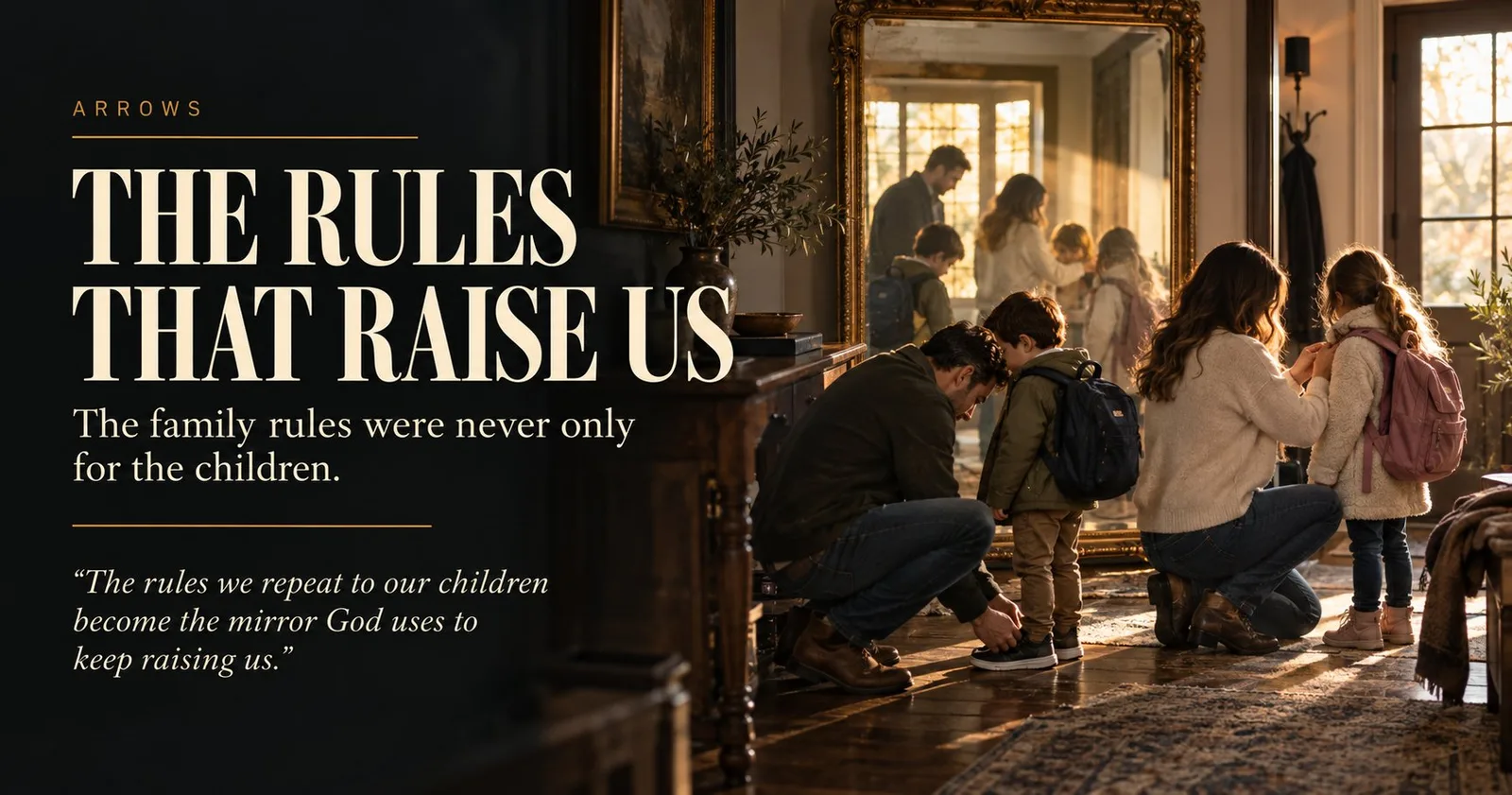
The rules we repeat to our children become the mirror God uses to keep raising us.
AI-generated narration · Adjust playback speed in the player.
Recently, we have had a house full of visitors.
Although, when you already have six children, two adults, and two full-time helpers, “house full” is not exactly a new condition. It is more like the permanent weather pattern around our home.
Then we added extended family, houseguests, more adults, and more children.
During this season there are twelve kids, six adults, and a playful partridge in a pear tree.
That last part may not be completely accurate, but we are getting closer to Christmas, and when nearly twenty people are under one roof, accuracy becomes less important than finding enough clean cups.
Some people hear those numbers and picture chaos.
They imagine children running in every direction. They picture competing requests, interrupted conversations, mystery spills, missing shoes, disputed ownership of toys, and at least one child crying because another child looked at them in a way they found spiritually offensive.
To be fair, all those things can happen.
Our home is not quiet because our children have been replaced by highly trained library staff. It is not peaceful because everyone speaks in whispers, walks in straight lines, and independently resolves conflict using laminated arbitration procedures.
They are children.
They hit the ground running in the morning like little balls of energy released from captivity. Someone needs breakfast. Someone cannot find a sock. Someone found the sock but now objects to wearing it. Someone wants to know what we are doing in six hours. Someone else has already begun doing the thing we specifically asked everyone not to do.
There are morning partner workouts, breakfast, school, snacks, lunches, naps, client calls, martial arts, pool time, errands, dinner, cleanup, baths, teeth, prayers, stories, and bedtime. Plus all of the work and other items the fill the spaces in between.
There are sibling disagreements and emotional spurts. There are tired parents and tired children. There are days when every request seems to arrive at the same time.
But there are also bright moments when a child notices what needs to be done and steps into it without being asked. An older sibling helps a younger one. Someone begins resetting the room. A child comforts another child. The next person in the routine moves into position because they already know what comes next.
Those moments are not accidental.
They are part of a culture.
With that many moving pieces, complexity becomes the enemy. If we try to manage our home through a constantly expanding list of rules, exceptions, negotiations, and individual accommodations, the whole thing breaks down.
Our family requires simplicity.
It requires team.
It requires a few beliefs that are clear enough for a small child to remember and strong enough for an adult to keep practicing.
Without those beliefs, our schedule would become survival. The demands would create breakdown instead of belonging. Our home would become dramatic instead of playful, heavy instead of safe, and burdensome instead of a sanctuary.
I know people with one child—or no children—who struggle to create peace in their homes. Meanwhile, we can have nearly twenty people in ours and still feel love instead of loathing.
That is not because we have perfected parenting.
Believe me, nobody needs to worry about that danger.
It is because we keep returning to a few simple rules.
The Golden Rule guides how we treat one another.
Sleep brings sleep reminds us to protect rest.
Routines create involvement teaches everyone that they have a place and a part.
At first, these sounded like rules for raising children.
Over time, I realized they were raising us too.
A House Is Always Teaching
Deuteronomy 6:6–7 says that God’s commands are to be held in our hearts and impressed upon our children. We are to talk about them when we sit at home, when we walk along the road, when we lie down, and when we get up.
That Scripture describes more than a lesson plan. It describes a household rhythm.
God did not tell parents to mention truth once, place a check mark beside it, and assume the children had absorbed it. He described truth being carried through an ordinary day—at home, on the road, in the morning, and at night.
In other words, our children are learning from what repeatedly happens around them.
They are learning while breakfast is being served.
They are learning when a sibling takes their toy.
They are learning when Dad is interrupted.
They are learning when Mom is tired.
They are learning when plans change, when something breaks, when somebody disobeys, and when an adult realizes they were wrong.
The house is always teaching.
The only question is what lesson it is repeating.
Rules can become tools of control. They can also become trellises that help a family grow in a healthy direction.
A trellis does not create the life in a vine. It does not manufacture fruit. It simply gives living growth something stable to climb.
That is how I have come to see the best rules in our home.
They do not save us. They do not make us righteous. They do not guarantee that our children will never make bad decisions or that our house will never have a hard day.
They give our growth a direction.
Structure without grace eventually becomes control.
Grace without structure can become instability.
Our children need both.
So do we.
The Golden Rule: A Picture Before a Principle
Matthew 7:12 records Jesus saying:
“So in everything, do to others what you would have them do to you.”
Most people know some version of the Golden Rule.
Treat others the way you want to be treated.
It sounds simple because it is simple.
Simple, however, does not mean easy.
The Golden Rule is not merely telling children to “be nice.” It reaches into sharing, speaking respectfully, considering how another person feels, repairing harm, telling the truth, honoring boundaries, and accepting accountability.
In our home, one of the questions we return to is:
Would you want someone to treat you that way?
Would you want someone to grab the toy from your hands?
Would you want someone to speak to you in that tone?
Would you want someone to laugh when you were already embarrassed?
Would you want someone to ignore you when you needed help?
Would you want someone to enter your room, use your belongings, break your creation, or reveal your secret without asking?
The question helps a child step outside the heat of the moment and imagine the experience from the other side.
But children do not initially understand principles through definitions.
They understand through pictures.
If I say the words “Golden Rule” to an adult, that adult may immediately connect the phrase with kindness and mutual respect. A young child may hear “golden” and picture treasure, pirate coins, shiny medals, or a trophy.
The words do not yet have enough lived experience behind them.
We must give them a picture. Our lives become that picture.
If the adults in a home yell, create chaos, make threats, hold grudges, and humiliate one another, no inspirational phrase on the wall can teach peace. The children will believe what they repeatedly see before they believe what they occasionally hear.
If we demand respectful voices while using disrespectful ones, they notice.
If we expect immediate apologies but never offer our own, they notice.
If we tell them to share while protecting every comfort, preference, and possession as if the family were invading our sovereign nation, they notice.
Children are outstanding auditors.
They may not understand the financial statements, but they can tell when the numbers do not match.
That means the Golden Rule begins at the tip of the spear. The adults and leaders of the home must walk it out. It cannot be forced downward and still carry the same power.
We cannot ask children to become what they have never been shown.
The Rule Begins Between Your Ears
For years, I thought the Golden Rule was mostly about the way I treated other people.
It is—but even that treatment often begins with what is happening inside me.
What I believe between my ears eventually appears in my words, posture, patience, and decisions.
If I walk around believing I am under attack, I will react as if everyone is an attacker.
If I believe I am unwanted, unloved, unworthy, or incapable, I will start interpreting neutral moments through that belief. I may push people away and then use their distance as evidence that the original lie was true.
If I build my identity around being an addict, a failure, an angry man, or someone incapable of change, my brain will keep presenting actions that fit the label.
Thoughts become beliefs.
Beliefs influence actions.
Actions produce consequences.
Consequences are then used to “prove” the beliefs.
It is a nasty little loop.
That is one reason the principle of sowing and reaping matters. Galatians 6:7 warns that we reap what we sow, but the passage does not end with hopelessness. Verses 9 and 10 urge us not to become weary in doing good and to keep using our opportunities to do good to others.
Every response is a seed.
Peace is a seed.
Patience is a seed.
Firm, honest accountability is a seed.
An apology is a seed.
So are rage, contempt, sarcasm used as a weapon, silence used as punishment, and promises we do not keep.
We do not always receive the harvest immediately. That is what makes careless planting so easy.
Sometimes the consequence appears years later in a child who learned that conflict means yelling, withdrawing, lying, pleasing, hiding, or pretending nothing happened.
I do not want to hand those lessons to my children and then act surprised when they reproduce them.
If I want peace, love, grace, acceptance, and accountability in our family, I must lead with those things.
That does not mean abandoning correction.
Respect is not permissiveness.
Love is not pretending destructive behavior is acceptable.
Grace is not the absence of a boundary.
Sometimes the most loving response is a firm no. Sometimes treating a child the way I would want to be treated means stopping them before their decision creates a larger consequence. Sometimes it means allowing an age-appropriate consequence to teach what another lecture cannot.
But correction should protect dignity, not destroy it.
The goal is not merely to win the moment.
The goal is to raise a person capable of recognizing truth, receiving correction, repairing harm, and treating others as someone made in the image of God.
That raises an uncomfortable question for me:
Am I modeling the treatment I expect?
There have been moments when I expected patience from my family while offering very little of it. I expected the children to regulate emotions I had not regulated in myself. I wanted everyone else to use a calm tone while my own frustration had already entered the room before I did.
I have had to apologize.
Not the apology that secretly blames the other person—“I am sorry I raised my voice, but you should have listened the first time.”
That is not an apology. That is an accusation wearing church clothes.
A real apology sounds more like:
“I was wrong to speak to you that way. You still need to follow the instruction, but I did not need to respond with anger. Will you forgive me?”
The boundary remains.
So does their dignity.
The Golden Rule does not require me to stop leading. It requires me to lead in the way I would want to be led.
Sleep Brings Sleep
The second rule in our home sounds almost too simple:
Sleep brings sleep.
That lesson arrived through experience.
Like many parents, we once assumed that keeping a child awake longer would make the child more exhausted and therefore easier to put to bed.
That theory sounds flawless until an overtired toddler begins communicating in frequencies detectable only by dolphins, angels, and parents who have not slept in three days.
We learned the pattern more clearly with Charlotte. Then we realized some of what we had to retrain with Madison.
When sleep was missed, bedtime did not automatically become easier. The child did not calmly announce, “Mom/Dad, I have exceeded my optimal waking window. I will now retire peacefully for the evening.”
The opposite could happen.
Everything became harder.
A small disappointment became catastrophic. A routine request became a negotiation with someone who had burned all available emotional fuel. The body was tired, but the child seemed more restless. Everyone else’s patience also began running low.
We started recognizing that protecting rest earlier often produced more rest later.
Sleep brought sleep.
With it came rhythm.
With rhythm came greater peace.
That does not mean every child is identical. Ages, developmental needs, health concerns, and family situations vary. It does not mean one household schedule should be copied and forced onto every family.
It means we learned to pay attention to what rest was doing in ours.
We also learned that a child’s behavior is information.
Sometimes a child needs correction.
Sometimes a child needs comfort.
Sometimes they need food, connection, quiet, help, or sleep.
Wisdom is learning to recognize the difference.
A Boundary or a Lifeline?
When a child is melting down over a misplaced toy, snapping at a sibling, or falling apart because the cup is the wrong color, the first parental instinct can be to correct the behavior.
Sometimes correction is appropriate.
But sometimes the behavior is a distress signal from a child who does not yet have the words or self-regulation to say, “I am overwhelmed. I have nothing left.”
The question becomes:
Does this child need a boundary or a lifeline?
Occasionally, the answer is both.
The action may still be unacceptable. Hitting a sibling is not suddenly permitted because someone is tired. But the tiredness may explain why a normally manageable frustration became an explosion.
Understanding the need underneath the behavior helps us correct without misreading the child’s heart.
It also forces adults to examine their own condition.
My ability to discern what a child needs changes when I am exhausted. When I am running on empty, my patience evaporates faster. A spilled drink can feel like sabotage. A repeated question can sound like rebellion. A small delay can feel like a personal attack against the constitutional order of the household.
Exhaustion can trick a parent into seeing vulnerability as defiance.
Sometimes the friction in the room is not coming only from the child.
Sometimes I need rest too.
That realization has changed the way I think about peace.
Peace is not merely the absence of noise.
A house can be silent because everyone is afraid.
That is not peace.
A house can be quiet because every difficult issue has been buried.
That is not peace either.
Peace is the presence of safety, order, repair, and trust.
It means the child knows what comes next. It means boundaries are predictable. It means a mistake can be corrected without threatening belonging. It means the parent is trying to respond to the whole person, not merely eliminate an inconvenient behavior.
Rest helps us do that.
Jesus told His disciples in Mark 6:31, “Come with me by yourselves to a quiet place and get some rest.” He did not treat their human limitations as moral failures. He recognized that people who continually pour out also need to withdraw and be restored.
Rest is not a prize we receive after proving our worth.
Rest is part of how we remain capable of loving people well.
That is true for children.
It is true for parents.
And it became important in another part of my life too.
The Need Underneath the Urge
The connection to Free Beer Tomorrow is not difficult to find.
Old habits often promised immediate relief from needs I had not learned to name.
Was I tired?
Was I overwhelmed?
Was I lonely?
Was I anxious?
Was I angry, ashamed, bored, or desperate to silence my own thoughts?
Instead of identifying the need, I could reach for something that changed how the moment felt.
Alcohol.
Gambling.
Work.
Noise.
Speed.
Isolation.
Anything that offered a different sensation without requiring me to sit with the truth.
The urge said, “You need this.”
Wisdom eventually taught me to ask, “What do I actually need?”
Sometimes I did not need another drink. I needed sleep.
Sometimes I did not need another risk. I needed to admit that I was afraid.
Sometimes I did not need to work later. I needed to be present with Danielle and the children.
Sometimes I did not need to disappear. I needed to ask for help.
Sometimes I did not need stimulation. I needed peace.
Adults can become overtired children with bank accounts, car keys, and enough vocabulary to rationalize what we are doing.
We can call exhaustion ambition.
We can call avoidance independence.
We can call numbing recreation.
We can call isolation focus.
But the body and soul still keep sending signals.
Learning that sleep brings sleep became larger than bedtime. It became a reminder that the right response to a need often creates more of what I truly need.
Rest can create capacity for rest.
Peace can create room for peace.
Honesty can create greater honesty.
Connection can make connection feel possible again.
Temporary discomfort is sometimes required. A child may not want the nap. An adult may not want to turn off the phone, end the conversation, leave the event, decline the drink, or admit that their body and mind are done for the day.
But a small discomfort accepted now can prevent a much larger explosion later.
I spent years sending problems to future Waldon because present Waldon did not want to experience discomfort.
Our sleep rule carries the opposite message:
Care for tomorrow by making a wise decision today.
Routines Create Involvement
The third rule is:
Routines create involvement.
Children want to help more often than adults realize.
They want to watch, learn, participate, and become capable. They want to know that they have a meaningful place in what the family is doing.
Sometimes the greatest obstacle to their involvement is not unwillingness.
It is mystery.
They do not know what comes next, what belongs to them, or what “helping” is supposed to look like.
People have joked that I am firm about schedules and routines.
That is probably a polite description.
But predictable rhythms remove unnecessary uncertainty. Our children generally know when breakfast happens, when they need to be ready, when school begins, when lunch and snacks arrive, when martial arts begins, when it is pool time, movie time, rest time, or bedtime.
They know which days can remain pajama days and which days require them to dress, show up, and be ready.
The mystery of the day has been demystified.
I love that word—demystified.
It is a classic marketing word. It sounds intelligent, slightly dramatic, and expensive enough to turn into a consulting package.
But it is also true.
When children know the sequence, they can begin owning part of it.
Before bedtime, the living room and homeschool room need to be reset. Things are put away before teeth are brushed. The house begins winding down. Older children can help younger ones recognize what comes next.
At first, help is imperfect.
A young child folding something may create a shape that has never existed in geometry.
Putting toys away may take longer with their assistance than it would without it.
Giving them a role requires patience because participation is initially inefficient.
But if I always choose speed over involvement, I may complete the task while failing to develop the person.
The goal is not simply a clean room.
The goal is a child learning, “I contribute to the place where I belong.”
Participation builds responsibility without making belonging conditional on performance.
They are not valuable because they completed the chore.
They participate because they are already valuable members of the family.
That distinction matters.
Removing Mystery Without Removing Wisdom
The principle of demystifying something reaches beyond schedules.
One example in our home is firearms.
This subject will make some people uncomfortable, so allow me to shock absolutely no one who knows my background: I am a Second Amendment advocate. I was raised around firearms. They remain an interest, a collection, and a skill set I value.
Because firearms exist in our world and in our home, I believe children need truthful, age-appropriate education about what they are, how they function, and the irreversible consequences of mishandling one.
I do not want Hollywood, video games, curiosity, or another uninformed child to become their primary teacher.
I also need to be honest about what this looks like in our home.
We do not keep every firearm locked away. Some are placed deliberately and strategically so they can serve the purpose of protecting our home. That is a decision we have made with full awareness of why they are there and the responsibility that comes with their placement.
Our approach depends on several layers working together: age-appropriate education, removing the mystery, repeated instruction, clearly established boundaries, active parenting, and the children understanding that touching a firearm without permission is never acceptable.
I believe that when the forbidden mystery is removed, much of the urge to experiment with it can be removed too. Our children have been allowed to ask questions, learn what firearms do, see how they work, and understand that they are tools with permanent consequences—not toys, movie props, or objects for secret exploration.
That education supports the protection of our home while giving our children a sober understanding of what is around them.
But I will not pretend our decision should become a universal formula for every family.
Familiarity does not make a firearm harmless. A boundary is only protective when it is understood and honored, and visiting children may not share the knowledge, training, or expectations of the children who live in the home. Every family remains responsible for preventing unauthorized access, complying with the law, evaluating the maturity and needs of the people in the house, and confronting the consequences that could follow a single failure.
Demystifying a firearm does not mean pretending there is no danger. It means replacing fantasy and secret curiosity with sober truth, firm boundaries, deliberate placement, and ongoing responsibility.
That distinction applies elsewhere too.
We can teach children about fire without leaving matches on the floor.
We can teach children to swim without removing the fence around the pool.
We can teach children about the internet without handing them unlimited, unobserved access to everything on it.
Knowledge and guardrails work together.
We do not protect children by making every danger mysterious. We also do not protect them by assuming knowledge has erased risk.
The objective is wisdom.
In the daily routines of our home, the same principle is at work on a smaller scale. We explain what happens, demonstrate it, maintain the boundaries, and give each child an appropriate opportunity to participate.
Over time, they begin moving without being chased.
They see what needs to happen.
They step into their part.
The routine stops feeling like an order imposed from above and starts becoming a shared rhythm.
The Rules Were for Me Too
This is where all three rules turned around and looked back at me.
I thought I was teaching children.
God was using the same material to keep parenting me.
The Golden Rule Was Teaching Me to Respond
It is easy to teach kindness when I am comfortable.
The test comes when I am frustrated, disappointed, interrupted, embarrassed, or overwhelmed.
In those moments, do I respond or react?
Reacting is fast. It protects pride. It releases pressure. It can make me feel powerful for a moment.
Responding requires enough self-control to recognize that the person in front of me is not the emotion moving through me.
The Golden Rule asks me to treat Danielle and the children with the same dignity I want when I am the one who has made the mistake.
That does not come naturally every time.
There have been seasons when my reactions created fear instead of safety. There have been moments when I demanded the patience, grace, or understanding that I was unwilling to give.
The rule exposed the contradiction.
Every time I ask a child, “Would you want someone to treat you that way?” I also hear the question aimed back at me.
Would I want someone larger, louder, and more powerful to correct me the way I just corrected them?
Would I want someone to use my worst moment as the permanent definition of my character?
Would I want Danielle to walk away from me, dismiss me, or punish me with silence because the conversation became uncomfortable?
The rule is not finished with me.
Sleep Was Teaching Me to Recognize Need
Protecting rest for our children forced me to confront the ways I had ignored my own limits.
I had often treated exhaustion as weakness and slowing down as failure. I could push through with stimulants, adrenaline, anger, alcohol, or obsession and call it discipline.
But an exhausted nervous system eventually collects its debt.
My family often received the bill.
Learning to name the need underneath the urge gave me another option. I could pray. I could rest. I could ask for help. I could tell the truth about what I was carrying. I could stop pretending that depletion made me heroic.
Rest did not remove responsibility.
It restored my ability to meet responsibility without becoming destructive.
Routines Were Teaching Me to Participate
Breaking an old habit leaves an empty space.
If that space remains empty, the old habit will keep advertising itself as the easiest tenant.
It is not enough to say no to what is destroying me. I must repeatedly say yes to the life I claim to want.
Prayer fills space.
Writing fills space.
Working out fills space.
Helping with the children fills space.
Sitting with Danielle through a hard conversation fills space.
Completing ordinary responsibilities fills space.
The routine becomes participation in the future.
Sobriety is not merely the absence of a substance or destructive behavior. It is learning to be present in a life I previously tried to escape.
Family routines have helped teach me where to put my body, attention, and effort when old instincts suggest disappearing.
I no longer want to be a guest in the home God entrusted to me.
I want to participate.
When the Day Goes Sideways
No routine survives contact with seven children, adulthood, illness, travel, business, visitors, and whatever mysterious force causes everyone to need something at the exact moment a parent enters the bathroom.
Days go sideways.
Plans fail.
Tempers flare.
Naps are missed.
Dinner burns.
The schedule gets derailed. Someone says something they should not have said. A child who knows the routine chooses not to follow it. An adult who teaches the Golden Rule temporarily forgets that Jesus did not add an exception for people who leave wet towels on the floor.
Peaceful homes are not homes where none of this happens.
Peaceful homes know how to return.
When the day goes sideways, we try to practice three things.
1. Pause and Pivot
Consistency matters, but rigidity can turn a good routine into an idol.
Sometimes the plan needs to change.
It may be better to have a shortened bedtime routine carried out with peace than a perfectly timed routine enforced through fury. It may be wiser to simplify the meal, cancel the optional event, move the conversation, or recognize that the family does not have the capacity for everything originally planned.
Pivoting is not always quitting.
Sometimes it is stewardship.
2. Apologize Early
When impatience gets the best of us, we need to own it.
An apology does not undermine parental authority. A sincere apology demonstrates that authority is also accountable to truth.
“I am sorry I raised my voice. I am tired, but that does not excuse how I spoke to you.”
That sentence teaches more than protecting an image of parental perfection ever could.
It teaches that relationships can be repaired.
It teaches that being wrong does not require hiding.
It teaches that love tells the truth and comes back to the table.
3. Begin Again
Every morning is another opportunity.
So is every moment after a meltdown.
We do not have to carry yesterday’s friction into today’s rhythm. We can clean up the mess, repair what was damaged, learn what the moment revealed, and return to the practices that help us love each other well.
Beginning again is not pretending nothing happened.
It is refusing to make failure the final authority.
Colossians 3 tells believers to clothe themselves with compassion, kindness, humility, gentleness, patience, forgiveness, and love. It then says to let the peace of Christ rule in our hearts.
Those are not decorations for a perfect family.
They are clothing for imperfect people who must keep living together after hard moments.
What Are We Teaching Them to Carry?
Psalm 127 describes children as arrows in the hands of a warrior.
That image carries movement.
An arrow is shaped, aimed, and eventually released.
Our children will not remain in our home forever. They will carry something from it into friendships, work, marriage, parenthood, ministry, business, and homes of their own.
The question is not whether they will carry our influence.
The question is what that influence will have taught them.
When they disagree with a future spouse, what will conflict mean to them?
When they become exhausted, will they know how to recognize their limits—or will they punish everyone around them for needs they refuse to acknowledge?
When they join a team, will they wait to be served, or will they know how to participate?
When they make a mistake, will they hide, blame, and defend—or tell the truth, repair the harm, and begin again?
When they lead, will they demand from others what they refuse to model themselves?
The Golden Rule teaches them how to see the person across from them.
Sleep brings sleep teaches them to care for the human being God made them to be.
Routines create involvement teaches them that love is expressed through participation, not merely intention.
These lessons are ordinary enough to be practiced every day and strong enough to shape generations.
That is what makes them fit inside Arrows.
We are not merely managing today’s noise.
We are preparing people for places we may never enter and relationships we may never see.
We are raising future friends, neighbors, spouses, parents, employers, employees, church members, and community leaders.
One day, one of our children may stand in their own crowded kitchen while several small voices make competing requests. They may feel frustration rise. Then, somewhere inside them, a familiar question may appear:
Would I want someone to treat me that way?
They may notice that the child in front of them does not need another lecture. The child needs rest.
They may invite everyone to reset the room together because that is simply what family does.
That moment will look small.
It will also be a harvest.
Three Questions for the House You Are Building
Your household may not look like ours.
You may have one child, seven children, adult children, foster children, grandchildren, roommates, aging parents, or no children at all.
You may live in a quiet apartment or a house where it sounds as if a youth sports tournament has been permanently relocated to the hallway.
The number of people is not the point.
Every shared life develops a culture.
Consider these questions:
What treatment are we modeling?
Do the people in your home see respect under pressure?
Can someone disagree without losing their dignity or belonging?
Are apologies normal, or does everyone defend themselves until the original issue disappears beneath a pile of counter-accusations?
Do your words create the behavior you say you want—or reproduce the behavior you keep correcting?
What needs keep getting overlooked?
Is the conflict really about disobedience, or is someone hungry, lonely, overwhelmed, afraid, or exhausted?
Are you expecting peace from everyone else while refusing the rest, honesty, help, or healing you need?
What do you repeatedly reach for when your internal resources are empty?
What need might be hiding beneath that urge?
Where could people participate more meaningfully?
What mystery can be removed?
What process can be explained?
What age-appropriate responsibility could help a child experience themselves as a contributor?
What are you doing for everyone because it seems faster, even though inviting participation might build capability, confidence, and connection?
You do not need fifty rules.
You may need three clear ones that the leaders are willing to live.
The House Settles
Eventually, even our house becomes quiet.
The living room has been reset—not perfectly, because we still live here. The homeschool materials are put away. Teeth have been brushed. Prayers have been prayed. Children who spent the day moving in every imaginable direction are finally still.
The energy that filled every room begins to settle.
In that quiet, it becomes easy to mistake peace for the silence.
But the peace was not created when the last child fell asleep.
It was built throughout the day.
It was built when a child chose to help.
It was built when a sibling repaired a disagreement.
It was built when a tired child was comforted instead of misread.
It was built when an adult apologized.
It was built when we returned to the rhythm after the rhythm broke.
The rules did not create a perfect home.
They helped create a place where imperfect people can keep growing.
They remind us how we treat one another, how we care for what God has entrusted to us, and how we take responsibility for the place where we belong.
And every time I repeat them to our children, God seems to repeat them to me.
Treat them the way you want to be treated.
Recognize what you truly need.
Participate in the life you have been praying to receive.
The family rules were never only for the children.
They are still raising all of us.
Prayer
Father,
Thank You for the children, relationships, and homes You have entrusted to us. Thank You for the ordinary moments that reveal what is growing inside our hearts.
Give us wisdom to build homes shaped by truth and filled with grace. Teach us to model the behavior we ask from others. Help us speak with respect, correct without humiliation, hold wise boundaries, and apologize quickly when our own reactions cause harm.
Give us discernment to recognize the need beneath the behavior. Show us when someone needs correction, when they need comfort, and when they need both. Teach us to honor rest rather than treating exhaustion as holiness or strength.
Help us create rhythms that invite every member of the family to participate. Give us patience when teaching takes longer than doing the task ourselves. Let our children know they are not valuable because of what they produce, but that they contribute because they are loved and belong.
When our plans fail and our days go sideways, help us pause, pivot, repair, and begin again. Protect us from turning structure into control or grace into an excuse for instability.
Raise us while we raise them.
Shape our children into arrows who carry Your love, wisdom, courage, humility, and peace into places we may never see. Let the seeds planted in our home become shade and fruit for generations to come.
May our homes become sanctuaries—not because they are always quiet, but because Your presence teaches us how to return to one another in truth and love.
In Jesus’ name,
Amen.
Join the conversation
Comments
Be the first to leave a comment.