Field Notes · October 10, 2026 · 23 min read
Use the Gate
I kept trying to secure a full life by controlling it. Jesus offers another way: come through the gate, follow the Shepherd, and learn to live with open hands.
AI-generated narration · Adjust playback speed in the player.
Apparently, There Was a Gate
Give a driven man a fence, and he may start developing a strategy before he bothers looking for the entrance.
How high is it? How much momentum will I need? Can I get over it without losing a boot? Is there someone with enough authority to move the damn thing?
Meanwhile, there may be a perfectly useful gate twenty feet away.
I offer that as an illustration, although the instinct is embarrassingly familiar. I have spent a considerable amount of life looking for the uncommon route, the way around the obstacle, the next solution that would make the outcome cooperate.
Persistence can be valuable. It can also become an elaborate way to avoid receiving direction.
Today’s subject is abundance: a full life, an overflowing life, the life Jesus describes in John 10:10. And before anyone starts putting together a shopping list, we need to be clear about what kind of fullness we are discussing.
Jesus is not handing me a guarantee of a bigger house, an agreeable calendar, or children who magically locate and put on their shoes the first time they are asked.
That last one would be an impressive miracle, though.
He is offering life in relationship with Him. A life in which fear, pride, secrecy, and the endless demand to prove myself do not get to govern every decision. A life where I can receive love, practice trust, tell the truth, and care for people while circumstances remain imperfect.
Those things sound simple until you have spent years believing peace will arrive as soon as you finally get enough of everything under control.
Enough money. Enough success. Enough certainty. Enough improvement. Enough distance from the past.
The finish line keeps moving, and the people I love keep living alongside a man who promises to become more available when he reaches it.
At some point, I have to question the route.
A Full Calendar Can Still Hold an Empty Life
I know what it is to fill a day with activity and still miss important parts of the day.
I can solve problems, answer calls, think through plans, and carry concern about the future while giving very little attention to the people sharing the present with me. I can look engaged from the outside and feel unsettled underneath it all.
That is one of the things I have been exploring in these Field Notes. Being useful can become a substitute for being known. Constant movement can make it easier to avoid the uncertainty I would have to acknowledge if I stopped.
There is a version of apparent success that slowly empties a person.
You keep producing, but you have less patience.
You keep providing, but you are difficult to reach.
You keep saying you are doing it for your family, while the family experiences the strain of living with you.
Eventually, the promise of a better future becomes the explanation for a present nobody particularly enjoys.
I am learning to ask a more direct question: What kind of life is this pattern producing now?
Does it make me more honest? More able to listen? More willing to receive correction? Does it create room for love, responsibility, joy, and care? Or am I becoming increasingly defensive, isolated, and certain that everything depends on my ability to keep pushing?
Those questions reach deeper than whether the day looked productive.
Because I can be very productive at maintaining the habits that are costing me the life I say I want.
I can even put a respectable label on them. Ambition. Protection. High standards. Sacrifice. Sometimes the label describes something real. Sometimes it is just better packaging for fear.
I have become interested in opening the package.
The Sound of Never Enough
Picture a place where every conversation points out what you lack.
Someone else is further ahead. Someone else’s marriage looks easier. Someone else’s children appear more cooperative. Someone else has the money, opportunity, influence, or certainty you believe would finally make you comfortable.
The view is full of comparisons. The background noise repeats the same instruction: Get more. Prove more. Protect more. Then maybe you can rest.
That is the landscape I mean when I use the image of a camp built around scarcity. It is a picture of how destructive beliefs can shape a life, not a literal place I have been shown.
The voice of “never enough” can sound surprisingly practical. It tells me to keep important information private because people might judge it. It tells me to remain in control because nobody else will care enough. It tells me that one more achievement will repair the discomfort I am carrying inside.
It can make generosity feel dangerous, honesty feel expensive, and rest feel irresponsible.
Then I start protecting things that should have been questioned. I protect an image instead of telling the truth. I protect a habit because it offers temporary relief. I protect my pride by treating correction as an attack.
That pattern can steal attention, trust, and peace in ordinary increments. It doesn’t require a spectacular disaster to become costly.
James 3:13–18 gives me a way to examine what I am calling wisdom. Bitter envy and selfish ambition produce disorder. Wisdom from above has a very different character: humility, mercy, sincerity, and a willingness to make peace.
That is useful when a thought arrives dressed as a brilliant strategy. I can ask what kind of character and conduct it is inviting me to practice.
A clever plan does not become wise simply because it offers me a result I want.
I have paid enough tuition on that subject.
Difficulty Does Not Put You Outside the Pasture
We need to be careful with this image, especially if we want it to help people who are genuinely carrying hard things.
Financial shortage is real. Grief is real. Illness, exhaustion, trauma, and anxiety are real. A person can love Christ deeply and still struggle to sleep, pay bills, feel safe, or find enough energy for the day.
Those circumstances do not prove that they have chosen the wrong shepherd.
I don’t want to take a promise of life and turn it into another accusation against a tired person. There is enough careless advice available already. We don’t need to add a Bible verse and pretend that makes it helpful.
Jesus speaks in John 10 about His care for the sheep in contrast with those who harm, exploit, or abandon them. He identifies Himself as the Shepherd who gives His life for them. The life He offers is grounded in who He is and what He does.
That is much larger than a consistently pleasant emotional state.
Psalm 23 includes rest, refreshment, guidance, a dark valley, and a table in the presence of enemies. The Shepherd’s presence does not depend on the landscape becoming easy. The same relationship sustains the person through different terrain.
I can be receiving life from Christ while a situation remains difficult. I can be learning trust while fear still needs attention. I can be growing in joy without denying grief.
The invitation is to follow Him within the life I am actually living.
That may include practical help, wise counsel, a needed boundary, a shared responsibility, or support for a struggle that cannot be resolved by another motivational declaration. Receiving care can be part of following the Shepherd.
I don’t have to prove that I am thriving by pretending nothing hurts.
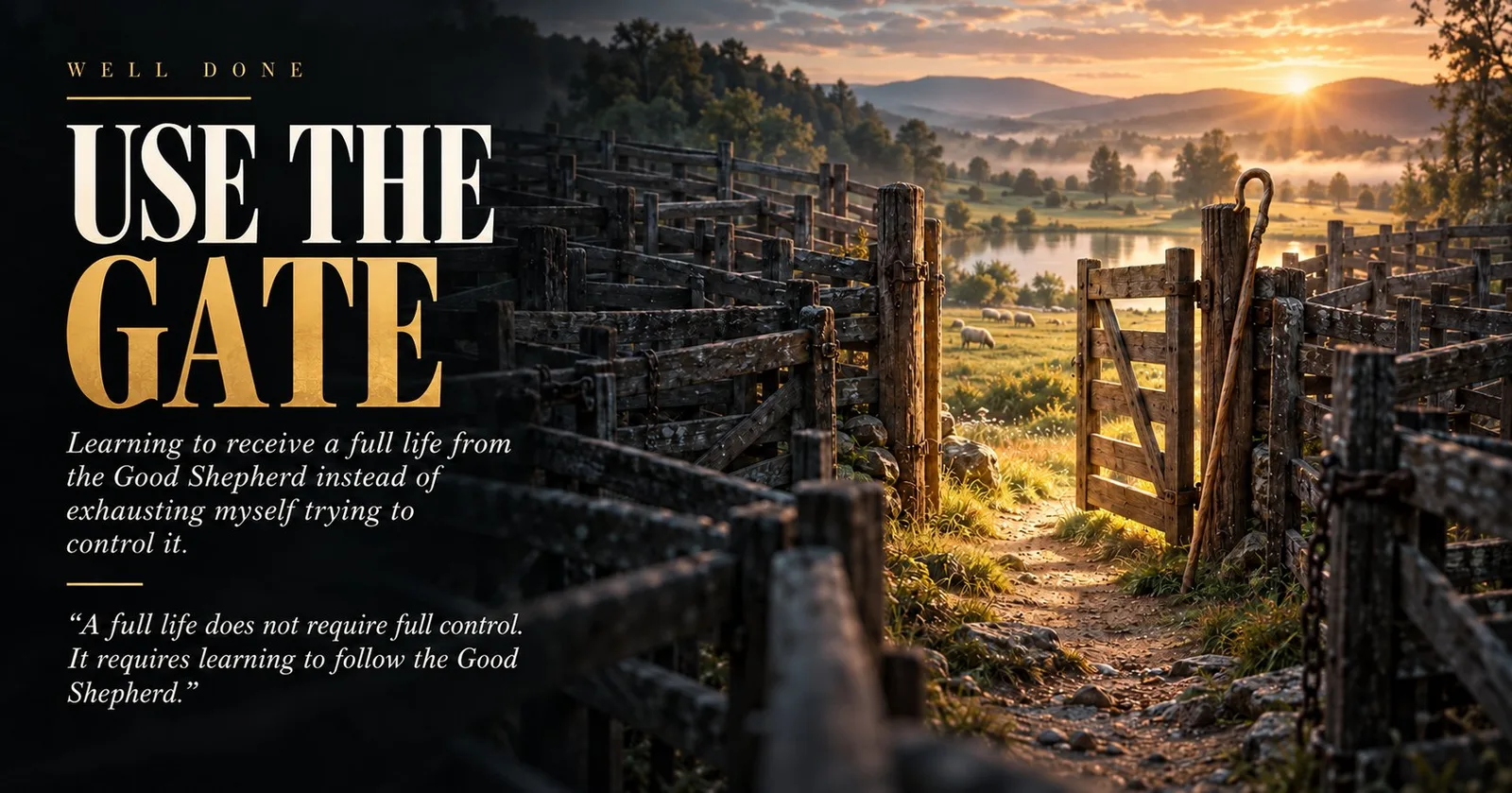
Use the Gate
My first instinct with this picture was to imagine getting over the fence. A dramatic moment of surrender. A clumsy leap into the green grass. Possibly a wardrobe malfunction, because pride rarely checks the barbed wire before committing to the jump.
It makes a funny image. But the actual passage gives us a better entrance.
In John 10:9, Jesus says:
“I am the gate.”
Earlier, He describes climbing into the sheep pen another way as the approach of a thief. So I probably shouldn’t turn unauthorized fence-climbing into the official method of Christian surrender.
There is a gate. Use it.
That small correction carries a lesson I need. I can become so attached to making something happen through my own ingenuity that I overlook the direction already given.
I don’t need to build a flawless account of my life before coming to Christ. I don’t need to manufacture an impressive spiritual arrival. I can acknowledge the truth about myself, receive His grace through faith, and begin learning to follow Him.
Ephesians 2:8–10 puts salvation by grace before the good works that flow from a life in Christ. The relationship is not a reward I purchase through sufficient performance.
There is a place for effort, discipline, service, and repentance. Those belong in the life I am learning to live. They cannot replace the Savior through whom that life comes.
Coming through the gate means I no longer need to invent my own way to be received.
I can stop negotiating with God as though my next accomplishment is the piece of evidence He has been waiting for. I can admit where I have sinned, where I am afraid, and where I have mistaken control for security.
Then I can respond to Him honestly.
The beginning of surrender may sound as plain as this: Jesus, I need You. Show me what belongs to me today, and teach me to trust You with what I cannot control.
There is no need for an Olympic hurdle routine.
A Different Shepherd, a Different Way of Living
John 10:10 gives us the heart of this invitation:
“I have come that they may have life, and have it to the full.”
Fullness begins in relationship with Christ. Learning to follow Him then changes how I carry responsibilities, respond to other people, and understand my place in the world.
The turning point is deeper than deciding to become calmer. I am recognizing that I have allowed other things to direct me: the need to win, the fear of being exposed, the belief that I have to secure every outcome, or the desire to numb whatever I cannot immediately solve.
I can surrender that authority without abandoning my responsibilities.
I still need to tell the truth. I still need to care for my family. I still need to honor commitments, manage resources responsibly, and make repair where my choices have caused harm.
Those duties can become expressions of love and trust rather than desperate attempts to prove I deserve love.
That difference reaches the people around me. They can experience it in the way I speak, the information I share, the attention I give, and the willingness I bring to a hard conversation.
Galatians 5:22–23 names the fruit of the Spirit, including love, joy, peace, patience, kindness, faithfulness, gentleness, and self-control. Those qualities offer a more useful picture of an overflowing life than a collection of impressive possessions.
I can have a larger bank account and less patience. I can have more influence and less honesty. I can have a full schedule and very little room for another human being.
I want the kind of growth my family can experience without checking my revenue.
And I want to remember that growth takes practice. The demand to control everything may return tomorrow. An old reaction may show up before I have had coffee. Surrender needs to become a continuing response, with repentance, support, and repeated choices when the familiar pattern returns.
The Shepherd is leading a person who is still learning.
That includes me.
Faith That Has Room for an Ordinary Tuesday
I want a relationship with God that reaches beyond the moments when everything is on fire.
I have brought Him plenty of urgent requests. There is nothing wrong with asking for help when I am afraid. Scripture gives us language for crying out, grieving, and needing rescue. But if my entire prayer life is a series of emergencies, I may be missing the opportunity to know Him in the ordinary hours between them.
I can thank Him when something small brings joy. I can ask for wisdom before answering a difficult message. I can bring Him a thought I am embarrassed to admit rather than waiting until that thought has become a decision with consequences.
I can also sit quietly without immediately demanding a strategic download.
Apparently, every conversation does not need to end with an action plan and a spreadsheet. This information remains personally inconvenient.
There is a difference between seeking God and trying to use prayer to obtain approval for whatever I have already decided. One makes room for correction. The other keeps talking until it hears something agreeable.
Following the Shepherd means His direction matters even when it interrupts mine.
That is where faith becomes part of daily life. I can read Scripture to receive instruction, pray to bring my actual self before Him, and listen to wise people who can challenge me. I can return after a distracted morning without turning that distraction into a verdict on the whole relationship.
An ordinary Tuesday can hold honest prayer, a necessary correction, and gratitude for something I would once have rushed past.
That is a life I can begin receiving today.
Marriage Without a Collection Agency
Scarcity can make a marriage sound like two collection agencies sharing a bedroom.
I did this. You didn’t do that. I apologized last time. You owe me affection. I will become generous when you become easier to love.
There may be real hurt underneath those statements. There may be responsibilities that need to be discussed and patterns that need to change. But keeping a running balance of who deserves what can turn every interaction into another attempt to collect.
I know what it means to withdraw when a conversation becomes uncomfortable. I have also had to acknowledge that walking away could punish Danielle. Calling it my way of handling pressure did not erase what she experienced on the other side of my absence.
The fuller life I want has to reach that part of me.
It has to change what I do when I feel criticized, misunderstood, or tempted to protect my pride. I want to become someone Danielle can bring a hard subject to without having to calculate whether the conversation will cost her my presence.
That takes more than a well-written paragraph. It takes listening, owning the specific behavior, and following through often enough for new trust to have something solid beneath it.
For a reader, that might begin with one conversation: I have been keeping score. Here is where I have withheld kindness. Here is what I am willing to change.
Or it might mean putting the phone away, asking how your spouse is doing, and resisting the urge to turn their answer into a debate about your intentions.
A marriage can need practical agreements, counseling, and clear boundaries. A pause to regulate your emotions can help when it includes a commitment to return. Those choices can protect connection. They are different from using silence or disappearance to make the other person pay.
I can take responsibility for my part without claiming control over Danielle’s response. Reconciliation involves both people, and forgiveness does not make damaged trust instantly whole.
But I can stop using her next move as permission to postpone mine.
There is abundance in becoming more available to the person I promised to love. There is strength in hearing something difficult without needing to win the exchange.
Besides, Danielle already beats me at enough actual games. We do not need to turn the marriage itself into another one.
A Home Where Correction Still Leaves Room for Love
Parents can become so committed to getting the behavior right that we forget the person learning it.
We want the room cleaned, the instructions followed, the argument ended, and the schedule respected. Those are reasonable concerns. Children need boundaries, responsibilities, and adults who follow through.
But a child can make a mistake without that mistake becoming a public review of our competence as parents.
Consider a spilled glass of milk. There is a mess to clean and probably a useful lesson about where to put the glass. There does not need to be a closing argument about disrespect, the future of civilization, and everything wrong with this generation.
It is milk. We can stand down the federal investigation.
The question is whether my response helps the child learn or mostly helps me discharge frustration.
Correction can be firm and loving. I can name what happened, explain the expectation, and help a child take responsibility. I can also notice when my reaction is larger than the situation and own the part that belongs to me.
That matters to the legacy I want for my kids and future grandkids.
I want them to inherit more than stories about what their dad achieved. I want them to know what it looks like when a man accepts correction, apologizes without excuses, and keeps practicing a better response.
My ceiling becoming their floor has to include emotional maturity. Otherwise, I can give them advantages while passing down the same old reactions in nicer packaging.
An overflowing home has room for laughter, questions, effort, and mistakes. Love remains available while lessons are being learned. A child does not have to produce perfect behavior to receive connection.
That kind of home is built through repeated moments. Some will go well. Some will require repair. I can return after getting it wrong and say plainly that my tone or reaction was wrong.
I want my children to see that receiving grace makes me more responsible for how I treat them.
Work That Serves People
There is nothing shameful about doing excellent work, building a business, earning money honestly, or enjoying the satisfaction of a problem solved.
I love solving problems. I love the energy of seeing an idea become useful. Persistence and creativity have been important parts of my life.
But they need direction and limits. Otherwise, the business can become a place where I keep trying to settle a question about my worth through another result.
That pressure changes how people are treated. A colleague becomes competition. A client becomes a number I need. An uncomfortable fact becomes information I would rather withhold. Rest becomes evidence that someone else is about to get ahead.
I have written about what can happen when ambition outruns stewardship. The lessons belong in the way I work now, including who gets to question a decision and how honestly I explain the risks.
Following the Shepherd gives me reason to do work that serves people even when the truthful answer is less impressive than the sales pitch.
That can mean admitting a mistake early, sharing credit accurately, declining work I am not equipped to do, or bringing qualified counsel into a decision before confidence starts writing checks that competence cannot cover.
Confidence has signed enough paperwork. It can let wisdom read the terms.
Ephesians 4 describes a practical change from taking to doing honest work so that there is something to share with people in need. Work becomes part of a life that contributes.
I want that direction. I want people to benefit from my work because they were served well, not because they were necessary props in my pursuit of success.
Stewardship also means respecting actual limits. Money has obligations attached to it. Employees need clear agreements. Clients deserve reliable delivery. Generosity requires judgment about what I can responsibly give.
Trusting God does not let me ignore those details. It helps me face them without pretending that I personally hold the universe together.
A faithful choice may cost an opportunity. Telling the truth may produce a difficult conversation. A boundary may disappoint someone.
I can make those choices and still do ambitious, excellent work. I can also leave room in my life for the people who will still be there when the meeting ends.
Overflow Has Somewhere to Go
A full life can make us more available to other people.
That does not require hosting the entire neighborhood, acquiring a commercial smoker, or becoming the unofficial mayor of the cul-de-sac. Some people enjoy a crowded table. Others serve best through a quiet conversation, a practical favor, or steady care that very few people see.
The question is whether I can notice a need without immediately measuring what meeting it will do for my image.
Can I listen without trying to become the hero? Can I offer help without making the other person feel obligated to receive it? Can I respect their answer when they say no?
If I want to pray with someone, I can ask. If I have useful advice, I can make room to learn whether they want it. Caring about another person includes respecting their boundaries.
Overflow might look like a meal delivered during a hard week, a ride to an appointment, or learning the name of someone I usually pass without speaking. It might mean showing up for a friend whose situation cannot be fixed in an afternoon.
Some days, I will be the person who needs that care.
I want to receive it without treating need as a personal embarrassment. Community becomes stronger when people can give and receive honestly, instead of everyone insisting on being the only capable adult in the room.
There is room for a mismatched chair at the table. There is room for the person who has very little to give today.
There is room for me when I am that person.
Learning to Stay When Escape Looks Easier
I have known the impulse to trade discomfort for immediate relief. Alcohol and gambling were part of my story. They could offer an experience that felt like escape while leaving the things I needed to face waiting for me afterward.
Sometimes the escape came with applause, excitement, or the convincing appearance of a win. The private cost could be harder to see while I was enjoying the result.
The full life I want includes the ability to face an uncomfortable moment without automatically reaching for a way to disappear from it.
That might mean telling someone I am struggling, leaving a setting that feeds an old habit, or using the support and routines that help me stay sober. It might mean accepting professional help rather than turning recovery into another competition I am determined to win alone.
I am not interested in making someone feel weak because their recovery requires more than a single decision. People need different kinds of support, and seeking that support can be a faithful response.
I want to become more honest about what a particular choice gives and what it takes.
Does it help me participate in the life I value? Does it make me more available to my family? Does it preserve the trust I am trying to build? What happens after the immediate feeling passes?
Those questions can interrupt the polished sales pitch an old habit brings to the door.
I do not have to buy it just because I have bought it before.
There is fullness in a sober evening, an honest conversation, and a hard feeling that I allow myself to experience without handing it control of the next decision.
Small choices like those give the transformation somewhere real to live.
What Does This Look Like in Your Life?
Your story may have very little in common with my businesses, addictions, or particular mistakes. You may be retired, raising a family, working shifts, studying, caring for someone, or trying to get through a season you never wanted.
The invitation to life in Christ reaches you where you are.
You do not need a dramatic testimony to examine what has been directing your choices. You can begin with the place where you feel compelled to control, conceal, compete, or earn the right to be loved.
Enough to Open My Hands
I still care about outcomes. I still want to do meaningful work, love my family well, and build something that serves people beyond my own lifetime.
But I am learning to examine what those pursuits are turning me into along the way.
If my pursuit of provision makes me unavailable to the people I want to provide for, I need to pay attention. If my determination to be right keeps me from hearing the person I love, I need correction. If my picture of abundance requires everyone around me to cooperate with my plan, I have made myself the center again.
I want a fuller life than that.
I want laughter I can actually participate in. I want conversations where I can tell the truth. I want work that respects people, a home where repair is practiced, and enough humility to receive help before a private struggle becomes a public consequence.
Psalm 23 gives me a picture of a cup overflowing while enemies are still present. The provision and the difficulty appear in the same psalm. I can receive care from the Shepherd while there are still things I do not understand and responsibilities I need to face.
That is why “Good Plans” by Red Rocks Worship fits this note. Its Shepherd imagery carries trust through difficult terrain as well as places of rest. The song makes room for following when the landscape changes.
I can learn to follow in both.
There will be mornings when I forget and grab for control again. There will be conversations where I need to stop, apologize, and begin differently. I can return to Christ, receive correction, and keep practicing the life He calls me into.
I do not need to turn the return into another elaborate obstacle course.
The gate is there.
Use it.
A full life does not require full control. It requires learning to follow the Good Shepherd.
Closing Prayer to Our Good Shepherd.
Jesus, The Good Shepherd, thank You for the life You offer and the love You have shown by giving Yourself for us.
I confess that I have tried to secure too much through control. I have allowed fear, pride, comparison, and the need to prove myself to influence choices that should have been shaped by love. Show me where those habits are still directing me.
Help me come to You honestly. Teach me to receive Your grace without hiding from correction. Give me courage to tell the truth, make repair, seek help, and honor the responsibilities that belong to me.
Where I have kept score in a relationship, teach me humility. Where I have withdrawn to punish, teach me to return with honesty and care. Where my family has experienced the sharp edges of my pressure, help me practice patience and become more available to them.
Guide my work. Help me serve people well, respect limits, welcome accountability, and handle resources faithfully. Give me discernment about what to accept, what to decline, and what I need to place in wiser hands.
For the person reading who is exhausted, grieving, afraid, or struggling to recover, bring comfort and practical support. Help us receive care without shame. Remind us that difficulty does not place us beyond Your love.
Grow the fruit of Your Spirit in our actual lives: in our conversations, decisions, homes, work, and communities. Make us generous with what we can responsibly give and humble about what we need.
Teach us to follow You through places of rest and through the valley. When we reach for control again, help us return.
Let the life we receive from You overflow in the way we love the people before us today.
In Jesus’ name, Amen.
Join the conversation
Comments
Be the first to leave a comment.