Field Notes · September 15, 2026 · 27 min read
Ambassador Fenster
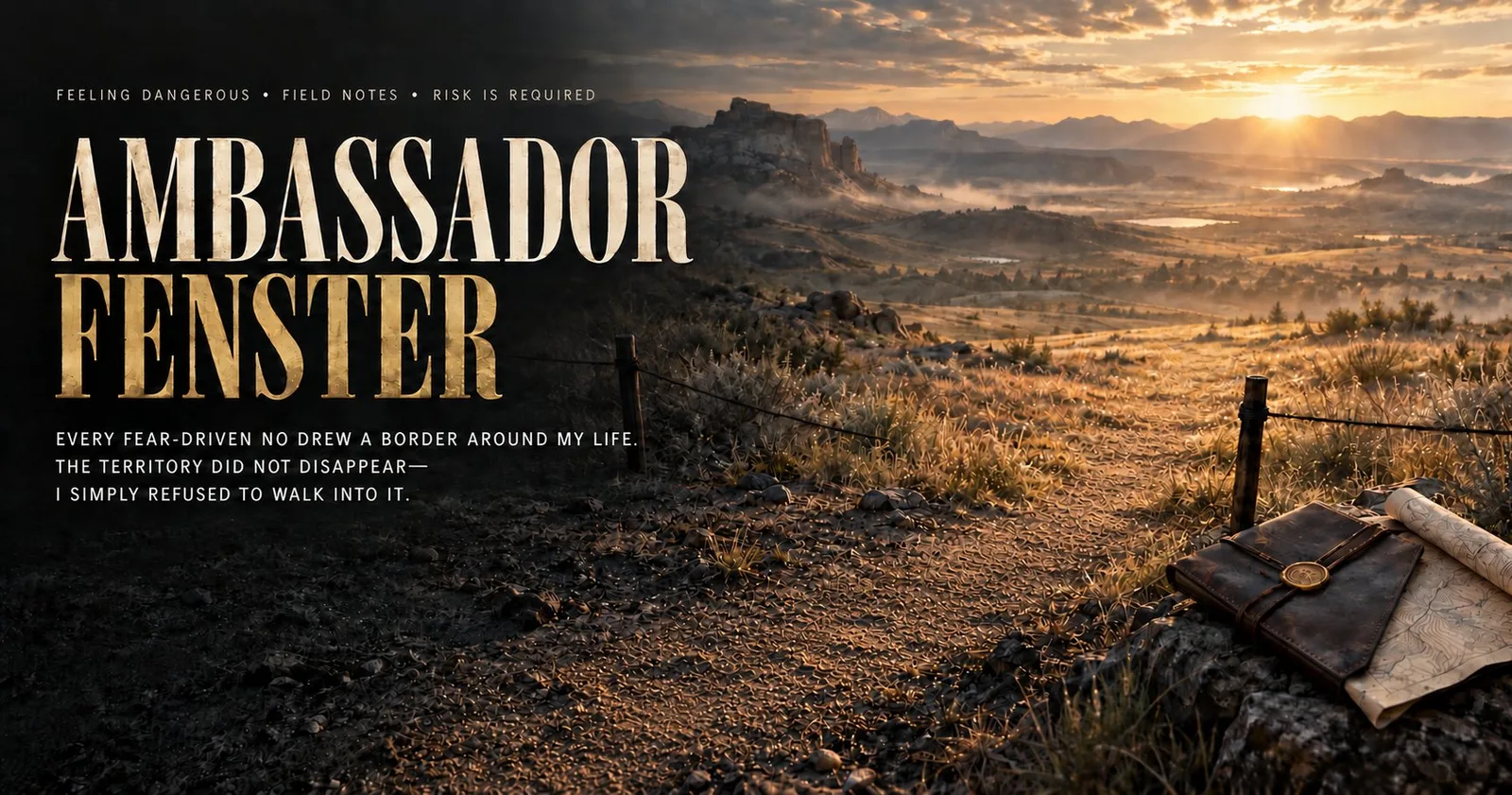
Every fear-driven no drew a border around my life. The territory did not disappear... I simply refused to walk into it.
AI-generated narration · Adjust playback speed in the player.
Ambassador Fenster
Ambassador Fenster.
That sounds official.
Maybe even a little ridiculous.
It sounds like a title engraved on a brass office door in a country I have never visited. It sounds like a diplomatic appointment that should come with credentials, security, a flag, and somebody important standing behind a podium.
It is not a title I would have naturally given myself.
Yet Paul wrote that believers are ambassadors for Christ.
If that is true, then the title does not elevate me above anyone. It places me under authority.
An ambassador does not create his own message. He does not enter another territory carrying only his own ambition. He represents the ruler who sent him. His conduct matters because people may form an opinion about the kingdom by watching the representative standing in front of them.
That changes how I understand the marketplace. How I understand business.
I am not merely a consultant, entrepreneur, problem solver, adviser, salesman, strategist, husband, father, or man trying to create another successful outcome.
I am a representative.
The question is not only whether I can enter a market, build a company, solve a problem, create profit, or expand my influence.
The question is whether the way I enter, build, solve, profit, and expand accurately represents the King whose name I carry.
The word ambassador sounds like authority.
It actually means accountability.
The Smallest Border
There is a risk in saying yes.
Yes can cost money. It can cost comfort. It can expose you to failure, criticism, rejection, embarrassment, and consequences you cannot completely forecast. Yes may require you to enter a room where you feel underqualified, start something before you feel ready, or carry responsibility you have never carried before.
That is the risk most people recognize.
But there is another risk we do not discuss nearly as often.
There is a risk in saying no.
No can sound responsible. It can sound mature, calculated, cautious, and safe. It can protect us from embarrassment and preserve the life we already understand. Sometimes no is exactly the right answer. Sometimes no is obedience.
But sometimes no is fear wearing a suit and carrying a spreadsheet.
Sometimes no is how we avoid admitting that we want certainty more than we want the assignment.
Sometimes no is the first fence post driven into the ground around a smaller life.
We place another post every time we refuse to move because we cannot guarantee the result. We stretch wire between the posts with practical explanations, other people’s expectations, old failures, limited resources, and the belief that somebody more qualified should go first.
Eventually, the boundary looks permanent.
We call it wisdom.
We call it reality.
We call it knowing our limits.
But sometimes it is only the border fear built.
What I Do With a Word
For as long as I have walked with God, I have carried a strong belief that when He places something in my hands, I am responsible for doing something with it.
It may be an idea, a direction, a dream, a relationship, an introduction, a problem, a skill, a warning, or a word that creates more questions than answers. It may feel large enough to rearrange my future or small enough that nobody else would understand why it matters.
Either way, I do not want to bury it.
I have often joked that if God gives me a direction and I do absolutely nothing with it, it feels like I am slapping away the gift. Who am I to demand more clarity while ignoring the small instruction already in front of me?
The parable of the talents has shaped that conviction. The story begins with a master preparing to leave on a long journey. Before he goes, he calls his servants together and entrusts his property to them. He gives different amounts according to their ability, then leaves.
The servants are not owners.
They are stewards carrying something that still belongs to the master.
Two of them put what they received into motion and multiply it. The third digs a hole and buries his master’s property. He does not lose it in a bad deal. He does not spend it on himself. He does not hand it to a thief. He protects the original amount and waits.
Then, after a long time, the master returns.
He settles accounts with each servant.
The first two do not merely hand back what they were given. They show the master what was produced while he was away, and he calls them good and faithful. The third servant returns the single talent exactly as he received it. He explains that fear shaped his decision, so he hid the money in the ground.
The master does not celebrate the preservation.
He condemns the servant’s fear-driven inaction and asks why the money was not at least placed where it could have produced a return. Then he removes the talent from the servant who buried it and gives it to the one who had multiplied ten.
That changes the weight of the story for me. The servant’s failure was not that he lacked ownership. None of the servants owned what they carried. His failure was treating temporary custody as permission for inactivity while the master was away.
A talent in the original story was a large unit of money, not the modern word for a personal gift or skill. But the stewardship principle still confronts me: what has been entrusted does not become mine simply because the Master appears absent, and the Master’s return includes an accounting.
Inactivity can look innocent before that accounting. Buried potential does not always create a visible crime scene. There may be no angry customer, failed launch, unpaid invoice, or public loss. There is only the quiet absence of what might have grown.
No multiplication.
No people served.
No capacity developed.
No testimony created.
Nothing obviously broke. Nothing was ever built.
Over the past twenty years, I have tried to take action on the littlest of the little. I have not done it perfectly. I have misunderstood instructions, moved too fast, attached my ego to outcomes, and sometimes used good intentions to justify bad methods. Other Field Notes carry those confessions.
But I still believe the answer to past misuse is not permanent inactivity.
Correction should teach me how to carry the next assignment more faithfully. It should not convince me to bury everything God may place in my hands.
My Field of Favor
God has spoken to me about marriage, family, health, healing, fatherhood, and faith. Yet even Danielle will tell you that one of my clearest fields of favor has consistently been the marketplace.
Business makes sense to me.
I see problems and begin arranging solutions. I hear an idea and start seeing the people, systems, offers, technology, relationships, and steps that could put it into motion. I can walk into confusion and begin finding the order hiding inside it.
If someone turned the past twenty years into a spreadsheet, there would be more ideas, directions, dreams, strategies, visions, and what I call downloads around business than almost any other category of my life.
That does not mean every idea came from God.
It does not mean every opportunity belonged to me.
It does not mean profit proves His approval.
It means the marketplace is one of the places where I have repeatedly been asked to practice stewardship.
For years, I believed stewardship mainly meant taking the idea and moving faster. Now I understand that faithful stewardship includes testing the idea, seeking counsel, counting the cost, protecting the people affected, telling the truth, honoring the law, building reserves, and remaining willing to hear no.
But after all those guardrails are named, there is still a moment when analysis must become action.
Eventually, somebody has to take the first step.
Four Meetings a Day
When I moved to Chicago, I did not arrive with a powerful network waiting to receive me.
I did not have years of local relationships, a family name opening doors, or a city full of people obligated to answer my calls. I was in an enormous market surrounded by people who did not know me.
I could have looked at that reality and said no.
No connections.
No established reputation.
No guarantee that the meetings would produce business.
No proof that I belonged in the rooms I wanted to enter.
Instead, I started scheduling meetings.
Four a day became normal. Some days it was more. Conversation after conversation, introduction after introduction, room after room, I built a network from nothing.
Most of those meetings did not create an immediate check.
Some did not produce any visible opportunity at all. Yet they were not wasted. Each one increased my understanding of the city, the industries, the problems, the language people used, and the people I might be able to serve.
One meeting created another introduction. One relationship opened another room. One solved problem became evidence that I could be trusted with a larger one.
My territory did not expand because I stood in our town home and prayed for Chicago to recognize my name.
Prayer mattered. Faith mattered. Direction mattered.
Then my feet had to move.
The network grew one uncomfortable conversation at a time.
That season taught me that territory is often disguised as repetition.
We imagine expansion as one massive breakthrough, but it frequently arrives through small acts of obedience completed long enough for roots to form.
If I had said no to the first awkward meeting because the outcome was uncertain, there would have been no second introduction. If I had waited until I felt like I belonged in Chicago, the city might never have become part of my assignment.
The risk was not only that the meetings could fail.
The risk was that fear could prevent them from happening at all.
The Ground Beneath the Promise
Joshua received an extraordinary promise after Moses died. God told him that the ground touched by his feet had been given to Israel, just as He had promised Moses.
The land was promised.
The walking was still required.
The promise did not eliminate rivers, fortified cities, conflict, decisions, or fear. Joshua still had to lead. Israel still had to move. The people had to cross out of familiar ground and step into a future they could not control.
That passage is powerful, but it also needs to be handled honestly.
God’s words to Joshua were part of a specific covenant and a specific moment in Israel’s history. They are not a blank check allowing me to point at any company, city, customer, building, or bank account and declare that God owes it to me.
People are not territory for me to conquer.
Competitors are not Canaanites for me to remove.
Profit is not proof that God promised the deal.
The marketplace is not a map I get to color in for my own glory.
Yet Joshua’s story still confronts a timeless temptation: demanding the experience of possession while refusing the obedience of movement.
I cannot ask God to enlarge my capacity while rejecting everything that stretches it. I cannot pray for influence while refusing to meet people. I cannot pray for provision while burying skills I was given to develop. I cannot ask to serve more people while saying no to every room where I am not already comfortable.
The ground does not move beneath my feet. My feet have to move onto the ground.
The Grasshopper Report
Years before Joshua led Israel across the Jordan, twelve men walked through Canaan and returned with evidence that the land was fruitful.
All twelve saw the same land.
All twelve saw the same cities.
All twelve saw the same people living there.
Ten focused on the size of the opposition and the smallness they felt inside themselves. They described themselves as grasshoppers. Joshua and Caleb did not deny the obstacles. They simply refused to let the obstacles become larger than God’s instruction.
The majority report sounded practical.
There are giants.
The cities are fortified.
We are not enough.
Turn around.
Fear rarely introduces itself by saying, “I am here to make you disobey.”
It usually arrives with research.
It produces a detailed presentation about everything that could go wrong. It calls retreat maturity. It makes the wilderness feel responsible because at least the wilderness is familiar.
There is a difference between identifying a giant and surrendering authority to it.
Wise people calculate risk. They examine the market, contracts, capital, capacity, timing, laws, team, and downside. They do not need to pretend the fortified walls are imaginary.
But after the facts are gathered, somebody still has to decide which voice receives the final vote.
Fear says, “Because this may fail, you must not move.”
Faith says, “Because God has made the next step clear, uncertainty does not get to veto obedience.”
I do not have to deny the giant.
I have to stop letting the giant write my answer.
When No Is Expensive
Every decision has a cost, including the decisions that preserve the present.
Saying no to the introduction may cost the relationship that would have changed your direction.
Saying no to the difficult conversation may preserve comfort while allowing distance to grow.
Saying no to learning may protect your pride while shrinking your usefulness.
Saying no to the unfamiliar market may eliminate the possibility of failure—and the possibility of growth.
Saying no to the first small act of obedience may mean never developing the capacity required for the larger one.
Saying no to asking for help may leave you holding dynamite at the bottom of a hole another person could have helped you exit.
Saying no to telling the truth may postpone discomfort while multiplying the eventual cost.
Saying no is still a decision.
Inaction still produces an outcome.
The future created by refusal is harder to measure because we never get to see the relationships, skills, businesses, repairs, ministries, and generational changes that did not happen.
That is why fear-based safety is so seductive. It hides the invoice.
Failure sends a bill we can read. Opportunity cost sends nothing.
It simply removes a future from the table and leaves us believing we saved ourselves from danger.
When My No Went Covert
I know what happens when no stops being a single decision and becomes a way of life.
I went through a season when the consequences of my bad decisions began limiting my yes. I stopped performing at the level I knew I could. I stopped taking territory in the marketplace. I stopped walking confidently in a skill set I believe God had given me, developed in me, and blessed through years of use.
At first, some of that retreat was necessary.
There were things that needed to stop. There were consequences I needed to face, damage I needed to understand, habits I needed to confront, and parts of my ambition that needed to be surrendered. Continuing at the same speed with the same motives and methods would not have been courage. It would have been repetition.
But correction slowly became contraction.
I started saying no to rooms I still had something valuable to bring into.
No to opportunities I was capable of serving.
No to conversations because I did not want to explain where I had been.
No to visibility because being seen meant being questioned.
No to using my gifts because I no longer trusted the man carrying them.
No to the future because I had decided the past had already disqualified me from it.
The noes began forming a perimeter.
Then the perimeter became isolation.
Then isolation pushed me into darkness.
Darkness is where fear prefers to work because it can make its voice sound like the only voice left in the room. When there is no light, no trusted counsel, no honest conversation, and no one close enough to challenge the story, fear can convert one consequence into a complete identity.
It tells you that stepping back is the same as disappearing.
It tells you that repentance requires you to stop being useful.
It tells you that humility means pretending you have nothing left to offer.
It tells you that protecting people means withholding your presence from them.
It tells you the safest answer is no—again, again, and again—until the life you once fought to build is on the other side of a border you created yourself.
That is part of the Covert season of my life.
Covert can be preparation. There are seasons when God pulls a person away from noise, attention, and activity to heal, correct, teach, and rebuild him. Hiddenness is not automatically punishment. Solitude can become sacred when God is welcomed into it.
But being hidden by God is different from hiding from God.
Solitude prepares us to return to the assignment.
Isolation tries to convince us never to return.
“Covert is preparation when God hides you. It becomes captivity when fear convinces you never to return.”
There came a point when I had to admit that fear had not conquered the territory through some dramatic attack. I had surrendered it one no at a time.
Fear did not have to remove my ability.
It only had to convince me to stop using it.
Fear did not have to destroy every relationship.
It only had to keep me from answering, calling, meeting, and telling the truth.
Fear did not have to lock every door.
It only had to train me to stop reaching for the handle.
I had fought for years to develop knowledge, relationships, experience, and influence in the marketplace. Then I allowed shame and uncertainty to convince me that disappearing was the same thing as surrendering to God.
It was not. I was surrendering to fear.
The First Inch Back
Getting back to yes does not mean returning to the same uncontrolled speed that helped create the need for correction.
It does not mean forcing open every door, accepting every deal, trusting every impulse, or pretending the consequences disappeared. It does not mean using faith to outrun accountability.
The renewed yes is smaller, slower, clearer, and more honest.
Yes to telling the truth.
Yes to accepting help.
Yes to making the call.
Yes to repairing what can still be repaired.
Yes to sitting in the meeting without needing to control the outcome.
Yes to serving one person with the wisdom earned through both victory and failure.
Yes to using the gift without worshiping the person carrying it.
Yes to being present with my family instead of calling my absence protection.
Yes to becoming visible again without making visibility my identity.
The first territory I had to reclaim was not a geographic market.
It was the distance between where I was hiding and the next act of obedience.
My family, marriage, businesses, and community do not need me to become their savior. I have already learned what happens when I accept that false position. But they do need me to be present, truthful, surrendered, and willing to carry the part of the assignment that actually belongs to me.
That is how the light returns.
Not always through one enormous breakthrough.
Sometimes through a single flame.
One honest conversation.
One repaired relationship.
One meeting scheduled.
One idea moved out of a notebook.
One person served.
One boundary honored.
One inch of ground walked faithfully today.
Isaiah used the image of enlarging the place of the tent, lengthening the cords, and strengthening the stakes. I do not read that as a promise that every business must grow or that every ambition will be blessed. I receive it as a picture of restored capacity: making room for what God actually entrusts while becoming strong enough to carry it.
Name the darkness that needs light today.
Name the fear that has been answering for you.
Take the next faithful step toward your family, your marriage, your work, your community, or the truth you have avoided.
Do not despise the inch because it is not yet a mile.
Light the fire again... not to burn everything around you, but to illuminate the next instruction.
Walk the ground God has actually placed in front of you.
Fear does not get to keep territory simply because you once stopped fighting for it.
The Holy No
This is where the lesson becomes more difficult.
I have spent much of my life treating movement as faith and resistance as confirmation. When an idea was difficult, I could assume the difficulty proved it mattered. When someone questioned the plan, I could hear fear in their voice instead of wisdom. When a boundary slowed me down, I could treat the boundary as opposition.
That mindset helped me move when other people froze.
It also helped me rationalize movement that should have stopped.
Not every no is fear. Some noes are holy.
No to the opportunity that requires secrecy.
No to the revenue that demands a compromised promise.
No to the business that would consume the marriage it claims to provide for.
No to the speed that outruns counsel, law, truth, capacity, or character.
No to another shiny object that would divide the focus required by the present assignment.
No to taking money that has not been earned.
No to calling appetite an anointing.
No to using God’s name as a signature beneath a decision He never authored.
I used to think taking territory meant saying yes more often.
Now I understand that some of the most important territory is protected by what I refuse.
The question is not whether I am brave enough to say yes.
The question is whether I am surrendered enough for God to choose my answer.
Doing the Don’ts
Danielle once shared a teaching from her mentor Myron Golden called “Doing the Don’ts.” The concept stayed with me because most goals come with an overwhelming list of things we could do. The list of things we absolutely must not do is usually much shorter.
That shorter list often protects the entire outcome.
When someone wants to improve physically, they can drown in programs, supplements, strategies, research, and routines. The simpler transformation may begin by honoring a few boundaries: do not keep feeding the addiction, do not spend every day without movement, and do not repeatedly choose what destroys the goal.
The principle applies far beyond health.
In marriage, do not hide what affects the covenant.
In leadership, do not make promises the team cannot fulfill.
In business, do not spend the seed required for the next season.
In growth, do not allow every good idea to fragment the assignment.
In faith, do not use spiritual language to silence correction.
Doing the don’ts is not a small life.
It is disciplined expansion.
A river without banks does not become more powerful. It becomes a flood.
Boundaries do not always limit impact. The right boundaries concentrate it.
That has changed how I think about profit. Profit is not greed by definition, and losing money is not proof of spiritual purity. A healthy business can create jobs, fund generosity, protect families, build reserves, invest in new solutions, and carry a vision through seasons when revenue changes.
But if I consume every harvest as proof that I have arrived, there is no seed left to plant. If I spend every reserve on appearances, there is no margin available when the next instruction requires movement. If I make luxury the evidence of favor, I will eventually be tempted to protect the image instead of the assignment.
Sometimes taking more territory begins with saying no to consuming everything produced by the territory already entrusted to me.
Resistance Is Not the Compass
I still believe resistance can appear when we are moving in the right direction.
Nehemiah experienced ridicule, accusation, threat, and distraction while rebuilding Jerusalem’s wall. Opposition did not prove the work was wrong. He remained focused because the assignment had already been made clear.
There have been moments when fear, insecurity, imposter syndrome, and external pressure became loud immediately after I committed to something that required growth. Recognizing that pattern can keep resistance from bullying me back into comfort.
But resistance by itself is not confirmation.
Sometimes resistance is spiritual opposition.
Sometimes it is ordinary friction.
Sometimes it is a warning.
Sometimes it is a consequence.
Sometimes it is the voice of someone who sees the cliff I am accelerating toward.
If I automatically interpret every obstacle as proof that I am right, I become impossible to correct. Every disagreement becomes an attack. Every closed door becomes warfare. Every consequence becomes persecution. Every person asking me to slow down becomes an enemy of the vision.
That is not discernment.
It is ego protected by spiritual language.
Resistance is information. It tells me to pay attention, pray, inspect the motive, examine the method, seek counsel, and confirm the direction. It may strengthen my resolve. It may redirect my steps. It may expose that the assignment is right but the approach is wrong.
The goal is not to move every time I feel resistance.
The goal is to become so submitted that resistance cannot control me in either direction.
The Door God Closed
Acts records a moment when Paul and his companions intended to preach in Asia, but the Holy Spirit prevented them. They tried another direction, and again the Spirit did not permit it. Later, Paul received a vision calling him toward Macedonia.
One direction closed.
Another opened.
Paul’s calling had not disappeared. His geography changed.
That matters for someone wired like me. I can receive a genuine assignment and still assume my preferred route is part of the promise. When that route closes, I may push harder because I believe persistence proves faith.
But sometimes a closed door is not the enemy keeping me out.
Sometimes it is God keeping me available for the door that actually belongs to the assignment.
The risk of saying no is real.
So is the risk of refusing to hear God say it.
Maturity is not becoming a permanent yes-man. It is becoming responsive.
Move when He says move.
Stop when He says stop.
Wait when He says wait.
Release when He says the season is complete.
The power is not in the word yes or no.
The power is in agreement with the One giving the instruction.
Taking Territory Without Taking Over
The language of taking territory can become dangerous when it is separated from the character of Christ.
Business culture often celebrates domination. Take the market. Crush the competition. Own the category. Build a moat. Become impossible to remove.
Some of that language describes normal strategy. But if I carry it into faith without examination, I can turn kingdom service into an excuse for personal empire.
God’s Kingdom does not advance because I become the savior of the marketplace.
It advances when His rule becomes visible in the way I work.
Truth where deception is normal.
Service where exploitation is rewarded.
Excellence where carelessness harms people.
Generosity where greed has become the operating system.
Repentance where leaders normally protect their image.
Restoration where failure is usually hidden or discarded.
Fairness in contracts.
Integrity in promises.
Care for employees, clients, vendors, partners, and families affected by decisions they may never see.
Taking territory for God is not about making more ground belong to me.
It is about allowing more of the ground beneath my responsibility to reflect Him.
Ambassador, Not Emperor
Second Corinthians calls believers ambassadors for Christ.
That word gives me a better identity for the marketplace.
An ambassador does not arrive representing himself. He carries the authority of the kingdom that sent him, communicates its message, reflects its values, and remains accountable to its ruler.
An ambassador does not annex every piece of ground he wants.
He does not rewrite the King’s instructions to match his appetite.
He does not use delegated authority to build a private empire.
He goes where he is sent.
He says what he is authorized to say.
He represents the King even when nobody from home appears to be watching.
That is who I want to become.
I am God’s ambassador in the marketplace.
I believe I am marked by Him and for Him. I believe the skills, relationships, experiences, failures, ideas, and opportunities placed in my hands can be used for purposes larger than my income or reputation.
But being an ambassador does not make every ambition sacred.
It makes surrender more serious.
I do not get to say yes simply because the opportunity can make money.
I do not get to say no simply because the assignment may cost it.
I do not get to claim that God sent me while refusing the standards of the Kingdom I claim to represent.
An ambassador’s success is not measured only by territory entered.
It is measured by faithful representation once he arrives.
The Border Comes Down
For much of my life, I have been more afraid of wasting an opportunity than I have been of taking one.
That willingness to move has produced some of the greatest blessings, relationships, lessons, and results I have experienced. It has also produced consequences when I confused speed with obedience and boldness with exemption.
I am not interested in becoming timid because I have learned painful lessons.
I am interested in becoming accurate.
I want my yes to mean that fear did not choose for me.
I want my no to mean that appetite did not choose for me.
I want both answers to belong to God.
There is territory I may have missed because I refused to move. There is territory I entered before I was sent. Grace meets me in both places—not to remove responsibility, but to restore my ability to follow the next instruction.
The next assignment may be a company.
It may be a client.
It may be a conversation.
It may be an apology.
It may be a new market, a smaller plan, a larger responsibility, or a closed door I finally stop trying to force open.
Whatever it is, I do not need fear to approve it.
I do not need ego to enlarge it.
I do not need profit to prove it.
I need the King’s direction and the courage to represent Him faithfully when my feet reach the ground.
The border fear built does not have to be the border I keep.
When God says no, I will protect the assignment.
When God says go, fear does not get a vote.
Prayer
Father,
Thank You for every idea, skill, relationship, opportunity, correction, and responsibility You have placed in my hands. Forgive me for the assignments I buried because I wanted certainty, and forgive me for the opportunities I claimed because I wanted the outcome more than I wanted Your direction.
Teach me the difference between fear and wisdom, resistance and warning, persistence and pride, territory and appetite. Do not let me call every obstacle spiritual warfare or every open door Your approval. Make me responsive enough to move, stop, wait, or release when You speak.
Set the borders of my life according to Your will. Give me courage to cross the boundaries fear created and discipline to honor the boundaries obedience requires. Help me count the cost without demanding a guarantee. Surround me with counsel strong enough to challenge me and give me humility strong enough to listen.
Make me Your ambassador in the marketplace. Let Your Kingdom become visible in my motives, methods, relationships, agreements, leadership, generosity, repentance, and results. Protect me from building an empire and placing Your name on it.
When You place the next ground in front of me, help me take the next faithful step. When fear says no, remind me who sent me. When ego says yes, remind me who rules me.
Build Your Kingdom here.
Amen.
Join the conversation
Comments
Be the first to leave a comment.