Field Notes · September 16, 2026 · 25 min read
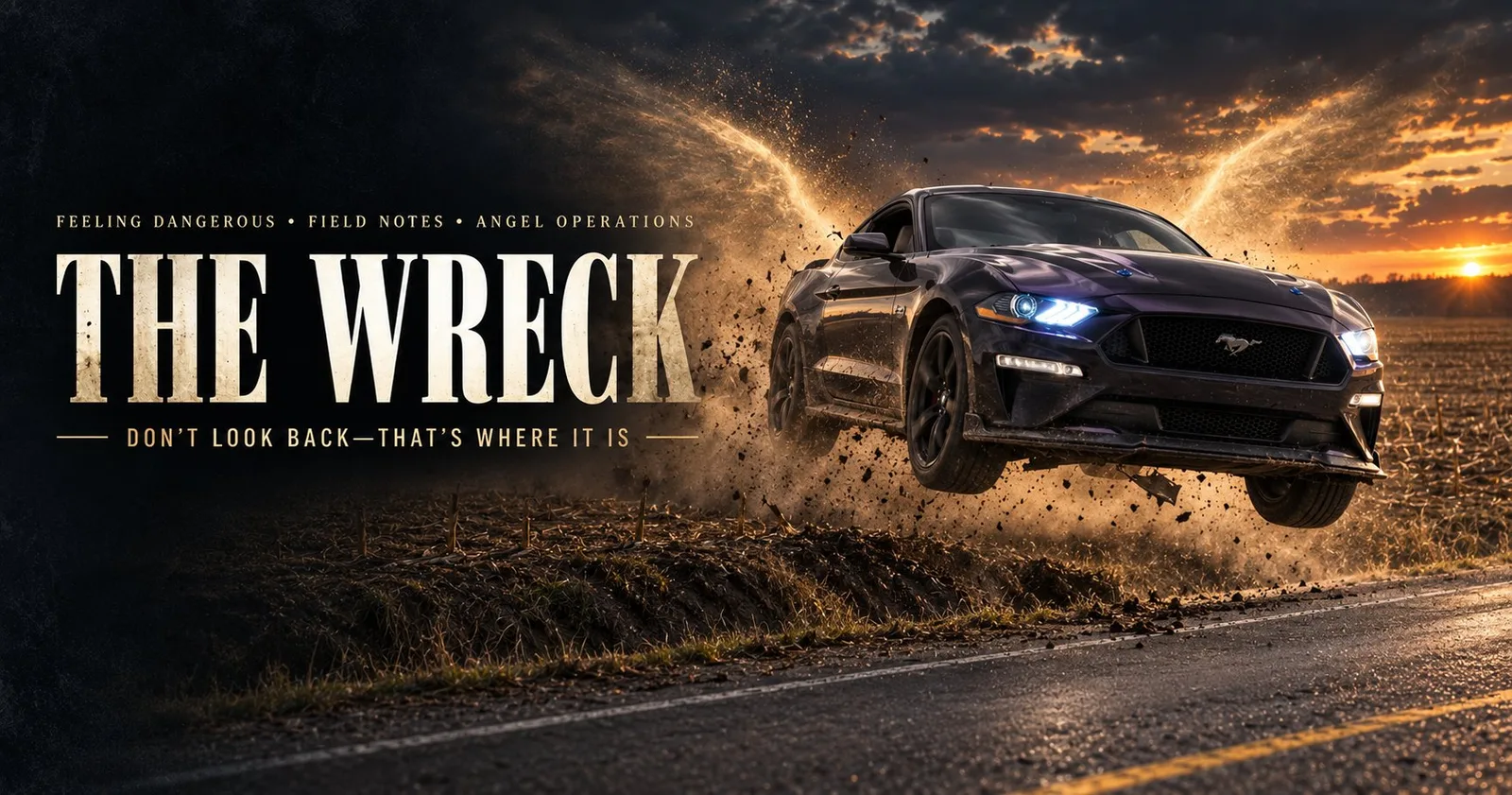
The Wreck
I believed speed could straighten almost anything until a cornfield taught me that protection is not permission to keep creating danger.
AI-generated narration · Adjust playback speed in the player.
My dad used to say:
“Don’t look back. That’s where the wreck is at.”
He said it often enough that the sentence worked its way into me before I was old enough to understand how many meanings it could carry.
I remember hearing it around the ranch... specifically activities including trailers. If a trailer began moving around behind the truck, his instruction was to keep your eyes forward.
Do not panic.
Do not stare backward and let fear begin steering the vehicle. Hold your line, focus on where you are going, and respond to what is happening in front of you.
I heard it around team roping too.
For those who did not grow up around rodeo, team roping has a header and a heeler. The header ropes the steer’s head. The heeler ropes the back legs. The fastest clean time wins.
My dad has competed as a header at a professional level for years. He has roped at national championships and, later in life, competed and won in senior professional rodeos. He would joke with his heelers that once he had the steer positioned, his job was to drive forward and create the right shot. He could not spend the whole run staring backward to see whether the heeler was ready. Sometimes he had to trust his partner, spur harder, and keep moving.
The phrase also followed him beyond horses and highways.
The past was the past. Another event. Another scar. Another lesson. Another story that could be told around a table someday. He seemed far more interested in what could be done today and what might be possible tomorrow.
Do not stare at the wreck.
Keep moving.
Without realizing it, I inherited that philosophy.
Then I added my own version of horsepower to it.
Built to Go Faster
I have always been fascinated with vehicles that were different, louder, faster, and harder to ignore.
In high school, I built a bright-orange 1972 Chevy Nova. It had a four-speed transmission, a bored-out 383 engine, less weight, and upgraded suspension. The car did not quietly idle. It shook the ground beneath it. Dirt would gather behind the exhaust. The sound announced the car before I arrived.
The orange paint made anonymity impossible.
That was good when I wanted attention and not so good when I broke a law. People knew whose car had passed them. The police knew where the car lived. If they did not catch me on the road, they could meet me at the front door.
In college, my attention moved toward diesel trucks.
I became fascinated with how much power, speed, and torque could be pulled from a Cummins engine. The question was no longer whether a three-quarter-ton truck could move quickly. The question was whether I could make it embarrass a sports car.
Later came other trucks, cars, and SUVs. Danielle and I joked that I changed vehicles the way some people change clothes.
Eventually, that pursuit led me to a McLaren MP4-12C in a custom orange that no longer exists. The car had appeared in magazines and commercials as a Ferrari killer. It had been modified, tested on the Autobahn, and pushed far beyond anything I had previously driven.
It could travel faster than 200 miles per hour.
I knew because passengers looked at the gauges while I kept my eyes ahead. They would announce the number after they found enough breath to speak.
I told myself that focus made me safe.
I believed the vehicle settled as it accelerated.
I believed experience made me capable. I believed hesitation was more dangerous than commitment. I believed looking forward could compensate for almost anything happening behind me.
There was some truth inside that thinking. Panic can make a dangerous situation worse. Fixation on a mistake can keep a person from responding to what comes next. A driver cannot steer toward a safe opening while staring only at the hazard already passed.
But a partial truth can become a complete lie when it is asked to justify everything.
I had taken a narrow lesson about focus and turned it into a philosophy of speed.
I had taken my dad’s statement about not living in the wreck and used it to avoid asking why I kept creating the conditions for one.
Loki
When we moved to Texas, the amount of driving changed immediately.
In Chicago, I could spend an hour in traffic and travel only a few blocks, but within a relatively short radius I had access to millions of people and countless businesses. In Texas, I could drive an hour and a half without traffic to see one client, then drive another hour and a half to reach the next.
The miles multiplied.
So did the time behind the wheel.
I used that reality to rationalize a questionable decision.
If I was going to drive that much, I thought, it might as well be fun.
Actually, it might as well be fast and fun.
I traded one of the newer SUVs that had moved with us from Chicago for a highly modified Mustang. It was a manual-transmission race car with substantial engine, transmission, and suspension work. The paint was a dark metallic purple. The interior was white. The color code was called Mischievous Purple, so I named the car Loki.
It fit.
The car was fast, loud, temperamental, and impossible to ignore.
My friend Tom called it the Batmobile because he imagined flames shooting out of the exhaust as I drove away. It was loud enough to wake the neighborhood when I left around six in the morning. Clients could hear me coming before I reached their building.
The car announced my arrival minutes before I appeared.
Loki made long drives entertaining.
It also amplified every tendency I had spent years developing.
I liked speed.
I liked power.
I liked having something few other people had.
I liked believing I could control machinery that demanded respect.
And when the Mustang became unstable, the same old instinct surfaced: do not panic, do not look back, and keep moving forward.
If it got squirrely, I believed more commitment could straighten it.
That belief worked just often enough to become dangerous.
Don’t Drive Faster Than James Can Fly
A few weeks before the cornfield, I woke in the middle of the night and saw what I believe was a warrior angel standing in our bedroom.
Duncan, one of our German Shepherds, was already awake and staring at the same place. I later came to call the angel James after a series of events directed me to James 1:22: be a doer of the Word, not merely a hearer.
I told that encounter in another Field Note, His Name Was James.
As I shared the story with family, friends, and clients, a line started following me:
“Don’t drive faster than James can fly.”
It was funny. It was memorable. It was also more revealing than I understood at the time.
The joke assumed protection while leaving my behavior untouched. It allowed me to treat an experience of grace as though it had expanded my margin for recklessness.
That is not what the encounter meant.
James 1:22 was not a promise that heaven would clean up every mess I created. It was a command to obey. The presence of protection did not remove the responsibility to exercise wisdom.
Scripture holds both truths together.
Psalm 91 says God commands His angels concerning His people. Then, during Jesus’ temptation, the devil quotes that very promise while urging Jesus to throw Himself from the temple. Jesus refuses. He answers that we must not put God to the test.
Protection is real. So is responsibility.
Trusting God is not the same as manufacturing danger and demanding that He prove Himself by rescuing me.
I understand that more clearly now.
At the time, I was still learning it at full throttle.
The Car That Kept Moving
One morning, while driving across Texas to meet a client, I realized I had made a basic mistake.
I was out of gas.
The gauge was empty, the indicators were flashing, and Loki had begun to sputter. I was in the middle of nowhere with no gas station nearby and approximately twenty more minutes to travel.
An engine producing more than 800 horsepower does not sip fuel. It consumes it. I used to joke that the Mustang did not measure miles per gallon. It measured gallons per mile.
Now the tank was empty, I was late, and there was nothing visible I could do to change either reality.
So I prayed.
I surrendered the outcome. I stopped staring at the gauge and focused on the road.
My mind went to the widow’s oil in 2 Kings 4... the small amount that continued pouring until there were no empty vessels left to fill. For approximately twenty minutes, the Mustang kept moving.
The ride felt almost effortless, as though the car were being pushed. Somehow, it reached fuel when I believed it should not have been able to make it.
I cannot offer a mechanical explanation with certainty. I can only tell the story as I experienced it. The engine had sputtered. The fuel was gone. The distance remained. I prayed, kept moving, and arrived.
I believed James had helped push the car.
But even that experience contained a lesson I was slow to receive.
The miracle was not permission to remain careless.
Provision met me inside a preventable problem.
Grace filled the distance I had failed to prepare for.
The right response should have been gratitude followed by greater responsibility.
Instead, a person can survive something and quietly become more confident in the behavior that created the need for rescue.
That is one of the most dangerous ways to misunderstand mercy.
The Cornfield
A few weeks later, I left an on-site client meeting earlier than expected and headed home.
This time, I had gas. What I lacked was patience.
I was traveling on an older Farm-to-Market road in Texas. Cow pastures lined one side. A harvested cornfield sat on the other. The road had two lanes with faded center markings. Sections had recently been scarified in preparation for resurfacing, leaving the pavement rougher and more slippery than I realized.
I also did not fully understand how worn the Mustang’s rear tires had become. Nearly a thousand horsepower had been eating the tread faster than my attention was measuring it.
The road was compromised.
The tires were compromised.
My patience was compromised.
Then I put all of it under more power.
I came up behind four vehicles led by a minivan traveling more slowly than I wanted to go. When the center line permitted passing, I accelerated and began moving around all four.
As I approached the front, another vehicle appeared.
I was running out of road.
I downshifted and pressed the accelerator, trying to complete the pass. The rear tires broke loose. The back of the Mustang began coming around, and suddenly I was no longer passing cars in a straight line.
I was sliding sideways through traffic at nearly 130 MPH.
People talk about time slowing during life-threatening moments. That is exactly what happened. Movements became exaggerated. Details sharpened. The world narrowed into a tunnel. Instinct took over before thought could form a complete sentence.
The Mustang swung until I was perpendicular to the front of minivan.
I looked through my passenger window and saw the Toyota emblem on its hood.
Then the old training fired:
Do not look back.
Commit.
Move forward.
I accelerated.
The Mustang shot through the ditch and into the harvested cornfield.
Forward was no longer on a paved road.
The field was dirt and mud. The car sat low on a stiff performance suspension. I believed that if I stopped, it would bury itself and require a tractor to pull it out. So I kept moving and turned back toward the road.
The tires caught a dry patch, and the car overcorrected. I came back onto the pavement, hit another change in traction with the wheels turned, and was thrown back into the field again.
By then, parts were already being ripped from the car. The body kit was breaking. Panels beneath the vehicle were disappearing. The air-conditioning belt was gone. The throttle cable was sticking. The suspension was taking hits it had never been designed to absorb.
I did not know those details yet.
I only knew that I was still moving.
On the second return from the cornfield, I anticipated the transition. I straightened the wheel and timed the movement as the tires came back onto the pavement.
The Mustang landed square.
For one strange second, it almost looked planned.
It was not.
I had passed four vehicles, spun sideways through traffic, crossed a ditch, entered a field, returned to the road, been thrown back into the field, and somehow landed on the pavement without hitting another vehicle.
No one was injured.
No one was struck.
The Mustang was damaged, but I was alive.
There were culverts, poles, traffic, uneven ground, and countless ways for that sequence to end differently. It could have rolled. The minivan could have hit me broadside. I could have entered the path of an oncoming vehicle. Someone who had nothing to do with my impatience could have paid for it.
I cannot prove what happened in the unseen.
I can only tell you what I believe.
I believe James was there.
I believe angelic protection surrounded a situation my own choices had made dangerous.
And I believe the mercy was far greater than I deserved.
The Car Broke. I Did Not.
Loki was not protected from the consequences.
The exterior pieces, bumpers, wheel-well covers, and aerodynamic panels underneath had been torn away or damaged. The car was scratched. The suspension needed work. Belts were missing. The power steering was affected. The machine that had made me feel powerful looked like it had been dragged through exactly what I had driven it through.
But I was alive.
So were the people in the other vehicles.
That distinction matters.
For years, I might have told the story mainly as evidence that I could drive. I might have emphasized the corrections, the timing, the way the car landed, or the fact that no one was hit.
Age, fatherhood, confession, and surrender have changed the story.
My ability may have mattered inside the moment, but my ability did not make the decision wise. Skill does not erase recklessness. Surviving a bad choice does not turn it into a good one.
I do not believe God preserved me so I could continue proving how close I could get to destruction without entering it.
I believe He preserved an unfinished assignment.
The car broke.
The story did not.
The mercy was not that Loki escaped without a scratch. The mercy was that the damage stopped with something replaceable.
Not Every Vehicle Has Wheels
You may never have driven an 800-horsepower Mustang. You may not care about modified engines, loud exhaust, or how quickly a car can cover an empty stretch of road.
But you may still recognize the vehicle.
Sometimes the vehicle is a business.
Sometimes it is a ministry, a church, a community organization, a relationship, a fitness goal, a public platform, or an endless list of people who need something from you.
The vehicle is whatever allows you to keep moving so quickly that you never have to sit still long enough to examine what is happening inside you.
My Mustang ran on gasoline, horsepower, and adrenaline.
Your vehicle may run on revenue, recognition, responsibility, applause, achievement, affection, or the feeling of being needed. It may look productive, generous, successful, or even spiritual from the outside.
Everyone may celebrate how quickly you are moving without realizing that the speed is slowly separating you from the people and principles meant to keep you grounded.
Work can become a vehicle when you keep accelerating because slowing down would force you to confront what is happening at home. You tell yourself that you are providing, building, or answering your calling, but your spouse and children receive whatever energy remains after the business has consumed your best.
Church can become a vehicle when serving God replaces spending time with God. You volunteer for another responsibility, join another team, attend another event, or accept another title because being useful feels safer than being still. Ministry can become the place where everyone sees your gift while nobody—including you—examines your heart.
Community involvement can become a vehicle when you become the solution to everyone else’s problems so you never have to face your own. Being needed creates momentum. Momentum creates identity. Eventually, you cannot slow down because you are afraid everything will fall apart without you.
Relationships can become vehicles too. Some people move from one relationship to another before grief, rejection, loneliness, or insecurity can catch them. Others accelerate a new connection before trust, character, and wisdom have had time to develop. Speed creates the illusion of intimacy, but arriving somewhere quickly does not mean you arrived there safely.
The warning lights look different in every vehicle.
Mine included an empty fuel gauge, worn tires, excessive speed, and a road surface I had not properly considered.
Yours may look like exhaustion, secrecy, resentment, neglected health, compromised integrity, spiritual numbness, or a family that keeps asking you to be present. It may be the quiet voice telling you to slow down while your ambition keeps reaching for another gear.
We often ignore those warnings because the vehicle is still moving.
The business is still producing.
The church still appreciates us.
The community still calls.
The relationship still feels exciting.
The audience still applauds.
As long as forward motion continues, we assume everything must be working. But movement and progress are not always the same thing. A vehicle can be traveling incredibly fast while heading directly toward a wreck.
That was one of my deepest problems: whenever something began to feel unstable, my instinct was to accelerate. I believed more power, more focus, and more commitment could straighten almost anything.
Many people live the same way without ever touching a race car.
When the business begins struggling, they work more hours.
When the marriage becomes distant, they spend more time outside the home.
When their faith feels empty, they add more religious activity.
When their body begins breaking down, they increase the supplements, workouts, or stimulants.
When a relationship becomes uncertain, they demand a faster commitment.
When their inner world becomes painful, they create more noise.
They feel the vehicle beginning to move sideways, so they press the accelerator harder.
But not everything becomes stable through additional speed.
Some situations straighten only when we slow down, tell the truth, ask for help, repair what has been neglected, and surrender the need to control the outcome.
Your cornfield may not be a harvested field beside a Texas Farm-to-Market road.
It may be a panic attack in an office, a spouse saying they cannot continue living this way, a child asking why you are never home, an ethical boundary you never imagined crossing, or a doctor explaining what years of pressure have done to your body.
It may not arrive as one dramatic crash. Some wrecks happen quietly, one neglected relationship, broken promise, compromised value, or exhausted morning at a time.
The point is not that ambition is wrong. Business is not the enemy. Neither are church, service, community, relationships, fitness, leadership, or achievement. A vehicle can carry you toward an assignment. It can also become the place where you hide from one.
The question is not simply, “How fast am I moving?”
The deeper question is, “What is driving me—and what am I refusing to see at this speed?”
Maybe your vehicle is already shaking. Maybe the warning lights have been flashing for months. Maybe people who love you have been asking you to slow down, but you have treated their concern like resistance to your calling.
You do not have to wait for the cornfield.
God’s mercy does not always arrive by carrying us through a spectacular wreck. Sometimes mercy is the warning that gives us time to exit. Sometimes protection looks like losing an opportunity, hearing a difficult truth, admitting we need help, or finally removing our foot from the accelerator.
The testimony does not have to be that you survived the collision.
It can be that wisdom reached you before the wreck.
The Rearview Mirror and the Windshield
There is a reason a vehicle has both a rearview mirror and a windshield.
The windshield is larger because most of the journey is ahead.
The mirror still matters because wisdom sometimes requires knowing what is behind you.
My dad’s statement was right in a way I did not understand as a boy: I cannot move safely into the future if I am hypnotized by the wreckage behind me.
Regret can become its own collision. Shame can keep replaying a moment long after the road has changed. Nostalgia can make a person reach backward for something God already told him to leave.
In Genesis 19, angels warned Lot and his family to flee and not look back. Lot’s wife looked back and became a pillar of salt. Scripture does not give us a complete psychological explanation for her decision, so I do not need to invent one. What it gives us is the warning. Jesus later said simply, “Remember Lot’s wife.”
There are backward glances that reveal a heart unwilling to leave.
Paul describes another posture in Philippians 3. He acknowledges that he has not arrived, then says he forgets what is behind, strains toward what is ahead, and presses toward the goal.
That does not mean Paul developed amnesia. He remembered enough of his past to testify about grace. Forgetting meant the past no longer held the steering wheel.
The Bible does not command us to erase the past.
It teaches us not to live there.
Romans 15 says what was written in the past was preserved to teach us. Psalm 77 says to remember the deeds and miracles of the Lord.
So I look back differently now.
I do not look back to relive the speed.
I do not look back to rebuild the identity.
I do not look back to convince myself that I was invincible.
I look back to see what I missed while I was racing forward.
I look back to identify the mercy.
I look back to honor the people who could have been hurt.
I look back to learn the lesson.
Then I face forward and live differently.
The past is a schoolroom. It cannot become my residence.
The rearview mirror is a tool. It cannot become my windshield.
What My Children Must Inherit
This is where the story moves from Angel Operations into Arrows.
My children do not need to inherit my need for speed, my appetite for attention, or my belief that danger will always blink first.
They do not need the lesson to be: Dad survived, so you probably will too.
They need the truer lesson:
Do not make grace repeatedly clean up what wisdom could have prevented.
As a father, I want my children to understand courage without confusing it with recklessness. I want them willing to move when God says move, but also willing to stop when wisdom says stop. I want them to take meaningful risks for their calling without manufacturing danger to prove they are protected.
Faith does not require bald tires.
Purpose does not require an 800-horsepower mistake.
Angelic protection does not make preparation unnecessary.
The same father who tells his children not to be trapped by yesterday must also teach them to inspect what yesterday revealed.
I can celebrate that heaven intervened while confessing that the danger was largely preventable. Those truths do not compete. Together, they form a testimony worth passing down.
The story is not, “Look what your dad got away with.”
The story is, “Look how much mercy God extended—and look how seriously we should take the life that mercy preserved.”
My children are arrows.
Danielle and I are responsible for helping prepare, aim, and release them. Part of that preparation is telling the truth about the targets I chased that were never worth hitting.
The next generation should not have to repeat every collision to inherit the lesson.
If I tell the story honestly, perhaps they can carry the wisdom without carrying the wreckage.
A Season Without My Own Vehicle
A few months after the Mustang was repaired, I sold it.
I did not immediately become detached from vehicles. That process will take years, more stories, and more surrender.
But selling Loki was a step.
For the first time since I was sixteen, I have gone nearly four months without owning a vehicle of my own.
I still have transportation. I can drive Danielle’s vehicle when I need to go somewhere. This is not a story about being stranded or unable to function.
It is a story about no longer needing a possession to prove an identity.
For much of my life, a vehicle represented freedom, speed, noise, achievement, uniqueness, and control. It told people something about me before I stepped out. It could announce that I had arrived even when I was still a mile away.
Now I am in a season of slowing down.
I am discovering that freedom does not have to sound like an exhaust system.
It can sound like silence.
It can look like borrowing my wife’s vehicle.
It can feel like having nothing to prove at the stoplight.
It can mean leaving early enough that I do not need to turn impatience into horsepower.
It can mean arriving as a husband, father, adviser, and servant instead of making a machine introduce me first.
For years, I believed going faster gave me more freedom.
Today, I am learning that freedom may be the ability to slow down without feeling smaller.
Remember the Rescue, Not the Rush
I still hear my dad’s voice: “Don’t look back. That’s where the wreck is at.”
I understand it differently now.
Do not look back with longing for the life God pulled you out of.
Do not look back and let shame convince you that the wreck is your identity.
Do not look back so long that you miss the new road opening in front of you.
But do remember.
Remember what happened.
Remember who could have been hurt.
Remember the consequences.
Remember the mercy.
Remember the God who preserved you before you understood what the preserved life would be for.
There is a difference between dwelling on the past and collecting its wisdom.
Dwelling asks me to move back into the wreck.
Wisdom asks me to stop rebuilding the same road toward it.
I believe James was present in that cornfield.
I believe God’s protection operated in ways I could not see.
I also believe heaven’s help is not a substitute for earthly obedience.
The angelic operation did not end when the Mustang landed back on the road. Perhaps the deeper operation continued for years as God loosened my grip on the identity, pride, noise, speed, and possessions wrapped around the car.
The rescue was immediate.
The transformation has been slower.
That may be the larger miracle.
God did not merely get me out of the cornfield.
He began getting the cornfield out of me.
Focus Forward
I do not know everything that happened in the unseen that day.
I know the Mustang should have hit something.
I know another person could have paid for my decision.
I know the car was damaged and human bodies were not.
I know I was given another day.
And I know another day is not something to spend carelessly.
The point of protection is not that I become more impressed with what I survived.
The point is that I become more faithful with the life that survived it.
So I will keep looking forward.
Not because the wreck does not matter.
Because the wreck taught me where not to live.
I will remember the past without surrendering the future to it. I will tell the story without worshiping the speed. I will honor the protection without using it as permission. I will teach my children that courage and wisdom belong together.
And when I am tempted to believe I need another loud machine, another rush, another possession, or another impossible escape to feel alive, I will remember the Mustang sitting broken after the cornfield.
The car carried the scars.
I carried the assignment forward.
Do not look back to admire the wreck.
Look back long enough to recognize the mercy.... then live like the life that remains was preserved for a reason.
A Short Prayer
Father, thank You for the protection I recognized and every act of mercy I never saw.
Forgive me for the times I treated rescue as permission to remain reckless or trusted my ability more than Your wisdom. Teach me to remember the past without living in it.
Show me the lessons I need to carry and the identities I need to leave behind. Help me honor the life You preserved by living it responsibly, faithfully, and fully present.
Give me courage that does not require carelessness, confidence that does not depend on possessions, and wisdom worthy of passing to my children.
Let every story of protection point back to You, and let every additional day become an act of obedience.
In Jesus’ name, amen.
Join the conversation
Comments
Be the first to leave a comment.