Field Notes · September 17, 2026 · 25 min read
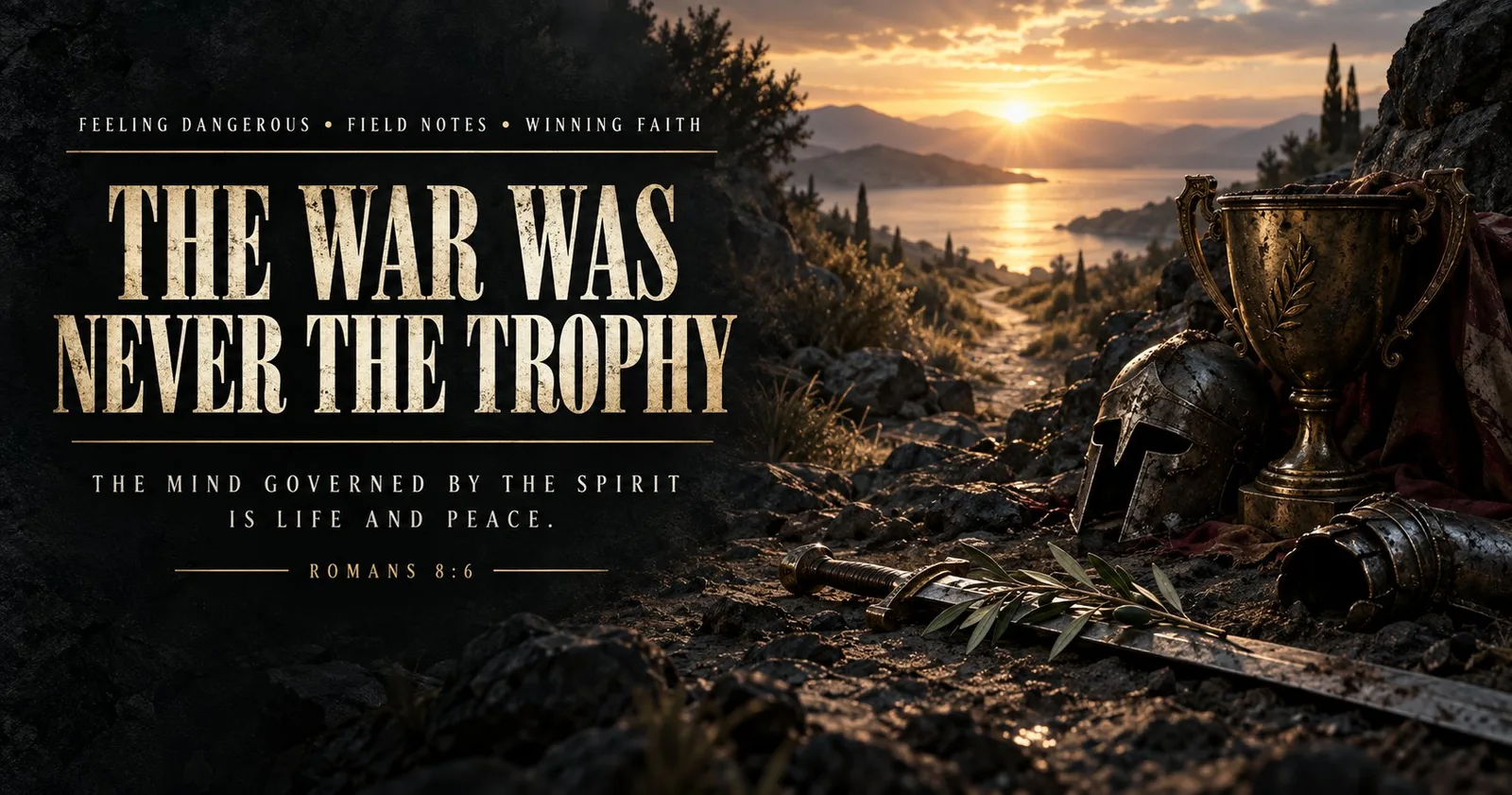
The War Was Never the Trophy
The war was never the trophy. The trophy was becoming the kind of man who could walk through war and still bring life and peace home with him.
AI-generated narration · Adjust playback speed in the player.
Peace Was for Wimps
For years, I thought peace was a weak word.
Honestly, I would have categorized it as a beta-male word.
Peace sounded soft. Passive. Like something reserved for people who did not have the stomach for pressure, competition, confrontation, or war.
I did not want peace.
I wanted momentum.
I wanted intensity.
I wanted to win.
In my head, every day was war. There were businesses to build, problems to solve, people to protect, competitors to beat, battles to survive, and territory to take. Peace may have been a nice theory, but it did not seem useful in the world I had chosen to live in.
I had confused peace with surrendering the mission.
I did not understand that peace could be the very thing that allowed me to complete it.
I thought the warrior was the person willing to fight the longest.
I am beginning to understand that the stronger warrior may be the one who can go through the fight without allowing the fight to take control of his mind.
Knowledge and Wisdom
Yesterday, someone who has been a friend for a while now... sent me a picture of a handwritten message:
Knowledge comes from learning. Wisdom comes from experiences understood.
I have not been able to stop thinking about it. Knowledge can tell me what peace means.
Knowledge can show me the definition, the Scripture, the Greek word, and the theological explanation.
Knowledge can tell me to breathe, pray, forgive, slow down, and trust God.
But wisdom requires me to look back at the experiences I survived and finally understand what they were trying to teach me.
For most of my life, I knew the word peace without understanding the experience.
I knew how to prepare for conflict. I knew how to increase pressure.
I knew how to become more aggressive when circumstances became more difficult.
I knew how to turn hurt into fuel, fear into motion, and anger into temporary strength.
I did not know how to be still inside myself while the world around me remained loud.
How can you embody something you have never learned to recognize?
How can you bring peace into your marriage if peace has never governed your own mind?
How can you bring peace into your business if every unexpected problem feels like a declaration of war?
How can you bring peace into your family if strength has always meant control?
How can you carry peace into your community if disagreement immediately becomes an enemy that must be defeated?
You cannot consistently give what you refuse to receive.
You cannot lead people somewhere you are unwilling to go.
Who Is Governing Your Mind?
Romans 8:6 says:
“The mind governed by the flesh is death, but the mind governed by the Spirit is life and peace.”
The word that stood out to me was not flesh.
It was not death.
It was not even peace.
It was governed.
Something is governing the mind.
Something is setting its direction, interpreting the circumstances, assigning meaning to the pressure, and deciding what should happen next.
In Romans 8, the flesh is not a declaration that the physical body, ambition, strength, business, or human emotion is automatically evil. It describes a life oriented away from God... a mindset ruled by self, fear, appetite, pride, and the belief that everything depends on human control.
That mind produces death long before a heart stops beating.
It kills peace.
It kills trust.
It kills intimacy.
It kills perspective.
It can slowly kill a business, a marriage, a family, a friendship, or a calling while convincing the person in control that he is fighting to save it.
The mind governed by the Spirit produces something different:
Life and peace.
Not life after every problem disappears.
Not peace after every enemy apologizes.
Not calm after the bank account, court case, marriage, health report, or business result goes the way we wanted.
Life and peace while we are still walking through what we cannot control.
That changes everything.
The Movie I Heard More Than I Watched
Our kids have watched a few movies dozens of times.
We used to have vehicles with Blu-ray players in them. For anyone born after 2010, that means we inserted an actual disc into the vehicle and the movie played without needing a cloud, a login, a subscription, or a Wi-Fi signal.
On long trips, the kids would watch a movie while I locked in on the road.
That meant I listened to some movies far more than I watched them.
One of those movies was Kung Fu Panda 2. To this day my son Titus quotes the movie and would place it at the top of his list.
At the center of the story are two characters shaped by painful histories.
Lord Shen becomes obsessed with controlling the future because he is still ruled by the past. He builds larger weapons, increases force, and attempts to destroy anything that threatens the ending he has chosen for himself.
Po also carries a painful past. For much of the story, that history disorients him. He cannot fight clearly because part of him is still fighting what happened to him.
The difference is not that one has pain and the other does not.
The difference is what governs them.
Shen allows fear, control, and the past to govern him.
Po faces the truth, grieves what happened, accepts what cannot be changed, and chooses who he will become now.
That is when he finds inner peace.
It does not remove the battle.
The ships are still there. His friends are still in danger. The cannons still fire.
The circumstances do not become peaceful just because Po becomes peaceful.
But once the war inside him becomes still, the chaos outside him loses the ability to control him.
He can finally see clearly enough to respond instead of react.
He stops trying to meet every destructive force with greater destructive force. He receives the cannonball’s momentum, redirects it, and sends it away from its intended target.
That scene stayed with me because it exposed something I had misunderstood for years:
Peace is not the absence of power. Peace is power that is no longer governed by panic.
I Tried to Punch Every Cannonball
My instinct was rarely to redirect pressure. My instinct was to hit it harder.
If a business problem came at me, I worked more hours.
If someone questioned me, I built a stronger argument.
If a relationship became tense, I defended my intent before understanding my impact.
If fear whispered that I might lose, I increased the size of the bet.
If the past tried to catch me, I moved faster toward the future.
If a cannonball was coming, I clenched my fist and tried to prove I could punch it out of the sky. Every once in a while, that worked just well enough to convince me it was wisdom.
Sometimes intensity does create a short-term result.
Sometimes aggression pushes a project across the line.
Sometimes force ends a conversation, wins a negotiation, or gets people moving.
Sometimes adrenaline makes us stronger for a moment.
But a temporary result does not prove the governing spirit was healthy.
You can win the argument and injure the marriage.
You can save the quarter and destroy the culture.
You can control the child and lose the relationship.
You can dominate the room and still be mastered by what is happening inside you.
You can call it leadership while fear is actually making the decisions.
That is the dangerous deception of a flesh governed mind: it can produce visible motion while creating invisible death.
The Battle Beneath Every Battlefield
Romans 8:6 reaches much further than a personal feeling of calm. It exposes the governing force beneath the choices we make in every area of life.
In Business
A mind governed by the flesh sees every downturn as a threat to identity. It panics, hides information, cuts ethical corners, obsesses over competitors, and treats employees as tools that must absorb the leader’s anxiety.
A mind governed by the Spirit can still make difficult decisions. It can reduce expenses, confront poor performance, close an unprofitable division, or take a disciplined risk. Peace does not make a leader passive.
Peace helps the leader tell the truth without being governed by terror.
It creates enough internal stillness to choose stewardship over panic, integrity over appearance, and long-term faithfulness over immediate relief.
In Marriage
A mind governed by the flesh keeps a scorecard.
It remembers every offense when an argument begins. It withholds affection, demands to be understood first, and treats apology like losing.
A mind governed by the Spirit can tell the truth without trying to wound. It can listen without preparing the next counterattack. It can forgive without pretending damage did not happen, and it can establish boundaries without allowing hatred to write them.
Peace is not avoiding the conversation.
Peace is refusing to let fear and pride control the conversation.
In Family
A mind governed by the flesh confuses parenting with control.
It reacts to a child’s mistake as if the mistake is a public review of the parent. It compares, pressures, explodes, or withdraws.
A mind governed by the Spirit can bring both grace and boundaries. It can correct without crushing identity. It can apologize when the parent is wrong. It can recognize that children are arrows to be guided and released... not trophies to be displayed or projects to be controlled.
In Community
A mind governed by the flesh needs a team and an enemy. It gossips, divides, hoards influence, and uses disagreement to justify contempt.
A mind governed by the Spirit does not surrender conviction, but it refuses to surrender love. It serves the vulnerable, welcomes the outsider, lowers the temperature, and carries light into places where fear has taught everyone to choose a side.
The battlefield changes. The question does not:
Who is governing my mind here?
The Comparison Trap
Recently, people close enough to see some of the battles in my life have said versions of the same thing:
Life could be worse. I could be battling what Waldon is battling.
I understand what they mean.
But I do not want my story to become the measuring stick that invalidates someone else’s pain. We are all battling something.
For one person, it is a marriage that looks normal in public and feels empty at home.
For another, it is a business that appears successful but is one payroll away from collapse.
For another, it is addiction, depression, grief, shame, loneliness, parenthood, health, faith, or the private fear that everyone would leave if they knew the entire truth.
Pain does not become unreal because someone else has more of it.
You do not need to win the suffering competition before you are allowed to ask God for peace.
And you should never wish for another person’s life without knowing what they had to survive, surrender, repair, and learn to carry.
What looks like overnight success may be the visible chapter of a twenty-year war.
What looks like supernatural calm may be the fruit of thousands of moments when someone had to take a thought captive and choose not to let fear govern it.
Peace is not a personality some people are born with. It is fruit grown through surrender to the Spirit.
The Past Is a Schoolroom, Not a Residence
For years, I believed the fastest way to defeat the past was to outrun it.
Keep building. Keep moving. Keep solving. Keep creating a future so large that no one, including me, would have time to examine where I had been.
But speed does not heal history.
It only changes the scenery around an unhealed person.
There is a difference between remembering the past and living in it.
The Bible repeatedly tells God’s people to remember His faithfulness. Remembering can create wisdom, gratitude, humility, and hope.
Dwelling is different. Dwelling turns regret into an address.
It sets up camp in what cannot be changed. It replays the same moment until yesterday begins governing today.
Paul writes about forgetting what is behind and pressing toward what is ahead. That does not require pretending the past never happened. Paul knew exactly what he had done and who had been harmed by it.
He simply refused to let his worst actions or greatest achievements become the final authority over his present obedience.
That is the difference between denial and redemption.
Denial says it did not matter.
Redemption says it mattered, it created real consequences, and God can still use the truth of it to produce wisdom, repair, humility, and life.
I do not believe every painful event was something God desired.
Some pain entered my life through the choices of others.
Some entered through a broken world.
Some came directly from my own decisions.
But I believe God can redeem what I finally surrender to Him.
Experience alone does not guarantee wisdom.
Unexamined experience can become a repeated pattern.
Wisdom comes when the experience is understood, the lie is exposed, the responsibility is accepted, and the lesson changes how I walk forward.
The Weight Truth Has Been Removing
Writing these Field Notes has become part of that process for me.
When I started sharing stories from my life, I knew there would be a cost. I was making public the decisions, failures, addictions, fears, wounds, wrong turns, and lessons that would have been much easier to keep buried.
There is always a risk in telling the truth.
People may misunderstand it.
They may judge a chapter without understanding the entire book.
They may use an old version of you to argue against the person God is shaping you into today.
There are also stories that require wisdom before they are shared. Transparency does not give me permission to expose someone else, violate confidentiality, interfere with accountability, or publish details that belong in a private conversation. Truth still needs stewardship.
But I am learning that secrecy and stewardship are not the same thing.
Stewardship protects what should remain protected.
Secrecy protects the false image I am afraid to lose.
For years, I carried the weight of managing different versions of my story. There was the part people could see, the part only a few people knew, the part Danielle experienced, the part I tried to forget, and the part I had never fully admitted to myself.
Carrying all of those versions was exhausting.
Every hidden chapter required energy to guard it.
Every unspoken truth added weight.
Every lesson I refused to understand remained attached to me as shame instead of becoming wisdom I could carry forward.
Something has changed as I have written these stories, made them public, and told the truth about the life I have lived.
I have been walking taller. I have been sleeping better. I feel lighter.
Not because the past changed.
Not because transparency erased consequences or made every decision acceptable.
Not because everyone agreed with my version of events.
I feel lighter because I am no longer using all of my strength to keep carrying what I have surrendered to God.
Jesus invited the weary and burdened to come to Him. Peter wrote that we can cast our anxiety on God because He cares for us. I spent years reading invitations like those while still trying to prove how much weight I could carry alone.
These Field Notes have become one way of opening my hands.
I bring God the memory. I bring Him the regret. I bring Him the consequence, the lesson, the person I hurt, the person who hurt me, and the version of myself I no longer want to defend.
Then I ask Him to show me the wisdom hidden inside the experience.
When the wisdom becomes clear, the memory stops being dead weight. It becomes something redeemed—something that can help another person recognize the same trap before it closes around them.
That does not make confession a performance.
It does not mean public exposure is required for every private wound. Some truth belongs with God, a spouse, a pastor, a counselor, an attorney, or the person directly affected. The goal is not to tell everyone everything.
The goal is to stop hiding from truth anywhere.
Transparency has not changed the life I lived. It has changed how much of that life I am still trying to carry alone.
I am moving lighter and freer because the lessons are becoming wisdom instead of remaining shame.
I am discovering that inner peace is not amnesia. It is not deleting the evidence or rewriting history until I look innocent.
Inner peace is being fully known by God, accepting responsibility for what is mine, receiving the grace Christ made possible, and trusting Him to carry what was never mine to control.
The more truth I bring into the light, the less darkness has available to use against me.
The more I surrender, the less energy I spend protecting an image.
The more wisdom I gain from past situations, the more freedom I have to be present in this one.
Maybe that is why I am walking taller.
I am no longer bent beneath the weight of stories I was afraid to tell.
Preparing for War
There is an old Latin line:
Si vis pacem, para bellum. If you want peace, prepare for war.
It is a powerful line.
Preparation matters.
Training matters.
Readiness matters.
You do not protect a family, build a business, pursue a calling, or stand for truth by refusing to develop strength.
But I learned how easily preparation for war can become an addiction to war.
You can become so prepared to fight that you interpret every question as an attack.
You can become so skilled at surviving pressure that you recreate pressure when life becomes quiet.
You can become so identified as the warrior that peace feels like unemployment.
You can pray for rest while building a life that requires constant emergency.
You can defeat every visible opponent and never confront the part of you that needs conflict to feel valuable.
If the mind remains governed by fear, winning one battle only creates the need to find another.
That is not victory.
That is captivity wearing armor.
Peace in the Middle
I used to believe peace came after the battle.
That made sense to me.
Fight first.
Win.
Then rest.
But Romans 8:6 does not describe peace as a retirement benefit for people who finally eliminate every problem.
Peace is the present fruit of a mind governed by the Spirit.
Philippians 4 does not promise that every source of anxiety will disappear before God’s peace arrives. It says to bring the requests to God with thanksgiving, and that His peace will guard the heart and mind in Christ Jesus.
A guard is most useful while a threat still exists.
Isaiah 26 connects perfect peace with a steadfast mind that trusts God.
Jesus tells His disciples that the peace He gives is not the kind the world gives. He says this before their circumstances become easier.
Biblical peace is not the reward for controlling the environment.
It is the result of surrendering the government of the mind.
That means peace can exist in a courtroom before a ruling.
It can exist in a hospital before a diagnosis.
It can exist in a business before the turnaround.
It can exist in a marriage before every wound is repaired.
It can exist in grief without insulting the person who was lost.
It can exist one day away from what looks like failure.
Peace does not always mean the situation is resolved.
Sometimes it means the situation no longer gets to be God.
Peace Cannot Depend on the Circumstance
Your situation may look nothing like mine.
You may not be facing a courtroom, a business crisis, public consequences, or a decision that affects hundreds of people.
Your battle may be happening in a hospital room.
It may be happening in a quiet house after everyone else goes to sleep.
It may be the uncertainty of a marriage, the pressure of providing for a family, the grief of losing someone, the exhaustion of caring for someone, the pull of an addiction, the fear of starting over, or the private realization that the life you built no longer feels like the life God asked you to live.
You may even be living through a season that looks successful from the outside. The numbers are increasing, people are applauding, and new doors keep opening—but inside, you are terrified that one wrong move will expose how little control you actually have.
Circumstances matter.
Pain matters.
Consequences matter.
The people affected by our decisions matter.
But no circumstance disqualifies us from pursuing inner peace, and no situation should be allowed to become the permanent governor of the mind.
If peace depends on the environment finally cooperating, then the environment is in control.
If peace depends on another person changing, then that person has become the gatekeeper of the soul.
If peace depends on receiving one specific outcome, then that outcome has taken a place in us that belongs to God.
I have done this more times than I can count.
I have told myself I would rest when the deal closed, breathe when the pressure passed, trust when the evidence appeared, and feel peace when the final decision went my way.
There was always one more condition.
That is not surrender.
That is a hostage negotiation with God.
It says, I will trust You after You prove that Your plan agrees with mine.
Surrender removes the condition.
It does not mean we stop praying for healing, fighting for restoration, building the business, protecting the family, preparing the case, or taking responsibility for repair.
It does not mean that every possible outcome is equally good or that we become indifferent to what happens.
Surrender means we stop demanding control of the ending before we agree to trust the Author.
It means I can want one outcome deeply while refusing to make my relationship with God dependent upon receiving it.
It means I can work with excellence without believing my effort makes me sovereign.
It means I can face consequences without treating them as proof that God abandoned me.
It means I can celebrate a victory without pretending I created it alone.
It means I can grieve a loss without allowing the loss to define the rest of my life.
This is why finding inner peace and surrendering outcomes cannot remain emergency tools used only when every human option has failed.
They must become a primary focus.
Not because circumstances are unimportant, but because the condition of the person walking through them will shape every decision made inside them.
A peaceful mind can still move quickly.
A surrendered person can still fight courageously.
A Spirit-governed leader can still make a hard decision.
The difference is that urgency no longer gets to impersonate God.
Fear no longer gets the final vote.
The outcome no longer determines whether obedience was worthwhile.
I can be responsible for my obedience without pretending I am responsible for controlling every outcome.
That is not giving up.
That is finally understanding the limits of my assignment.
My responsibility is to listen, obey, tell the truth, make the repair, take the next faithful step, and remain available to God.
The outcome belongs to Him.
When that truth moves from something I say into something I live, peace stops being postponed until tomorrow.
It becomes available here—even in this circumstance, even in this uncertainty, and even before I know how the story ends.
One Day Away From Failure
When you are one day away from failure, the greatest danger may not be the weapon pointed at you.
It may be the civil war inside you.
Fear says to move now, even if the direction is wrong.
Pride says no one can know how uncertain you feel.
Shame says the present crisis proves every accusation you have ever made against yourself.
Control says one more forced outcome will finally create relief.
The flesh-governed mind becomes rigid because it believes it must manufacture salvation.
Rigidity can be deadly on the brink.
When everything depends on one preferred outcome, every interruption feels catastrophic. When identity depends on winning, facts become enemies. When peace depends on control, any person who cannot be controlled becomes a threat.
The Spirit-governed mind can see something the panicked mind cannot:
The next faithful action.
Not the entire path.
Not a guaranteed outcome.
Not a promise that consequences will disappear.
The next faithful action.
Tell the truth.
Make the call.
Ask for help.
Apologize without defending the intent.
Accept the boundary.
Close the door that should never have been opened.
Keep the promise that is yours to keep.
Wait when God has not said move.
Move when fear is the only thing saying no.
Peace creates the clarity to distinguish surrender from avoidance and boldness from panic.
It does not make every decision easy.
It makes the decision less governed by death.
Redirecting the Cannonball
There are attacks that require a response.
There are lies that must be corrected.
There are people who need protection, boundaries that need enforcement, injustices that need confrontation, and assignments that require courage.
Peace does not require pretending the cannonball is not coming.
It changes what happens when it reaches you.
A mind governed by the flesh catches the attack and carries it into the next room.
The boss feels threatened and humiliates the employee.
The employee goes home and speaks harshly to a spouse.
The spouse loses patience with a child.
The child carries the rejection into school.
One cannonball travels through an entire community because no one learned how to redirect it.
A mind governed by the Spirit can interrupt the trajectory.
It can receive a hard truth without turning it into self-hatred.
It can experience another person’s anger without allowing that anger to determine the next response.
It can face a consequence without creating an additional victim.
It can feel fear without handing fear the keys.
It can break the chain.
That is not weakness.
That is dangerous strength.
Darkness understands how to multiply through reaction.
Peace removes its transportation.
The Trophy I Could Not See
I have spent much of my life pursuing visible trophies.
Wins that could be counted.
Numbers that could be measured.
Recognition that could be displayed.
Businesses, revenue, deals, speed, strength, territory, and outcomes.
Some of those pursuits were good. Some were assignments. Some created real value for other people.
Some were simply attempts to prove that I was strong enough, important enough, successful enough, or far enough removed from the person I feared becoming.
Visible trophies can be lost.
Markets change.
Companies close.
Bodies age.
People forget.
Applause moves to the next person.
But wisdom produced through experiences understood cannot be repossessed.
Peace rooted in the Spirit cannot be taken by a headline, a balance sheet, another person’s opinion, or an outcome I cannot control.
That does not mean circumstances no longer matter.
It means circumstances no longer determine who governs me.
Winning faith is not pretending I will receive every result I want.
Winning faith is trusting that obedience remains possible even when the result is still unseen.
It is facing what is true without allowing the truth of the circumstance to replace the truth of God.
It is realizing that the ultimate victory may not be defeating every enemy around me.
It may be refusing to let the enemy occupy my mind.
The Victory I Want to Bring Home
I still believe in preparation.
I still believe in discipline, courage, strength, movement, boundaries, hard conversations, and taking faithful action.
I am not trying to become less dangerous.
I am learning to become dangerous to the right things.
Dangerous to fear.
Dangerous to generational patterns.
Dangerous to panic disguised as leadership.
Dangerous to pride disguised as strength.
Dangerous to the belief that peace is only available after the world finally obeys me.
The strongest version of me is not the one who can stay at war forever.
It is the one who can enter conflict without allowing conflict to enter the throne room of his mind.
It is the husband who can come home from a battle and bring presence instead of transferring pressure.
It is the father who can correct without handing his children the fear he carried all day.
It is the leader who can face brutal facts without making the team pay for his uncertainty.
It is the believer who can stand one day away from failure and still hear the Spirit clearly enough to take the next faithful step.
I spent years believing peace was for people unwilling to fight.
Now I understand that peace may be the clearest evidence that the fight no longer owns the fighter.
The war was never the trophy.
The trophy was becoming the kind of man who could walk through war and still bring life and peace home with him.
Today's Prayer
Father, show me what is governing my mind.
Expose every place where I have called fear wisdom, panic responsibility, control leadership, or aggression strength. Teach me to recognize the difference between Your direction and my reaction.
Give me the courage to face the past without living there, to accept responsibility without becoming imprisoned by shame, and to receive the wisdom hidden inside experiences I have finally allowed You to help me understand.
Govern my mind by Your Spirit.
Bring life where my choices have produced death. Bring peace where I have carried war. Give me clarity for the next faithful action, humility to ask for help, strength to enforce necessary boundaries, and grace to stop passing pain into the people You entrusted to me.
Do not merely end the battles around me. End the agreement with fear inside me.
Make me dangerous to darkness because I carry Your light, Your truth, Your love, and Your peace into every room.
Let my family experience the fruit of a mind surrendered to You.
In Jesus’ name, amen.
Join the conversation
Comments
Be the first to leave a comment.