Field Notes · September 18, 2026 · 18 min read
The Wrong Hand Raise
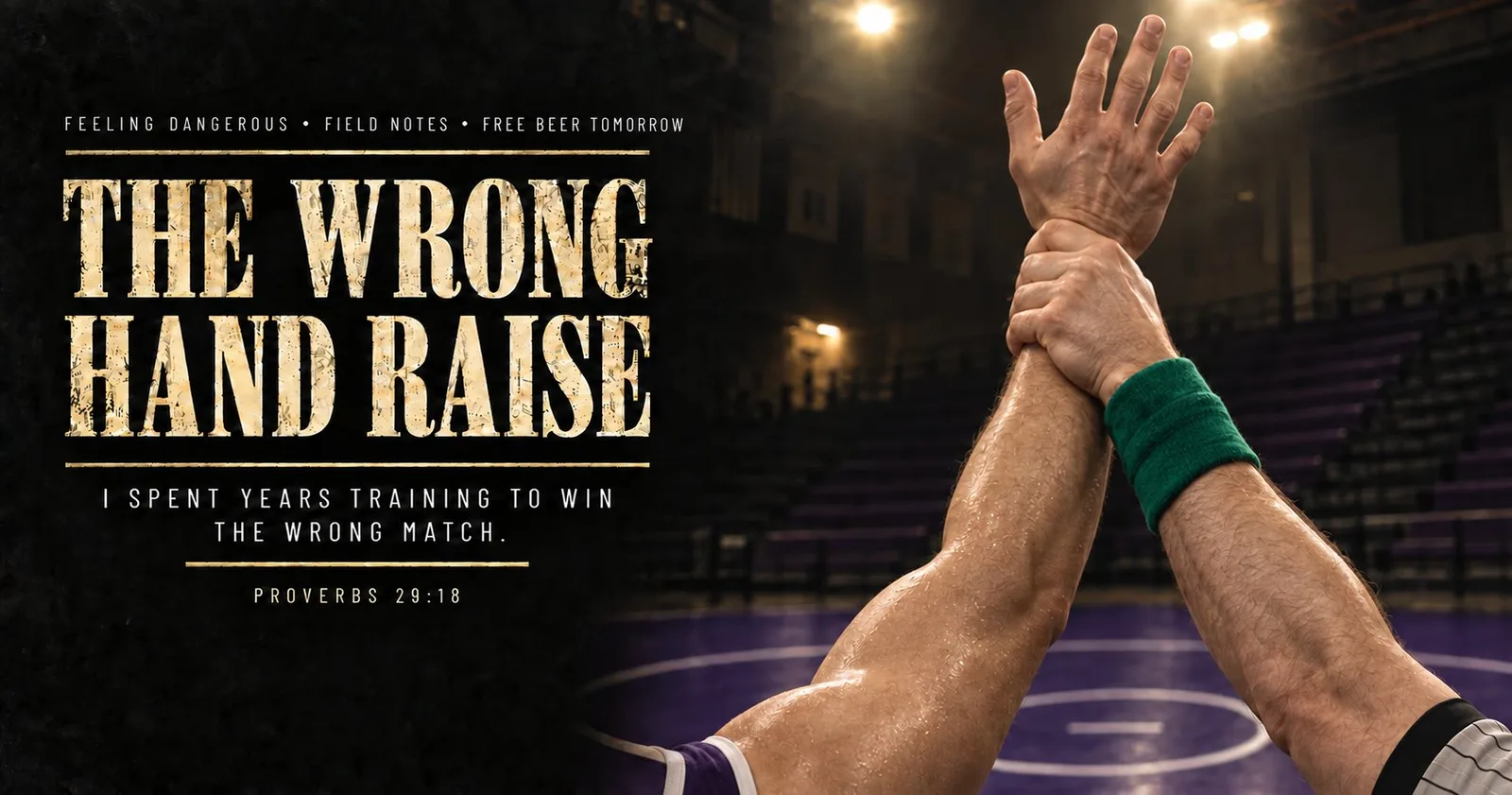
I never lost the ability to visualize victory. I spent years training to win the wrong match—and had to give God the picture.
AI-generated narration · Adjust playback speed in the player.
The Difference Nobody Talks About
There are plenty of obvious differences between football and wrestling.
One requires eleven players on the field. The other eventually leaves you alone in a circle with one opponent.
One hides your face behind a helmet. The other leaves nowhere to hide.
One gives you time between plays. The other can punish a moment of hesitation before you have time to understand what happened.
You can fill in the rest of the blanks and save both of us a lot of time.
But there was one difference that seemed small when I was young and feels enormous to me now.
In both sports, we practiced.
We lifted weights, watched film, studied opponents, drilled movements, ran sequences, and repeated the fundamentals until our bodies could perform them while exhausted.
A mentor once told me that repetition is the mother of skill.
Scripture carries a related principle. Jesus said that whoever can be trusted with very little can also be trusted with much. Before anyone is entrusted with a larger assignment, there is usually a long season of doing small things correctly when no crowd is watching.
Football and wrestling both taught me that.
But wrestling added something football never gave me.
We practiced the ending.
The Last Whistle
Before tournaments and duals, we would end practice by dimming the lights in the wrestling room.
We would spread out across the mat, lie down or sit still, close our eyes, and allow the intensity of physical training to become mental preparation.
The room would become quiet.
The same room that had been filled with shoes dragging across the mat, bodies hitting the floor, coaches yelling, lungs gasping, and the whistle stopping and starting every drill would become still.
Then the coach would begin walking us through the match.
In our minds, we would hear the opening whistle.
We would see the opponent take his stance.
We would rehearse the first shot, the counter, the throw, the escape, or the sequence we planned to use. We would imagine pressure, resistance, and the adjustments that might be required.
It was similar to studying film, but more personal.
Film taught us what might happen.
Visualization required us to see ourselves responding when it did.
The most powerful moment came at the end.
We would hear the final whistle.
In our minds, we would walk back to the center circle beside the opponent. We would see the referee reach for our wrist and raise our hand. We would imagine turning toward the other side of the bleachers so he could raise it again. We would shake the opponent’s hand, jog across the mat, shake the opposing coaches’ hands, and return to our teammates, coaches, family, and cheering crowd.
We rehearsed victory before the match began.
We gave the pain of practice a picture.
The running, lifting, dieting, drilling, soreness, sacrifice, and repetition were no longer disconnected activities. They were small movements aimed toward one visible ending:
The hand raise.
Football Never Practiced the Celebration
My experience in football was different.
We practiced the drive, but we did not practice what it felt like to complete it.
We rehearsed blocking assignments, defensive formations, routes, audibles, and the movement of every player. But I do not remember us closing our eyes and seeing the offense finish with a touchdown.
We did not visualize the defensive wall stopping the other team one yard short.
We did not practice the jog back to the sideline after doing our jobs perfectly.
We definitely did not spend organized practice time perfecting our touchdown dances.
Maybe we should have.
The difference was not that football lacked goals. Every team wanted to win.
The difference was that wrestling taught me to see the conclusion with enough clarity that present sacrifice felt connected to a future moment.
That ability followed me long after I stepped off the mat.
Unfortunately, the picture did not always follow God.
Everyone Has a Plan Until the Punch Lands
Visualization is powerful, but it is not magic.
Everyone has a plan until they get punched in the face.
That is true in wrestling, football, business, marriage, parenting, recovery, faith, and life.
You can plan A, B, C, X, Y, and Z. You can practice the sequence until it feels automatic. You can see every detail of the preferred ending.
Then the opponent moves differently.
The market changes.
The test result comes back.
The person you trusted makes a decision you did not anticipate.
The marriage enters a season you never pictured.
The craving arrives on the exact day you thought you had finally defeated it.
The right hook lands.
Visualization cannot guarantee that life will follow the script in your head. It cannot control other people, obligate God, erase consequences, or keep every hard thing from happening.
What it can do is help prepare the person who will be standing there when the plan breaks.
The best mental rehearsal did not merely teach me to expect an easy win. It helped train my mind to remain connected to the ending while making adjustments inside the match.
The vision told me why I should get back to my feet.
The practice helped my body remember how.
When the Arena Went Dark
After years of sports, high-intensity training, preparation, competition, and mental rehearsal, the seasons ended.
The Friday night lights went dark.
The tournament brackets stopped carrying my name.
No coach was waiting to tell me what we were preparing for next.
No official was standing in the center circle.
No crowd was waiting for the last whistle.
I had been trained to pursue something with intensity, but the picture disappeared.
That created a void.
Looking back, I did not stop needing competition when sports ended. I did not stop rehearsing outcomes. I did not stop wanting to be known as the person who could do more, endure more, and outlast everyone else.
I simply entered a different arena.
In college, I looked around and saw what everyone else seemed to be doing.
They were partying, drinking, and having a good time.
So I took the intensity sports had trained into me and attached it to the neon lights of a bar.
Alcohol replaced part of the pursuit that football and wrestling had filled.
I had not lost the ability to visualize victory.
I had changed what victory looked like.
Champion of the Neon Lights
During the summers, I often stayed in our college town to work, take classes, and continue partying.
At the end of summer, there were events that turned drinking into an organized competition.
One was the Tour de Laramie.
It was an all-day bike-to-bar event. People would begin on one side of town early in the morning, drink at bars throughout the day, ride across town, and finish with a crowd at the final bar around midnight.
The accomplishment was not merely participating.
The accomplishment was drinking at every stop and finishing the tour.
Then there were the Beer Olympics. Teams competed in drinking games for bragging rights, prizes, and gift cards. One year, our team of three beat teams of four while still consuming what the larger teams consumed.
At the time, that felt like a victory.
It gave the same competitive part of me a new picture to chase.
Drink more.
Last longer.
Do not throw up.
Do not tap out.
Wake up and do it again.
Years later, after traveling, networking, and building friendships around the world, people would say, “Waldon can drink you under the table and do it again tomorrow.”
I treated that description like a championship belt.
I had built a tolerance. I had learned how to function. I had become the person who could drink all day and still appear capable enough to keep moving.
Looking back, the word functional did not make the alcoholism less destructive.
It made the damage easier to disguise.
Every day I drank without getting arrested, crashing, throwing up, losing the deal, or visibly falling apart felt like another victory.
In my mind, I could return to the center circle and have my hand raised again.
I had beaten sobriety. I had won another match in the wrong arena.
I never lost the ability to visualize victory. I spent years training to win the wrong match.
When Vision Becomes Counterfeit
Proverbs 29:18 is commonly quoted from the King James Version:
“Where there is no vision, the people perish.”
That line is powerful, but it deserves its full meaning.
The NIV renders it this way: “Where there is no revelation, people cast off restraint; but blessed is the one who heeds wisdom’s instruction.”
This is not a promise that a vision board will manufacture whatever future we imagine.
The verse is about revelation, restraint, and obedience.
Without God’s revealed truth and the wisdom to obey it, people become unrestrained. They run loose. Appetite begins choosing the direction.
That is exactly what happened to me.
When the disciplined vision of athletics disappeared, I did not become a person without vision.
I accepted a counterfeit one.
The bar gave me a scoreboard.
The drinking event gave me a tournament.
My tolerance became evidence of training.
The approval of other drinkers became the crowd.
My survival became the hand raise.
The enemy did not need to destroy my ability to pursue a vision. He only needed to corrupt the picture at the finish line.
The Why Needs a Picture
I have written before about the importance of a reason why. The why has to become larger than the addiction.
Marriage has to matter more than pornography.
Family has to matter more than pills.
Relationships have to matter more than the endless pursuit of business success.
God has to matter more than the performance of appearing religious.
But I am beginning to understand that a reason becomes even more powerful when it has a picture.
It is one thing to say, “I want a healthy marriage.” It is another to see the people your covenant is protecting.
It is one thing to say, “I want to be sober.” It is another to picture yourself fully present when your child needs you.
It is one thing to say, “I want to build a faithful business.” It is another to see the employees, customers, families, and communities that could be served if the business is stewarded well.
It is one thing to say, “I want to follow God.” It is another to see what becomes possible when the gifts He placed in you are no longer being consumed by the appetite that has been controlling you.
A why without a picture can remain an idea.
A God-aligned vision gives today’s obedience somewhere to go.
One Decision and Then Today Again
To this day, there are moments when I both believe and resist the statement that I was an alcoholic.
Part of me still wants to argue with the label. Then I remember that I could rarely have one drink.
I did not want a light buzz. I wanted to get drunk. I wanted to go further, stay longer, consume more, and prove that I could still function afterward.
That is not a flattering truth, but it is the truth.
What still surprises me is how quickly the pattern changed when the reason became large enough. I went from drinking every day to making a conscious decision that alcohol could no longer be allowed to compete with my marriage, family, calling, and future.
The decision felt immediate. Living it has still required today.
One decision established the direction. Repeated decisions have continued walking it out.
That distinction matters because I do not want my testimony to become a weapon against someone whose recovery looks different.
Some people require medical supervision, treatment, recovery meetings, counseling, medication, structured accountability, or several attempts before lasting sobriety begins.
Needing help does not mean the reason is too small or the faith is too weak.
For me, the larger vision broke alcohol’s authority to define the future. It did not make every future temptation disappear.
The vision established which direction I would face when temptation returned.
That is why the picture matters.
The Porch
Early into marriage, God gave me a picture of Danielle and me as old people.
Our hair is white.
We are sitting together on a porch swing.
That picture has returned to me enough times that it has become more than a sentimental thought.
But the interesting part is the image only comes in seasons of sobriety.
It has become a visible reminder of the covenant I want to keep walking toward.
The porch does not mean our marriage will never be difficult.
It does not mean we will never disagree, misunderstand each other, experience stress, or have a full-on fight.
We are married.
We are human.
We are not perfect, regardless of what someone looking from the outside may assume.
In fact, the hard days are when the picture matters most.
Those are the days when addiction tries to offer another ending.
Those are the days when free beer tomorrow becomes more than the name of a sign or a future book. It becomes the daily decision to refuse the false promise of relief today.
I do not have to remain sober for every future day all at once.
I need the vision to be strong enough to help me remain faithful today.
When the craving appears, I can see the porch.
When disagreement makes escape feel easier than repair, I can see the porch.
When an appetite promises immediate comfort, I can see the people who could be absent from that future if I surrender the present to it.
The picture does not do the work for me. It reminds me why the work matters.
That is a hand raise worth pursuing.
That vision defeats the vision of addiction because it offers something alcohol never could: A future I actually want to remember.
The Orchard Beyond the Porch
The picture becomes even larger when I look beyond Danielle and I.
I can see a future family reunion surrounding a fiftieth wedding anniversary.
I can see our children, grandchildren, and great-grandchildren gathered together.
For some families, that picture may be a small group.
When I picture ours, I see hundreds of people.
Danielle and I already have a growing collection of arrows. In the vision, those arrows have built families of their own. Then their children have built families. Two, three, even a fourth generation are standing together because God arranged a meeting, formed a covenant, and gave two imperfect people the grace to keep choosing faithfulness.
I see an apple orchard growing from seeds we are nurturing today.
I see a family tree becoming a redwood forest.
That picture is larger than a drink. It is larger than one argument.
It is larger than a bad season, a business loss, a legal problem, an old mistake, or the temptation to trade permanent purpose for temporary relief.
I cannot control every decision future generations will make.
I cannot guarantee the exact picture will unfold the way I see it.
The vision is not a contract that makes God or my family perform according to my imagination.
It is an orientation.
It shows me the kind of seed worth planting now.
They say the best time to plant a tree is 20 years ago, the second best time is today.
It makes today’s choices generational instead of temporary. What seed are you planting today?
What Does the Hand Raise Look Like Here?
This is bigger than sobriety. It applies to every arena of life.
In faith, the hand raise is not looking more spiritual than the person beside me. It is becoming obedient when no one is applauding.
In marriage, the hand raise is not winning an argument. It is protecting the marriage while telling the truth and doing the work required for repair.
In parenting, the hand raise is not producing children who make me look successful. It is preparing, aiming, and eventually releasing arrows who know God, recognize truth, and carry light into the places they are sent.
In business, the hand raise is not merely revenue, recognition, or market share. It is faithful stewardship and creating real value, treating people honestly, multiplying what God entrusted to me, and refusing to let profit become another addiction.
In community, the hand raise is not becoming the most important person in the room. It is leaving people, neighborhoods, churches, and systems healthier because I was willing to serve.
In recovery, the hand raise may look unimpressive to everyone else.
It may simply be going to bed sober tonight.
It may be telling the truth before the secret grows.
It may be making the first call, attending the meeting, deleting the app, installing the accountability software, changing the route home, or accepting professional help.
The vision needs to be large enough to inspire us and clear enough to govern the next small action.
That is how the little becomes the much.
Not through one heroic performance, but through repeated faithfulness aimed in the right direction.
Write the Vision and Then Surrender the Script
Habakkuk 2 says to write down the revelation and make it plain.
That passage is not a blank check for personal ambition. Habakkuk was receiving a message from God, not teaching people to manifest a preferred lifestyle.
But the principle still confronts me:
If God gives direction, do not keep it vague.
Write it.
Make it plain.
Return to it when the present becomes confusing.
Allow it to create movement.
Then surrender the script.
There is a difference between seeing a faithful destination and demanding a specific route.
God may give me the porch without showing me every conflict we must survive to reach it.
He may give me the family forest without revealing every storm that will test the roots.
He may give me a business assignment without promising that every company I start will succeed.
He may give me a calling without telling me how many times my original plan will have to die.
Vision gives direction. Faith leaves God in control of the map.
Visualization Is Not Salvation
We need one more important distinction.
I cannot visualize my way into heaven. I cannot mentally rehearse enough good behavior to erase sin. I cannot imagine myself as faithful and call that obedience.
Salvation comes through Jesus Christ, not the strength of my mental picture.
Visualization can help focus attention, expose a counterfeit goal, rehearse a faithful response, and connect today’s discipline to tomorrow’s purpose.
It cannot replace grace. It cannot replace repentance. It cannot replace action. It cannot turn my preferred outcome into God’s promise.
The Christian life is not about closing my eyes and forcing reality to obey my imagination.
It is about opening my life to God, receiving His revelation, and allowing His truth to reshape what I desire, what I pursue, and what I call victory.
The goal is not to make God serve my vision. The goal is to bring my vision under His authority.
The Hand I Want Raised
Phil Wickham’s “Battle Belongs” fits this story because the final posture is not self-congratulation. It is surrender.
The hands are raised because the battle belongs to God.
That corrects something wrestling could never teach me by itself.
On the mat, the raised hand meant I defeated the person standing beside me.
In the Kingdom, raised hands can mean I finally stopped pretending I could win the battle alone.
Hebrews tells us to run with perseverance while fixing our eyes on Jesus. It points to Christ, who endured the cross because of the joy set before Him.
There was suffering in the present and a redemptive end beyond it. That is much deeper than positive thinking. It is faithful endurance anchored to the One who has already won.
I want to see the porch. I want to see the orchard.
I want to see a faithful marriage, children walking in purpose, businesses serving people, communities transformed, addictions defeated, and assignments completed.
But above every temporary picture, I want one final vision to govern the rest:
Standing before God with nothing left buried, nothing left protected by pride, and nothing He entrusted to me still trapped in the ground.
I do not need the world to raise my hand. I want the Master to say, “Well done.”
That is the only win large enough to organize every other arena.
The question is not whether my mind is rehearsing a victory. It is which victory I am training to receive.
For years, I kept getting my hand raised in the wrong arena.
Now I want every repetition, every small act of obedience, every surrendered appetite, every repaired relationship, and every risk taken in faith to point toward the hand raise that actually matters.
I do not want to spend another day becoming the champion of the wrong match.
Prayer
Father, show me the picture that is governing my choices.
Expose every counterfeit victory I have been rehearsing and every appetite I have allowed to become my finish line. Where I lack Your revelation, bring truth. Where I have cast off restraint, restore discipline. Where I have confused my ambition with Your direction, correct me.
Give me a vision for my faith, marriage, family, work, recovery, and community that is submitted to You. Make the picture clear enough to guide today’s obedience without allowing me to turn it into an idol or a demand.
Teach me to be faithful with little. Train my mind, body, habits, and desires toward the assignments You have given me. When the punch lands and the plan breaks, help me remember why I need to get back up.
Give me courage to seek help where desire and discipline are not enough. Protect my family from the consequences of appetites I have tried to call victories.
Above every temporary win, fix my eyes on Jesus. Let the final vision of hearing “Well done” reorder what I celebrate today.
The battle belongs to You.
In Jesus’ name, amen.
Join the conversation
Comments
Be the first to leave a comment.