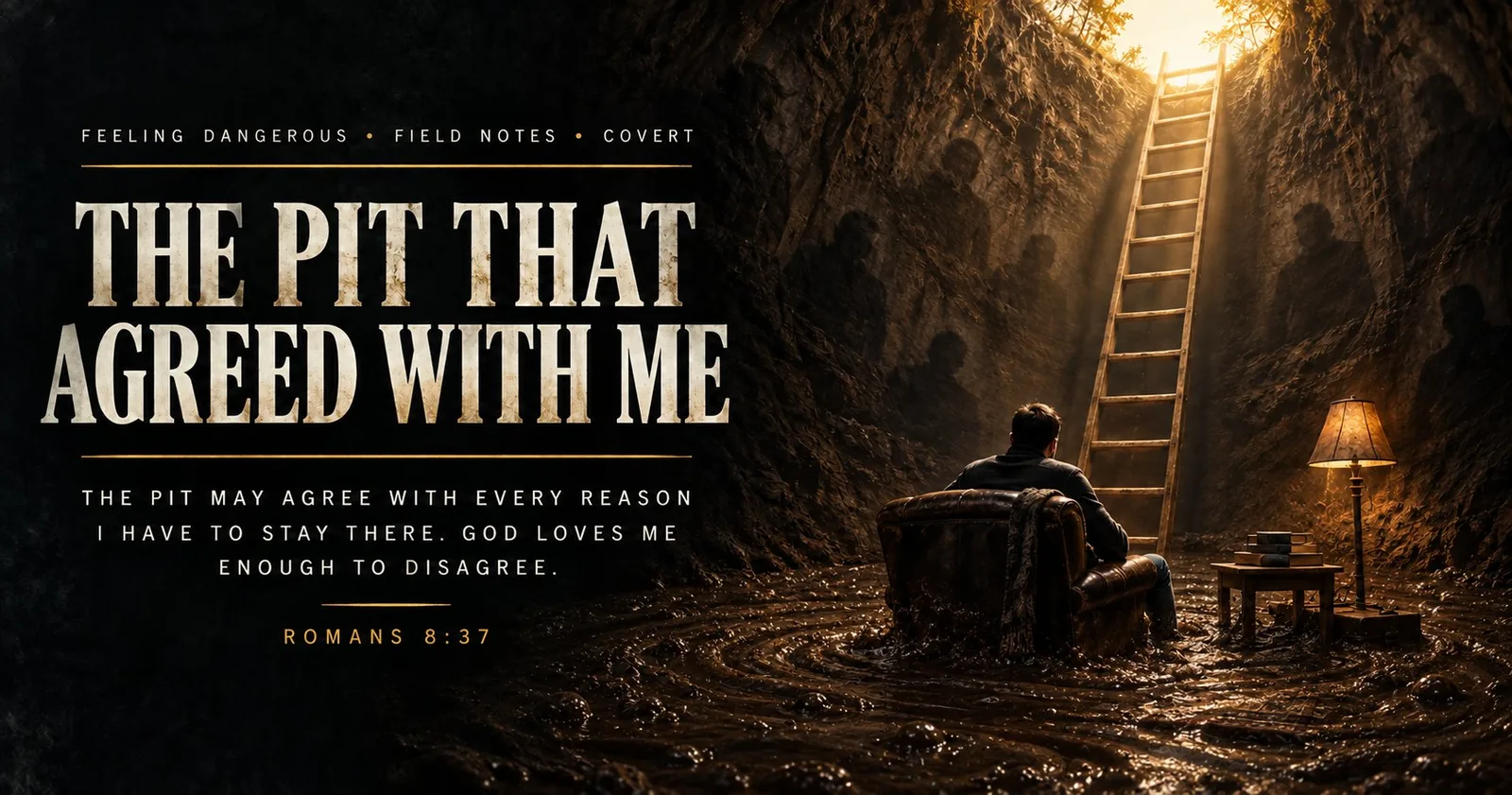
Field Notes · September 19, 2026 · 15 min read
The Pit That Agreed With Me
I can tell the truth about what happened to me without giving it the authority to tell me who I am. Pain may explain me, but it cannot own me
AI-generated narration · Adjust playback speed in the player.
There is a pit that will agree with everything you say.
It will agree that what happened was unfair.
It will agree that the person who hurt you was wrong.
It will agree that you deserved better.
It will agree that life should not have unfolded this way.
It will agree that somebody owes you an apology, an explanation, a refund, a restored relationship, a different childhood, a better opportunity, or several years of your life back.
The pit will not argue with you.
That is what makes it dangerous.
It does not have to convince you that the pain was imaginary. Some of the pain was very real. It only has to convince you that because you were hurt, you are now helpless.
Then it hands you two words that feel like comfort:
Poor me.
At first, those words can feel validating. They acknowledge the wound. They allow you to stop fighting for a moment. They make room for grief.
But if you keep repeating them, comfort becomes identity. Identity becomes agreement. Agreement becomes a permanent address.
Before long, you are no longer describing something that happened to you.
You are describing who you believe you are.
That is the pit of victimhood.
It is not filled with dirt. It is filled with quicksand.
The longer you remain there, the harder it becomes to imagine yourself anywhere else.
You Can Be Victimized Without Becoming a Victim
I need to make an important distinction before going any further.
People are victimized.
Children are abused. Spouses are betrayed. Families experience violence. Employees are exploited. Business partners lie. People are harmed by addiction, crime, negligence, manipulation, disease, accidents, and decisions they did not make.
Calling those things wrong is not a victim mindset. Telling the truth is not weakness. Grieving is not self-pity. Seeking justice is not bitterness. Establishing boundaries is not unforgiveness. Asking for protection is not faithlessness.
Sometimes the most courageous sentence a person can say is:
“That happened to me, and it was wrong.”
Victimhood begins somewhere else.
It begins when I make an agreement that what happened to me has the final authority over who I can become.
It begins when pain moves from being part of my history to being the ruler of my identity.
It begins when an explanation becomes an excuse.
It begins when another person’s sin becomes my permission to stop taking responsibility for my next decision.
Being victimized says, Someone violated what was right.
A victim identity says, Because they violated what was right, I am now powerless to do what is right.
Those are not the same statement.
I can tell the truth about what happened to me without giving it the authority to tell me who I am.
The Hand I Was Dealt
Families pass down more than eye color, height, facial features, land, recipes, and last names.
They pass down behaviors. They pass down coping mechanisms. They pass down definitions of strength, weakness, love, discipline, success, masculinity, conflict, and forgiveness.
They pass down wounds that nobody had the language or courage to address.
In my family, I do not believe learned helplessness was the primary inheritance. If anything, we were raised in the opposite direction.
Take responsibility.
Get up.
Fix it.
Do the work.
Do not be powerless.
Someone is watching, and somebody will check what you did.
There was strength in that. There still is.
But we held plenty of cards from another deck.
When it came to cycles of pain, I held the Ace, King, Queen, and Jack of spades: addiction, rage, emotional abuse, and physical aggression.
I have never been comfortable calling those things a mystical generational curse. I saw them as choices, habits, environments, examples, and survival mechanisms that people repeated because they had never been shown another way.
People looking from the outside may use different language. That is okay.
What I know is that repeated pain becomes familiar. Familiar behavior begins to feel normal. What feels normal rarely gets challenged.
Until somebody tells the truth.
The more I have shared these Field Notes... the addiction, the anger, the gambling, the bad decisions, the secrecy, the physical aggression, the fear.... the more I have felt certain agreements breaking.
Not just in me.
Potentially behind me and ahead of me.
The direction of a family can change when one person stops protecting the pattern.
Transparency removes the privacy that dysfunction needs to reproduce.
Repentance cuts off its permission. New action changes its inheritance.
I am not dishonoring previous generations by refusing to repeat everything they handed me. I can honor their endurance while ending the patterns that should not survive them.
I can be grateful for the strength and still surrender the pain.
Pain Can Explain Me Without Excusing Me
There were times I hurt people because I was hurting.
That sentence may be true, but it is not a complete apology.
“Hurt people hurt people” can create understanding. It can help us trace behavior back to its source. It can expose why anger, addiction, control, avoidance, or emotional distance became survival tools.
But explanation is not absolution.
If I approach somebody I wounded and say, “You have to understand what I was going through,” I may be telling the truth while still making the conversation about me.
If I say, “I only did that because of my childhood, my pressure, my addiction, my fear, my business, or what somebody else did to me,” I can turn my pain into a defense attorney.
Suddenly the person I hurt is being asked to comfort me for hurting them.
That is not accountability. That is victimhood wearing the costume of vulnerability.
Real humility sounds different:
You are right. I hurt you. I am sorry. There is no excuse. What would restoration look like from your perspective?
My history can help me understand why I reached for alcohol, drugs, gambling, rage, work, risk, control, or isolation.
But my history does not make the damage disappear.
I can have compassion for the version of me that was trying to survive and still hold that man accountable for the ways he made other people suffer.
That is not self-hatred. That is redeemed brokenness.
Psalm 51 does not present a man building a defense. It presents a man with a broken and contrite heart asking God to create something clean in him.
Brokenness says, I cannot repair myself without God.
Victimhood says, I should not have to change until everyone else repairs what they did to me.
One posture opens the door to grace.
The other keeps checking the hallway for an apology that may never arrive.
The Rescue Boat I Expected
Every time I believed I followed God’s direction and arrived at an outcome that looked terrible through human eyes, I was tempted to fall into the same pit.
Poor me.
I trusted You, God.
I tried to follow You.
Now look where I am.
Where is the rescue boat?
Where is the miracle that erases the consequence?
Where is the public vindication proving that I heard correctly?
Where is the sudden turnaround that makes this pain meaningful?
I used to think redemption meant God would remove the situation.
He would reverse the ruling, restore the money, rebuild the business, repair every relationship, eliminate every consequence, and make the testimony end the way I had already written it.
Sometimes He does change circumstances.
Sometimes rescue is visible, immediate, and undeniable.
But sometimes God’s rescue looks nothing like the boat I was watching for.
Sometimes rescue is exposure before a pattern grows worse.
Sometimes it is a boundary I did not want.
Sometimes it is a consequence that stops my momentum toward something more destructive.
Sometimes it is sobriety.
Sometimes it is losing access to the thing I had turned into an idol.
Sometimes it is a person finally refusing to participate in my dysfunction.
Sometimes it is the death of the false identity I was trying to protect.
Sometimes God does not remove me from the fire on my preferred timeline. He removes what the fire was revealing inside me.
That kind of rescue is difficult to recognize when I am committed to being the victim of the story.
If my definition of God’s goodness requires Him to erase every consequence, then accountability will always feel like abandonment.
But discipline is not desertion. Exposure is not always rejection.
The loss of control is not the loss of God.
Some Pain Was Done to Me. Some Pain Was Caused by Me.
I have had enough material to build a convincing victim narrative.
Lawsuits.
Addiction.
Gambling.
Business losses.
Betrayal.
Miscarriages and grief.
Fear surrounding jail and freedom.
Broken trust.
Health battles.
Relationships damaged by decisions I made and decisions other people made.
There are parts of that list where I was genuinely harmed.
There are parts where no person was to blame; life was simply painful.
There are also parts where I made the decision, ignored the warning, hid the truth, rationalized the risk, or hurt somebody else.
Maturity requires enough honesty to separate those categories.
Self-blame says everything was my fault. Victimhood says nothing was my responsibility.
Truth refuses both lies.
Not everything that happened to me was my fault.
What I do with it now is my responsibility.
That does not mean I can control every outcome. It means I can control whether I continue agreeing with helplessness.
I can seek counsel.
I can confess.
I can apologize.
I can accept a boundary.
I can enter recovery.
I can make restitution where possible.
I can stop hiding.
I can surrender justice to God without refusing the practical work in front of me.
I can take the next obedient step even when it does not immediately change the circumstance.
That is agency under God, not control over God.
Isolation Hands Pain a Microphone
The pit becomes most dangerous when I climb into it alone.
There is a difference between isolation and solitude. The difference between isolation and solitude is not whether you are alone. It is who you bring into the silence.
Isolation removes God, wise counsel, accountability, community, and opposing evidence. It creates a closed courtroom where I become the victim, prosecutor, witness, judge, and jury.
The same evidence plays on a loop.
Look what they did.
Look what I lost.
Look how unfair this is.
Look how nobody understands.
Look how God has abandoned me.
Because nobody else is allowed into the room, every thought sounds authoritative.
In isolation, I became the coach, quarterback, referee, opponent, and replay official.
I could review the same painful play for hours and always reach the same verdict:
Poor me.
Solitude is different.
In solitude, I invite God into the film room and ask what is true.
I allow Him to validate the wound without validating every conclusion I formed because of it.
I ask:
What actually happened?
What was done to me?
What did I do in response?
What am I responsible for now?
What lie have I agreed with?
What are You trying to heal, expose, teach, or rebuild?
Isolation lets pain narrate the entire story.
Solitude lets God interrupt the narration.
Isolation says, “You are alone.”
Solitude says, “You are being rebuilt in the presence of the Father.”
Isolation turns the offender into the center of the story.
Solitude returns the Healer to the center.
Abraham Did Not Know What Provision Would Look Like
The story of Abraham and Isaac has often challenged me because Abraham walked toward an outcome he could not understand.
God tested Abraham by directing him toward the mountain with the son connected to the promise. On the way, Isaac asked where the sacrifice was.
Abraham answered that God would provide.
Hebrews 11 later says Abraham reasoned that God could even raise the dead. Abraham did not know how the story would resolve, but he trusted the character and promise of God beyond what he could see.
He did not arrive at the mountain and collapse into “poor me.”
He kept walking.
But this story requires care.
There have been times when I believed I was following God while my ambition, urgency, pride, fear, or appetite distorted what I heard.
Faith does not eliminate discernment.
Obedience does not eliminate accountability.
Trust does not require pretending the consequences are good.
The lesson I carry from Abraham is not that every frightening decision is holy. It is that when God’s direction is tested and grounded, I do not have to understand the provision before I take the next faithful step.
Faith asks, What does obedience require now?
More Than Conquerors In These Things
Romans 8 does not say believers avoid every painful thing.
It names trouble, hardship, persecution, famine, danger, and death. Then it says something that changes the entire meaning of victory:
“In all these things we are more than conquerors through him who loved us.”
Not outside all these things.
Not after every difficult thing has been erased.
In them.
That matters.
An overcomer is not somebody who was never knocked down. An overcomer is somebody whose identity was not buried where they fell.
Second Corinthians 4 gives the same pattern: pressed but not crushed, perplexed but not surrendered to despair, struck down but not destroyed.
Pressure is real.
Destruction is not inevitable.
Pain is real.
Powerlessness does not have to become permanent.
I can be grieving and still moving.
I can be accountable and still loved.
I can face consequences and still have a future.
I can lose something without losing my identity.
I can admit what I did without agreeing that my worst decision gets to name me forever.
That is what it means to be more than a conqueror through Christ.
It is not denial.
It is not motivational language pasted over an untreated wound.
It is not pretending everything worked out.
It is refusing to give pain a throne.
The Grace to Say, “You Are Right”
One of the clearest signs that victimhood is losing its grip is the ability to hear how you hurt somebody without immediately explaining yourself.
There was a time when almost every accusation activated a defense.
I wanted context entered into evidence.
I wanted my intentions considered.
I wanted the pressure I was under acknowledged.
I wanted the other person’s mistakes discussed at the same time.
I wanted the whole courtroom to know that I had been hurting too.
Maybe all of that was true.
But truth used to avoid accountability becomes manipulation.
Grace has taught me that I can sit with the pain I caused without demanding that the injured person manage my shame.
I can say:
You are right.
I did that.
It hurt you.
I am sorry.
You are allowed to heal at a pace I do not control.
That final sentence may be the hardest.
The people I hurt are not required to trust me because I finally apologized. Forgiveness does not automatically restore access. Reconciliation requires safety, truth, time, and changed behavior from both sides.
I do not get to make myself the victim of somebody else’s healing process.
That is where grace becomes visible.
Grace is not avoiding the debt.
Grace is telling the truth about the debt, receiving what Christ has done for me, and becoming willing to repair what I can.
Where Are You Calling Yourself Powerless?
Look at your life.
Where have you begun building a home inside what happened?
My spouse does not love me the way I need.
My spouse does not trust me.
My kids will not listen.
My parents damaged me.
My business partner stole from me.
I made a bad investment and lost everything.
I wrecked the car.
My health changed.
I relapsed.
I am facing consequences.
I trusted God, and the outcome still hurt.
Some of those statements may be completely true.
But what agreement follows the statement?
Do you believe you are now helpless?
Do you believe somebody else must change before you can obey?
Do you believe healing cannot begin until the apology arrives?
Do you believe God must restore what was lost in exactly the form you expect before you will call Him faithful?
The pit of victimhood is filled with quicksand because every repeated agreement pulls you deeper.
Isolation accelerates the descent.
God is the lifeline but reaching for Him does not mean refusing every human hand He sends.
He may send a spouse, pastor, friend, sponsor, attorney, physician, counselor, mentor, or stranger who tells you the truth you were trying not to hear.
Sometimes asking for help is how you stop agreeing with helplessness.
You are not powerless because you need help.
You become more vulnerable to the pit when pride convinces you to refuse it.
A Prayer for Leaving the Pit
Father, show me where pain has become my identity and where explanation has become excuse.
Help me tell the truth about what was done to me without accepting blame that is not mine. Give me courage to take responsibility for what I have done without drowning in shame.
Expose every agreement that says I am helpless, abandoned, or permanently defined by my past. Meet me in solitude, interrupt the lies I repeat in isolation, and lead me toward safe people who carry truth and grace.
I surrender my demand to control how rescue, justice, and restoration must look.
Through Christ, teach me to live in peace.
Amen.
Join the conversation
Comments
Be the first to leave a comment.