Field Notes · September 20, 2026 · 30 min read
The Man I Kept Punishing
I called it future Waldon’s problem, but Danielle paid immediately. I bought today’s comfort with tomorrow’s peace and her trust.
AI-generated narration · Adjust playback speed in the player.
Future Waldon Could Handle It
If you have been around me for very long, there is a decent chance you have heard me say one of two things.
The first was, “That is future Waldon’s problem.”
The second was, “Man, that past version of me was a real dick.”
Normally, both lines got a laugh. They sounded like jokes because I delivered them like jokes. Humor has always been one of my favorite ways to make an uncomfortable truth easier to carry. If I could get everybody laughing, including myself, I did not have to sit too long with what the sentence actually revealed.
“Future Waldon’s problem” was never merely a joke. It was a philosophy.
It meant I wanted the comfort, speed, pleasure, opportunity, escape, or win available to me right now, but I did not want to carry the full weight of what it might cost later. It meant the version of me making the decision received the immediate reward while a man I had not met yet inherited the consequence.
That man was apparently going to be stronger, richer, wiser, more disciplined, and less tempted than me. Future Waldon was going to be an absolute superhero.
I thought highly of that guy. I also tested the hell out of him.
I sent him financial problems, relationship problems, health problems, business problems, legal problems, emotional problems, and spiritual problems. I delayed conversations he would eventually have to finish.
I accepted pleasure he would eventually have to pay for. I ignored warning lights he would eventually have to investigate. I signed present Waldon’s name on decisions and mailed the invoices to a future address.
The amazing part is that I acted surprised when the bills arrived.
When I later wondered how so much pressure had arrived at once, the answer was uncomfortable: it had been shipped there one decision at a time. Past Waldon stacked the boxes. Future Waldon became present Waldon, the doors opened, and every package had my handwriting on it.
That is the trap of instant gratification.
The word instant tells you when you receive the reward. It says nothing about when the cost arrives.
I felt better in the instant. I escaped the pressure in the instant. I avoided the conflict in the instant. I received the rush, relief, approval, money, drink, win, or silence in the instant.
Then time did what time always does.
It turned future me into present me.
The First Man I Was Punishing Was Me
We often talk about honoring our future as if that future belongs to somebody else. We tell people to build wealth for their future self, improve their health for their future self, make disciplined choices for their future self, and create the marriage or family their future self will be grateful to inherit.
The language is useful because it gives us distance. It lets us imagine a person waiting at the end of our decisions. But the distance is also an illusion.
Future you is still you.
Future you will live inside the body, trust, finances, private habits, delayed apologies, unfinished assignments, and spiritual agreements you are building today.
You do not get to disappear before they arrive.
For years, I behaved as though future Waldon were a separate man I could punish without feeling guilty. I let him absorb the consequences because present Waldon was busy moving fast. I had somewhere to go, something to build, somebody to impress, a problem to solve, or a feeling I did not want to feel.
Slowing down long enough to consider the future felt like weakness. I did not realize I was taking out a loan against my own peace. Every avoided conversation accrued interest, every temporary escape weakened trust, and every promise to fix it tomorrow made tomorrow more crowded.
Eventually, I met the man I had been punishing.
He looked back at me from the mirror.
He was older, but he did not magically know everything. He had more experience, but much of that experience came from cleaning up what I had left behind. He was tougher in some ways because survival had made him tough. He was also more tired because strength does not make accumulated weight disappear.
I used to insult past Waldon because it gave present Waldon somebody to blame. But he did not vanish. He became me.
The same will be true tomorrow.
The man receiving the harvest of today’s actions will still carry my name, live inside my covenant, parent my children, steward my assignment, and answer to God for what he does with what I give him.
That realization forced me to consider whether one changed word could begin changing what I sent forward.
What if I stopped saying, “That is future Waldon’s problem”?
What if I started saying, “That is future Waldon’s blessing”?
One word changes the direction of the sentence.
But only if it changes the direction of the person saying it.
One Word Can Carry Authority
Scripture contains moments when a single word changes the entire scene.
Peter and the other disciples were in a boat at night, fighting wind and waves, when they saw Jesus walking on the water. They were terrified. Peter called out and said that if it was really Jesus, He should tell Peter to come to Him.
Jesus answered with one word: “Come.”
That word did not flatten the waves before Peter moved. It did not turn the night into daylight. It did not make the boat disappear or give Peter a detailed explanation of how water would support a human body.
The word carried an invitation and the authority of the One who spoke it.
Peter still had to move.
He had to transfer his weight from the thing that had always held him to the word he had just received. He had to lift one leg over the side of the boat while the storm was still behaving like a storm.
The word created the opportunity. The step revealed the belief.
In another scene, a Roman centurion came to Jesus because his servant was suffering. Jesus offered to go to the man’s home, but the centurion understood authority. He knew a command did not need physical proximity to carry power. He told Jesus, in essence, that He only needed to say the word.
The centurion understood something that I am still learning: authority is not measured by volume, distance, or the number of words used. Authority comes from the one speaking.
God’s Word does not need my emotional intensity to become true.
His promises are not waiting for me to create enough enthusiasm around them. Isaiah 55 says His Word accomplishes the purpose for which He sends it. Psalm 119 calls His Word a lamp for the next step and a light for the path.
A lamp is important language. A lamp does not always illuminate the entire road. It gives enough light for the next faithful step.
That is frequently how direction has arrived in my life. I wanted a stadium full of floodlights, a detailed map, a guaranteed outcome, and written confirmation from Heaven’s legal department. God often gave me one word, one instruction, one conviction, or one next step.
Come.
Stay.
Stop.
Go.
Listen.
Wait.
Confess.
Forgive.
Ask.
Return.
The word was often simple. Obeying it was not.
Words Are Not Magic
There is an important distinction here because it is easy to turn a biblical truth into a self-help shortcut.
Changing the word problem to blessing is not magic. It is not a manifestation formula. I cannot speak whatever outcome I want into existence and then claim God is required to produce it. I am not the Creator, and my vocabulary does not place Heaven under contract.
God’s Word carries divine authority because God speaks it.
My words carry consequences because they reveal, repeat, and reinforce what I believe.
Proverbs 18 says the tongue holds the power of life and death. That wisdom is not permission to treat words like spells. It is a warning that speech has the power to nourish or poison relationships, courage, identity, reputation, hope, and action.
What I repeatedly say becomes easier to believe. What I repeatedly believe influences what I repeatedly do. What I repeatedly do eventually builds evidence that appears to confirm what I said in the beginning.
That is the loop.
Thought becomes word. Word strengthens belief. Belief produces action. Action produces a result. The result returns as evidence for the original thought.
If I keep saying, “I always screw things up,” I begin approaching decisions like somebody who cannot be trusted. I hesitate where I should move, hide where I should ask for help, and treat every mistake as proof that the sentence was correct.
If I keep saying, “Danielle never understands me,” I stop trying to communicate in ways she can receive. I begin listening only for evidence that she missed me again. I enter the conversation expecting opposition, respond defensively, and then use the conflict I helped create as proof that she never understands me.
If I keep saying, “That is future Waldon’s problem,” I give present Waldon permission to avoid the action that would protect tomorrow.
The words do not magically manufacture reality.
They train me to participate in it.
Changing one word matters because it interrupts the agreement.
“Problem” allowed me to postpone responsibility.
“Blessing” requires me to create something worth receiving.
If this is future Waldon’s blessing, then present Waldon has work to do.
One Word Plus One Action
The equation is simple enough to remember:
One Word + One Action = A Different Future
The word interrupts the old narrative. The action proves that the interruption was more than motivational language.
If I say “health” while continuing to damage my body, “peace” while hiding from my wife, or “freedom” while protecting the addiction, I did not choose a new direction. I selected nicer labels for the same road.
If I say “blessing” and then refuse the short-term discomfort required to create it, the word becomes another way to feel spiritual without changing.
Peter heard “Come,” but the story moved when his feet did.
The word did not replace action. It authorized it.
This is where the idea of short-term pain for long-term peace becomes more than a conference phrase. Recently, I attended an event in California where the speaker repeated variations of the same line throughout the weekend:
Short-term pain for long-term peace.
You can replace the final word depending on the situation: peace, pleasure, freedom, health, trust, happiness, alignment, stability, intimacy, or growth.
The principle remains the same. Something uncomfortable now can protect something valuable later.
We understand this when the trade is obvious: exercise for health, saving for margin, studying for capability, and treatment for healing.
The trade becomes harder when the pain is emotional.
Having the difficult conversation today may create an uncomfortable hour, but avoiding it can create a distant marriage.
Admitting the truth today may create consequences, but hiding it can create a second life that eventually collapses onto everybody you love.
Saying no to an opportunity today may cost immediate revenue, but saying yes could divide the attention required to protect the actual assignment.
Apologizing today may injure pride, but refusing to apologize can injure trust for years.
The short-term pain rarely feels like a blessing while it is happening. It feels like pressure, loss, humility, exposure, inconvenience, discipline, or fire.
Its identity becomes visible later.
The Marriage Pattern I Repeated for Thirteen Years
Marriage is where this truth became personal enough that I could no longer keep it as a business principle.
Danielle and I went from meeting to marriage in 58 days. It is a magnetic story because it shows how quickly God can arrange a connection, open a door, and change the direction of two lives. Fifty-eight days got us to the altar.
The days after that taught us how to become married.
A fast beginning does not exempt a couple from slow formation. God can arrange the introduction, confirm the covenant, and still allow two complete strangers to discover one another through thousands of ordinary days.
Those ordinary days reveal patterns.
One of mine was walking away.
For years, I could rationalize it as wisdom. If a conversation became too intense, if the pressure built, if I felt attacked, misunderstood, cornered, or afraid that I was about to say something I could not take back, I would leave the room.
Sometimes leaving briefly can be wise. A healthy pause is different from abandonment. Two people can agree to take twenty minutes, regulate their emotions, pray, think, and return at a specific time. There are moments when continuing a conversation in a flooded emotional state will only create more damage.
That is not the pattern I am describing.
I was not always taking a healthy pause so I could return better.
I was escaping discomfort so present Waldon could feel relief.
Walking away was not neutral. Even when I did not consciously intend it as punishment, that was often how it functioned. The conversation ended on my terms. Connection disappeared when I decided it would disappear.
Danielle was left holding the pain, uncertainty, and unanswered questions while I controlled when (or whether) we returned to them.
That meant I held the key to relief from a situation I had helped create. If she brought me a hard truth and I walked away, honesty cost her connection. If she expressed pain and I disappeared, vulnerability cost her access to her husband. If the conversation became uncomfortable for me, she became the one left alone inside the discomfort.
I was not only postponing a problem for future Waldon.
I was punishing Danielle in the present.
Future Waldon could finish the conversation.
Future Danielle could wait.
Future marriage could absorb the uncertainty.
I told myself that leaving prevented an explosion. Sometimes it probably did. What I failed to understand was that avoiding one kind of damage can quietly create another.
The punishment was not always loud. Sometimes it was the absence of my voice, presence, reassurance, and willingness to remain. I may not have said the cruel sentence forming in my mouth, but I still sent a message with my feet.
Your pain is too much for me.
Your concern is not safe with me.
My relief matters more than your need to be heard.
You will have to carry this alone until I decide I am ready.
That may not have been my intention.
But covenant is affected by impact, not only intention.
Every time I walked away without a clear promise to return, I made Danielle pay the emotional bill for the comfort I had purchased. She was not simply experiencing an unfortunate side effect of my coping mechanism. She was the person the coping mechanism injured.
I escaped the pressure of the moment. She inherited uncertainty. She did not know when the conversation would continue, whether the concern mattered, whether I had emotionally left the relationship, or whether bringing up a difficult subject would always cost her access to me.
I was transferring the pain, not resolving it.
The issue did not disappear because I changed rooms. It waited. Often it grew. By the time we returned to it, the original problem had accumulated a second problem: the way I had responded when she tried to talk about it.
Then future Waldon had two conversations to finish instead of one.
He had to address the original concern and repair the damage created by abandoning the discussion.
That is compound interest in the wrong direction.
What Walking Away Protected
Patterns survive because they serve us somehow.
If walking away had produced nothing useful, I would have stopped earlier. It protected me from something I did not yet know how to hold.
It protected me from shame. If Danielle’s concern exposed a failure, staying present required me to look directly at the gap between the husband I believed I was and the husband she was experiencing.
It protected me from powerlessness. I knew how to solve problems, build plans, create revenue, take action, and move fast. I did not always know what to do with pain that could not be solved in one conversation. Leaving restored a sense of control.
It protected me from words. I grew up around language that could become physical, sharp, loud, and destructive. When I felt that intensity rising in me, distance appeared safer than presence.
It protected my self-image. If I left before hearing the entire concern, I could continue telling myself that the reaction was unreasonable, the timing was bad, the delivery was wrong, or the issue had been exaggerated.
Walking away gave me short-term relief.
It punished Danielle for bringing me the very truth our marriage needed. It taught my wife that the hardest parts of her heart might make me disappear. It trained her to consider whether raising a concern was worth the disconnection that could follow. A marriage cannot become fully safe when one person must calculate whether honesty will cost them the other person’s presence.
That is a terrible trade.
It took me thirteen years to recognize how much long-term pain I had created by repeatedly choosing short-term comfort. Thirteen years is a long time to rehearse a pattern. It is also a long time for the person beside you to wonder whether this conversation will be different.
I cannot recover those years by feeling guilty about them. I cannot demand that Danielle instantly trust a new promise because I finally understand the old pain. Awareness is an opening, not evidence of transformation.
The evidence will be what I do the next time the pressure rises.
Stay
If one word can redirect the pattern in my marriage, I believe the word is stay.
Stay in the room.
Stay emotionally present.
Stay curious after the first defensive thought arrives.
Stay quiet long enough to hear the sentence beneath the sentence.
Stay humble when the truth feels like a kick to the balls.
Stay connected even if we need to pause.
Stay committed to returning at the time we agreed upon.
Stay until Danielle knows her heart did not make me leave.
That does not mean every conversation must continue without interruption until both people are exhausted. It does not mean boundaries disappear. It does not mean either spouse must remain in danger, tolerate abuse, or accept language intended to destroy.
Staying is not the absence of wisdom.
It is the refusal to use distance as punishment, control, or escape.
Sometimes staying sounds like, “I am overwhelmed, and I need twenty minutes. I love you. I am not leaving this conversation or this marriage. I will come back at 7:30, and we will keep talking.”
That is different from walking out, driving away, going silent, or leaving the other person to guess whether the relationship is safe.
One word... stay..... requires one action: remain connected.
The action may be sitting down instead of pacing toward the door. It may be putting the phone away. It may be repeating what I heard before defending what I meant. It may be asking Danielle whether she wants an answer, an apology, a plan, or simply the experience of being heard.
It may be allowing silence to exist without filling it with a rebuttal.
It may be admitting that my intention was not enough.
It may be using my words to say... I need some time to think through this.
The old version of me believed strength meant controlling the outcome of the conversation. The man I am becoming understands that strength can look like remaining present while somebody I love tells me how my actions affected them.
I want to become the husband Danielle knows can handle the truth.
I want her to know she can bring me the hardest subject without having to calculate whether honesty will make me disappear.
I want her to experience me as safe enough to listen, strong enough to stay, humble enough to apologize, and surrendered enough to change.
That is future Danielle’s blessing.
That is future Waldon’s blessing.
That is the blessing our children inherit when they watch two imperfect people refuse to let discomfort become disconnection.
The Conversation Is the Forge
I have written before about becoming comfortable being uncomfortable. I still believe God has used discomfort to move me into assignments, relationships, decisions, and growth I would have avoided if comfort had been allowed to lead.
But I have learned that discomfort is not only waiting outside the front door of opportunity.
Sometimes it is sitting across the kitchen island from your wife.
Sometimes the dangerous step is not launching the company, making the investment, driving across the country, walking into the room, or standing on the stage.
Sometimes the dangerous step is not leaving.
Being dangerous to darkness comes down to being willing to bring things into the light. Darkness does not only hide in obviously evil places. It hides inside unspoken resentment, delayed truth, private agreements, unfinished conflict, secret spending, protected habits, and the subjects everybody in the house knows not to mention.
Light changes what secrecy can sustain.
When I stay in the conversation, I invite the light into places where an old pattern once had privacy. I may feel exposed. I may feel misunderstood. I may hear something I do not want to hear. But exposure in a covenant can become the beginning of repair when both people remain committed to truth, love, and safety.
The conversation becomes a forge.
A forge is hot because transformation requires heat. Metal is not placed in the fire because the blacksmith hates it. It is placed there because heat makes it workable. The hammer is not punishment. It is intentional force shaping something for its purpose.
Marriage has been one of the primary forges of my life.
It has burned off impurities I once mistook for strength: refusing help, demanding control, needing to win, defending every intention, leaving when I felt exposed, believing provision excused absence, and treating vulnerability like surrendering a weapon to an enemy.
Those things were not protecting the covenant. They were protecting versions of me that could not survive intimacy.
The heat of a hard conversation reveals what is still in the metal.
Not stepping up.
Not listening.
Not helping.
Not being trustworthy.
Not being emotionally safe.
Not loving unconditionally.
Not becoming the one person my wife should be able to bring the truth to.
The impurities do not leave because I rename them. They leave when I submit to the fire long enough for God to work them out of me.
Short-term discomfort becomes long-term strength.
The forge hurts, but the goal is not pain.
The goal is a covenant capable of carrying more weight without breaking.
The Compound Interest of One Better Decision
We usually notice compound interest after a long period of time.
One financial deposit appears small. One workout changes very little. One honest conversation does not erase thirteen years of walking away. One day of sobriety does not restore everything addiction removed. One evening of listening does not instantly rebuild complete trust.
That can be discouraging if we expect one new action to produce an immediate harvest.
But the power of a seed has never been measured by how impressive it looks in your hand.
Galatians 6 teaches that we reap what we sow and warns us not to become weary in doing good. The passage assumes a delay between planting and harvest. It acknowledges that obedience can feel unproductive before the result becomes visible.
“Future Waldon’s problem” was the practice of sowing weeds and assuming tomorrow would have better gardening tools.
“Future Waldon’s blessing” is the decision to plant something today that I would be grateful to harvest later.
One conversation where I stay plants evidence that I can remain present.
One apology without a defense plants humility.
One disclosed decision plants trust.
One night without the substance plants freedom.
One expense declined plants margin.
One workout plants health.
One hour with a child plants connection.
One act of obedience plants a testimony whose ending I cannot yet see.
None of these single actions guarantees the outcome I prefer. A seed is not control. Other people still have agency. Bodies still experience illness. Markets change. Relationships require participation from more than one person. Some consequences cannot be reversed.
But obedience changes what I contribute to tomorrow.
I may not control the weather, but I can stop planting weeds.
I may not force the harvest, but I can become faithful with the field.
That is where self-trust begins returning. Every time I do what I told myself I would do, I become more believable to myself. Every time I remain present after promising Danielle I will stay, I become more believable to her.
Trust is not rebuilt by the size of the promise.
It is rebuilt by the repetition of the proof.
The Blessing May Look Like Pain Today
There is a reason we keep choosing immediate comfort: the better decision frequently feels worse at the beginning. Truth can create consequences, listening can expose selfishness, sobriety can uncover pain, boundaries can anger people who benefited from their absence, and repentance can damage an image before it restores integrity.
The blessing is not always the sensation attached to the first step.
Sometimes the blessing is hidden inside the direction.
This is why Deuteronomy 30 is such an important anchor for this Field Note. Moses presents life and death, blessing and curse, and then tells the people to choose life so they and their children may live.
The choice is not described as a private preference with private consequences. It reaches marriage, parenting, family culture, and the next generation.
When I choose to stay in the hard conversation, the blessing is not limited to the disagreement Danielle and I resolve. Our children receive another example of what love does under pressure. They learn that conflict does not automatically mean abandonment. They learn that a strong man can listen, that repentance is not humiliation, and that covenant is not the absence of hard subjects.
They learn that love can remain present while truth is spoken.
The short-term discomfort may be mine. The long-term blessing can become theirs.
My children are listening not only to what I tell them but to what I say about myself, my wife, God, our problems, and the future. If they hear that everything difficult belongs to tomorrow, they learn delay. If they see me choose the harder faithful action today, they learn stewardship.
The word becomes a culture when the action becomes a pattern.
Where Else I Sent the Bill
Marriage gave this truth a face, but the pattern was never limited to marriage.
In business, future Waldon could handle the exposure created by present speed.
In finances, he could replenish the reserve, pay the tax, or solve the debt.
In health, he could sleep more, eat better, and repair the damage.
In addiction, he could quit tomorrow.
In parenting, he could put the phone down after the business reached the next level.
In faith, he could pray, apologize, obey, or surrender later.
The categories changed. The trade remained the same.
I borrowed comfort from tomorrow and spent it today.
Changing problem to blessing gives each category a new question... not one I need to publish as a reflection exercise, but one I need to live as a decision filter:
What can I do now that the person I become will experience as peace later?
That filter usually points toward the action I postponed because it was uncomfortable: make the call, tell the truth, book the appointment, decline the opportunity, finish the assignment, ask for help, put the money away, pour out the drink, sit back down, and stay.
God’s Word Before My Preferred Word
One word can change a life, but it matters where the word came from.
I have generated plenty of my own words. I have called ambition obedience, urgency discernment, appetite opportunity, avoidance wisdom, and consequences spiritual warfare. A powerful personality can make a personal preference sound prophetic, especially to himself.
That is why the goal is not simply to select a more positive word.
The goal is alignment with God’s Word.
If my chosen word contradicts Scripture, requires deception, avoids accountability, harms people, or consistently produces fruit opposed to the Spirit, it does not become holy because I say God gave it to me.
God’s direction can challenge conventional wisdom, but it will not require me to make dishonesty a spiritual discipline. His grace may meet me inside consequences, but grace does not retroactively rename every bad decision obedience.
The Bible is the light on the path because my internal voice can be loud, persuasive, impatient, and wrong. Wise counsel matters because other people can see the gap between what I claim to believe and what my actions are producing. Prayer matters because surrender allows God to interrupt the answer I had already decided to hear.
Sometimes the one word from God is not the word I wanted.
I wanted “go,” and He said “wait.”
I wanted “build,” and He said “rest.”
I wanted “defend,” and He said “confess.”
I wanted “leave,” and He said “stay.”
I wanted "Win," and He said "lose."
The authority is not in selecting the word that makes me feel powerful.
The authority is in receiving the word God is actually speaking and arranging my next action beneath it.
Thirteen Years Is Too Long but Not Too Late
I wish I had recognized the marriage pattern earlier.
I wish I had understood after the first year that walking away was not creating safety for Danielle. I wish I had known how to regulate my emotions without turning distance into a weapon. I wish I had learned sooner that listening is not agreement, apology is not defeat, and remaining present does not mean surrendering my voice.
Thirteen years is a long time to realize something sucks.
But regret can become another way of abandoning the present.
If I spend today punishing myself for the years I did not understand, I send the work of transformation to tomorrow again. I repeat the same pattern with more spiritual language.
The point is not to hate past Waldon.
The point is to stop asking future me to fix the present.
God’s grace does not allow me to revisit every old conversation and perform it correctly. Grace gives me today. It gives me the next difficult subject, the next rising emotion, the next opportunity to sit back down, and the next chance to prove that the new word has reached my feet.
Thirteen years is too long to keep repeating a damaging pattern.
Just like addiction, it is not too late to stop.
That is one of the reasons I write these Field Notes. If somebody recognizes himself in this story after thirteen months instead of thirteen years, maybe my delay can become his warning. If a wife finally has language for why an unfinished conversation hurts, maybe this story helps her explain the difference between a healthy pause and abandonment. If a parent recognizes the pattern before a child learns it, maybe the next generation receives a different example.
Wisdom is experience understood. But understood experience becomes useful only when it changes what happens next.
Choose Life Today
Deuteronomy does not say to choose life someday when the decision becomes easier. It says to choose life today.
Today is where the seed is available.
Today is where the conversation can happen.
Today is where the apology can begin.
Today is where the truth can be told.
Today is where the first dollar can be saved, the first drink refused, the first boundary established, the first appointment scheduled, the first screen turned off, and the first step out of the boat taken.
Today is where I can change the word.
Problem becomes blessing.
Avoid becomes stay.
Defend becomes listen.
Later becomes now.
Escape becomes endure.
Control becomes surrender.
Fear becomes faith.
But the new word cannot remain printed on a page.
It needs a body.
It needs my feet, my calendar, my attention, my money, my confession, my restraint, my presence, and my obedience. It needs me to accept short-term discomfort without worshiping pain and without confusing avoidable chaos with holiness.
The goal is not to make today miserable so tomorrow can be happy.
The goal is to stop sacrificing tomorrow every time faithfulness feels uncomfortable today.
For thirteen years, there were moments when I walked away because I believed leaving protected me from becoming destructive. I can honor the part of that instinct that wanted to prevent harm while still admitting the pattern created harm of its own.
Now I want Danielle to experience a different man.
Not a perfect man. Not a man who never feels defensive, overwhelmed, hurt, angry, or afraid. A man who recognizes those feelings without letting them decide whether he remains present. A man who can say, “This hurts, and I am staying.”
A man who can say, “I do not agree with everything yet, but I want to understand.”
A man who can say, “I need a short pause, and I promise I will come back at the time we agreed.”
A man who can hear the hardest truth from his wife without making her regret telling it.
That is the man I want to become.
The way I bless my future self is by practicing today.
The Man Waiting for Me
I used to imagine future Waldon as the man responsible for cleaning up whatever present Waldon did not want to carry.
I see him differently now.
He is not standing in the future waiting to punish me. He is waiting to receive what I send him.
He will receive either the compound weight of avoidance or the compound reward of obedience.
He will inherit either another unfinished conversation or another piece of restored trust.
He will wake up inside either the habits I protected or the freedom I practiced.
He will live in either the marriage I neglected or the covenant I chose again today.
I cannot guarantee what will happen to him. I cannot protect him from every loss, trial, attack, diagnosis, disappointment, or consequence. I cannot write every page of his story from here.
But I can stop sabotaging him.
I can stop mailing him boxes filled with decisions I was unwilling to open.
I can send him evidence that I chose life.
I can send him a wife who has repeatedly experienced her husband staying.
I can send him children who watched their father apologize and change.
I can send him clearer accounts, healthier habits, honest relationships, completed assignments, and fewer secrets.
I can send him the peace produced when present obedience no longer negotiates with future consequences.
The man I kept punishing was me.
But he was not the only person paying.
The woman I was punishing in real time was Danielle. Every time I walked away, I protected myself from the immediate pressure by placing the full emotional weight onto her. Future Waldon inherited the unresolved problem. Danielle endured the present abandonment.
I cannot call that protection anymore.
I can name it, repent for it, and replace it with presence.
The man I can begin blessing is future me. The woman I must begin honoring now is my wife.
One word changed the sentence. One action must change the story.
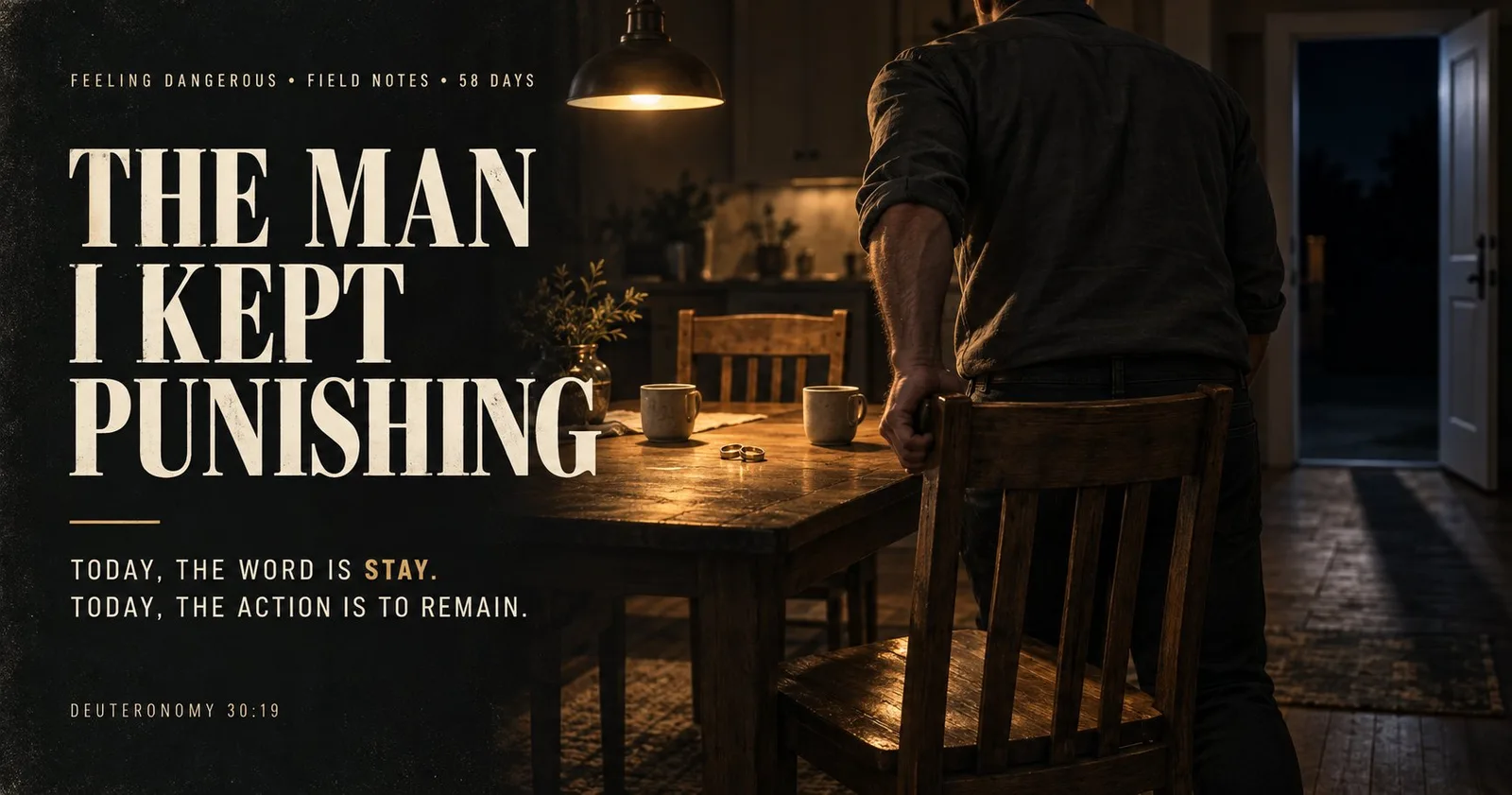
Today, the word is stay. Today, the action is to remain.
Tomorrow will receive the blessing.
Prayer
Father, thank You that Your Word carries authority beyond my feelings, circumstances, and limited sight.
Show me the words I have repeated until they became agreements, and expose every agreement that has trained me to postpone obedience. Forgive me for spending tomorrow’s peace to purchase today’s comfort.
Give me courage to choose the short-term discomfort of truth, discipline, repentance, and presence over the long-term pain of avoidance. Teach me to hear the word You are actually speaking—not merely the word I prefer—and give me the faith to move when You say come, wait when You say wait, confess when You say confess, and stay when You say stay.
Help me become a husband Danielle can trust with difficult truth, a father whose choices bless his children, and a man whose actions agree with his declarations. Let the seeds I plant today become life for the people who come after me.
Amen.
Join the conversation
Comments
Be the first to leave a comment.