Field Notes · October 4, 2026 · 30 min read
The Inheritance That Can’t Be Spent
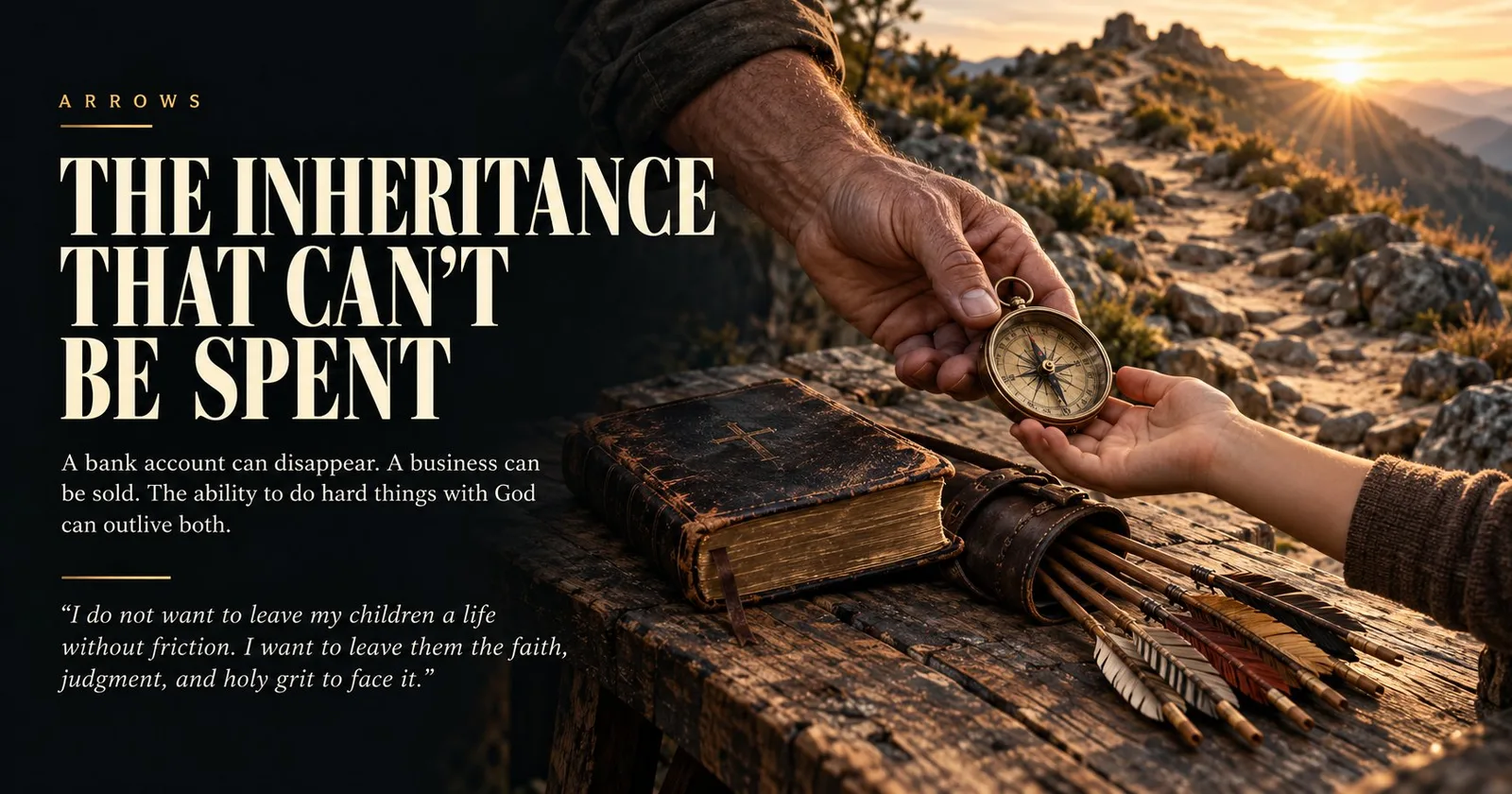
A bank account can be spent and a business can be sold. The faith and grit to do hard things can become a generational inheritance. I do not want to leave my children a life without friction. I want to leave them the faith, judgment, and holy grit to face it.
AI-generated narration · Adjust playback speed in the player.
I have spent a lot of time thinking about inheritance.
Not only money, property, businesses, trusts, or whatever else may eventually have our family name printed across the top of a legal document. Those things matter. Stewardship includes planning, building, protecting, and trying to leave the next generation with a stronger starting point than the one we received.
But money can be spent.
A company can be sold, mismanaged, disrupted, or made obsolete by technology that did not exist when the founder was still convinced the fax machine represented the peak of human innovation.
Property can be divided. Markets can fall. A comfortable season can end with one unexpected phone call. Even the best financial plan cannot guarantee that our children will never meet uncertainty, disappointment, loss, rejection, pressure, or failure.
So I have been asking a different question.
What can I place inside Madison, Charlotte, Titus, David, Kennedy, and Emma that cannot be taken from them when life stops being easy?
The answer is not a life without friction.
It is the ability to face friction without losing their faith, their character, or their direction.
It is the willingness to do hard things daily.
Not because pain is holy by itself. Not because suffering automatically makes a person wise. Not because children need to be hardened until nothing can reach them. I am not trying to raise six tiny employees who wake up before sunrise, submit quarterly performance reports, and ask whether their cereal produced an acceptable return on investment.
I want to raise faithful, resilient people.
People who can hear no without believing their life is over. People who can fail without accepting failure as their identity. People who can receive correction without collapsing, work without constant applause, wait without forcing an outcome, apologize without building a defense, and begin again without pretending the last attempt did not matter.
That kind of inheritance cannot simply be transferred when Danielle and I are gone.
It has to be built while we are here.
More Is Caught Than Taught
Deuteronomy 6 does not describe faith formation as a once-a-week lecture.
Parents are told to keep God’s commands in their hearts and impress them upon their children through the repeated rhythms of life... at home, along the road, at bedtime, and when the day begins.
The lesson is lived close enough to be observed.
Children hear what we teach, but they study what we do.
They watch how we act when the bill is larger than expected, when work becomes uncertain, when someone criticizes us, when a plan fails, when marriage requires humility, or when obedience becomes inconvenient. They notice whether prayer is our first source of direction or the religious sentence we add after making the decision alone.
They also notice whether our version of doing hard things means faithful endurance or uncontrolled self-destruction.
That distinction matters in my story.
I grew up learning how to work. Ranch life was not especially interested in whether I felt inspired. Animals needed attention. Weather changed the plan. Physical jobs were completed because the work existed, not because everyone woke up feeling passionate about it.
My dad would talk about cattle walking into a Wyoming blizzard. The snow and ice could pelt their faces so hard that they lowered their heads until their eyes were nearly level with the snow. They protected their faces, kept their feet moving, and continued toward shelter.
Keep your head down and your feet moving forward.
That image stayed with me.
It followed me into sports, college, marriage, business, and every season when stopping appeared easier than continuing. It taught me persistence. It taught me that discomfort did not mean the direction was wrong. It taught me how to work when emotion was no longer providing fuel.
But even a strength needs direction.
Putting your head down can help you walk through a storm. It can also keep you from seeing the cliff in front of you.
Persistence without wisdom becomes stubbornness.
Courage without accountability becomes recklessness.
The refusal to quit can build something meaningful, but it can also keep a person committed to a method, relationship, investment, or identity that needs to change.
That is part of what my children must learn from me too.
I do not only want them to see how often I got back up.
I want them to see when I stopped, listened, apologized, changed course, accepted help, and admitted that the route I had chosen was wrong.
Holy grit is not the ability to keep making the same mistake with more intensity.
Sometimes the hard thing is continuing. Sometimes the hard thing is turning around.
Business Is the Case Study. Home Is the Incubator.
There is a real overlap between entrepreneurship and parenting, although they are not the same job.
A business forces decisions about time, money, talent, culture, risk, failure, responsibility, and long-term return.
A home requires decisions about those same resources, but the people involved are not employees, customers, or assets. They are souls entrusted to us, each with a distinct identity and a future we do not own.
Business has given my children a front-row seat to risk.
They have seen me build. They have seen the conversations, changing schedules, intense seasons, new ideas, client problems, business pivots, and the energy that arrives when I believe there is a solution in front of me. They have watched opportunities appear because I was willing to walk into unfamiliar rooms, build relationships, learn quickly, and put something into motion before every variable was guaranteed.
Some of the best things in my business life began with uncertainty.
The first businesses were not born from complete readiness. They came from recognizing problems, teaching myself new skills, talking to people, making offers, and learning how to deliver value.
In Chicago, there were seasons when I scheduled multiple meetings a day because repeated, useful contact created opportunities that isolation never could. A willingness to move turned strangers into relationships, relationships into customers, and experience into capacity.
Those are lessons worth passing down.
But my children have also lived near the consequences of risk that outran wisdom.
They have seen pressure enter the house. They have watched business demands compete for attention. They have lived through seasons when my confidence moved faster than accountability and when my desire to solve a problem made it harder for me to admit that the problem had moved beyond my ability to solve it alone.
That is also part of the inheritance.
I cannot teach them that every bold move is faith simply because their father made it. I cannot turn damage into a heroic origin story or use the language of entrepreneurship to make poor stewardship sound brave.
I have said it before because I need to remember it:
Risk is required. Recklessness is optional.
A lawsuit is not proof that I was moving fast enough. Sometimes it is evidence that I moved faster than wisdom.
A financial loss is not automatically tuition. Sometimes it is a bill created by a decision that needed better counsel, clearer limits, or the courage to say no.
Failure can provide information, but people are not data. When a decision affects employees, customers, investors, partners, or family members, the lesson does not erase what they carried. Repair, restitution, accountability, and changed behavior belong inside any honest definition of learning.
Risk changed when my decisions stopped affecting only me and began entering other families’ kitchens.
Payroll made leadership personal. A business decision could affect whether another parent felt stability at home. A broken promise did not remain inside a spreadsheet. The downside traveled into marriages, meals, mortgages, and children’s lives.
That is why the lesson I want my children to inherit is not merely take more risks.
It is this:
Move what God entrusted to you, but remain responsible for how you move it and who carries the downside.
The Master Went Away
Matthew 25 is often brought into conversations about gifts, resources, risk, and stewardship. Jesus tells a story about a master who goes on a long journey and entrusts property to three servants according to their abilities.
Two servants put what they received to work. The third, controlled by fear, buries his portion in the ground. When the master returns, he evaluates what each servant did with what had been entrusted to him.
The master is the one who leaves.
The servants are the ones who must decide what stewardship looks like while he is gone.
That distinction matters because the parable is not a blanket promise that every business risk will double, every investment will succeed, or God will financially bless any idea we label bold. It is not permission to gamble with other people’s futures and call the danger faith.
The story confronts the paralysis of fear. The third servant does not lose the entrusted resource in a failed effort. He refuses to put it into motion at all. He chooses burial over faithful use.
The lesson I carry is that faithfulness is active.
What God entrusts to us is meant to be stewarded, developed, served through, and returned with evidence that we did more than protect ourselves from discomfort.
That applies to a business gift, an artistic ability, a capacity to lead, a mechanical mind, a talent for teaching, a heart for caregiving, a voice, a relationship, an opportunity, or a child’s emerging strength.
Our children do not all need to become entrepreneurs.
One may build a company. Another may become a physician, tradesperson, teacher, artist, minister, engineer, homemaker, public servant, or something we do not yet have language for.
The goal is not to reproduce my career in six different bodies.
The goal is to teach them not to bury what God placed in them simply because using it involves uncertainty.
Six Names, Six Different Arrows with More to Come.
One of the dangers of a large family is speaking about “the kids” so often that individuality disappears inside the group.
Madison, Charlotte, Titus, David, Kennedy, and Emma are not six copies of the same arrow.
They came into our hands at different stages of our marriage, faith, maturity, business life, and understanding of parenthood. Equal love does not require identical parenting. Consistency matters, but consistency is not sameness.
Madison is our first arrow. She received two parents who were learning everything in real time. There was no older-child case study, no proven family system, and no previous version of us to draw from. She has watched more of our formation simply because she arrived first. Part of doing hard things with Madison is allowing her to grow without turning “the oldest” into a permanent job description.
Charlotte came next and immediately proved that prior experience does not give parents control. Her arrival taught me that presence is sometimes physical, immediate, and terrifying. Later, her own decision of faith reminded me that a parent can teach, model, guide, and stand nearby, but eventually an arrow must begin making choices that belong to her.
Titus entered through the breath we waited for. His beginning carried fear, prayer, and the kind of gratitude that permanently changes the sound of an ordinary laugh. His story reminds me that life cannot be guaranteed by a parent, but it can be received, protected, shaped, and celebrated while it is in our care.
David deserves a direction that is his. He should not be treated as another version of Titus, compared against his sisters, or made to carry a lesson simply because it would fit well inside one of my books. Doing the hard work of fatherhood means learning him rather than assuming I already understand him because I understand the family. David will be a leader of leaders.
Kennedy needs to be seen and heard inside a house filled with louder voices, older opinions, younger needs, work, school, meals, and motion. A busy home can offer tremendous community, but it can also reward whichever need makes the most noise. One of the daily hard things is slowing down enough to recognize the child who is not currently demanding the room.
Emma arrived after Danielle and I had accumulated more experience, but experience can create its own danger. It can make parents believe they already know how the next child will develop. Emma deserves the tenderness of experienced parents without being trapped inside our assumptions. Wisdom should make us more attentive, not more certain that we have seen everything before. Emma has been our easiest baby.
Six names.
Six lives.
Six different strengths to shape without crushing.
Six different fears to help them face without teaching them fear deserves control.
Six different callings that belong to God before they belong to any vision I have for them.
If I am going to pass down the ability to do hard things, I first have to do the hard work of knowing the person standing in front of me.
The View From the Grave
Recently, I was sitting in church when I received what I can only describe as a clear vision.
It did not arrive like a passing thought. The picture formed with an intensity and clarity that pulled me completely into it.
I was looking upward from inside a grave.
My view passed through the opening of a casket toward six fully grown children standing together in a row. They were no longer the ages they are today. They appeared to be in their forties or maybe even their fifties. Madison, Charlotte, Titus, David, Kennedy, and Emma had lived entire stretches of life I had not yet seen. They carried years of decisions, marriages, work, faith, disappointment, victories, children of their own, and stories that had continued long after mine had ended.
I was seeing them from the final earthly position a father can occupy.
I could no longer correct the record.
I could no longer explain my intentions, defend a decision, make another promise, or ask for more time to demonstrate that I had changed. Whatever I had built into them had already been built. Whatever example I had given had already become part of their understanding of me.
Then David stepped forward.
He stood with authority and spoke on behalf of all of them. One sentence echoed above the grave:
“The best thing our dad showed us was what not to do.”
That is not exactly the line a father imagines engraving on a trophy.
My ego would prefer something more heroic.
I would like them to talk about the businesses I built, the risks I took, the battles I survived, the prayers I prayed, the places we went, or the moments when I appeared to know what I was doing.
Instead, the sentence honored the lessons exposed through my mistakes.
At first, it sounded like an indictment. As I sat with it, it began to sound like redemption.
The vision did not tell me that everything I did was wrong or that my children would only remember failure. It confronted me with a more humbling possibility: the greatest value of my story may not be that they copy my route. It may be that my honesty helps them avoid parts of it.
I do not know whether the vision was a literal picture of a future funeral or a spiritual picture God used to confront me in the present. I do not need to pretend I understand every detail. The message was clear enough.
My mistakes cannot remain hidden if their lessons are supposed to protect the next generation.
That does not mean making my children carry adult confessions they are not mature enough to hold. It does not mean turning the dinner table into a daily documentary about their father’s worst decisions. Wisdom still considers timing, age, detail, and what belongs in a conversation.
But silence cannot be the family inheritance.
I cannot edit my life into a highlight reel and then act surprised when my children repeat a danger I refused to name. I cannot hide the price of addiction, unchecked speed, secrecy, pride, poor stewardship, or self-reliance and still claim I prepared them for those same traps.
They need more than warnings.
They need the truth beneath the warning.
They need to understand what I believed, what I ignored, who was affected, what it cost, what finally broke the pattern, and what I would do differently if I were standing at the same decision again.
That is not passing down shame.
It is passing down a map.
A map does not require the traveler to visit every dangerous place marked on it. Its value is that someone already went far enough to identify the cliff, the dead end, the washed-out bridge, and the road that looked faster but charged a much higher price.
If David someday stands with that kind of authority, I do not want it to be because he had to survive every explosion I did. I want it to be because the truth helped him recognize the wire before he stepped on it.
The best thing I showed them cannot only be what not to do.
It must also be what a man does after realizing he was wrong.
He tells the truth.
He accepts responsibility.
He makes repairs.
He changes his behavior.
He turns the crater into a marker so the people behind him do not have to call the same destruction experience.
Stop Rescuing. Start Equipping.
Protection is one of the strongest instincts a parent carries.
When our children hurt, we want the pain gone. When they struggle, we want to step in. When someone treats them unfairly, something in us immediately begins preparing a speech, a phone call, and possibly a small military campaign.
Some dangers require intervention. Children need protection from abuse, exploitation, threats beyond their maturity, and consequences they are not yet equipped to understand. Letting a child struggle is not permission to abandon them, shame them, or manufacture pain in the name of character.
But if we eliminate every manageable frustration, we can accidentally teach them that discomfort is an emergency.
A forgotten responsibility becomes the parent’s problem. A difficult assignment becomes evidence that the standard is unfair. A conflict becomes something an adult must immediately solve. A disappointing result becomes a reason to remove the activity rather than examine effort, preparation, attitude, or fit.
Rescue feels loving because it creates immediate relief.
Equipping often feels slower.
Equipping means staying close while allowing an age-appropriate consequence to teach. It means offering guidance without taking over, asking a child to try before providing the answer, and letting them experience the relationship between preparation and outcome.
It means giving real responsibility.
A chore is not only household labor. It teaches that membership in a family includes contribution. A difficult school subject is not only academic content. It teaches how to remain engaged when mastery is not immediate. Saving for something desired is not only about money. It teaches patience, tradeoffs, and the difference between wanting and stewarding.
A lemonade stand, lawn service, craft project, resale idea, or small family business can become a safe laboratory for initiative. The point is not to turn childhood into a revenue department. The point is to allow a child to experience cost, effort, uncertainty, service, feedback, and the dignity of earning.
The sandbox matters.
Good business leaders do not remove every risk; they define what can be responsibly tested. Good parents can do the same. We can create environments where the cost of failure teaches without destroying, where guidance remains available, and where mistakes become something to examine rather than hide.
The goal is not a child who never needs help.
The goal is a child who learns how to use help without surrendering responsibility.
Failure Is an Event, Not an Identity
Entrepreneurs often say failure is data.
There is truth in that phrase. An idea can fail without the person becoming a failure. A bad result can reveal a weak assumption, poor timing, an unserved market, insufficient preparation, or a strategy that needs to change.
But I want my children to receive a more complete version.
Failure is data only if we are honest enough to read it.
Blame corrupts the data.
Pride deletes the parts we do not like.
Shame convinces us the report is actually a permanent identity.
Repetition without reflection produces another version of the same result.
The healthy response to failure includes truth, responsibility, learning, repair, and a changed next action.
That means I cannot only tell my children about the businesses that worked, the rooms I entered, the money generated, the problems solved, or the times persistence produced a win. If they only receive my highlight reel, they may assume courage guarantees victory and faithful people never misjudge a situation.
They need the honest version.
Some ideas did not work. Some partnerships ended. Some risks should have been smaller. Some decisions needed outside counsel. Some confidence was pride. Some of my actions created consequences for people I loved and people who trusted me.
The lesson is not that failure did not matter.
The lesson is that failure did not remove my responsibility to tell the truth, make repairs, receive correction, and keep doing useful work.
That is failing forward without stepping over the people who absorbed the fall.
My children do not need a father who pretends he never lost. They need a father who shows them what responsible recovery looks like.
My Ceiling, Their Floor
I have written before that I want my ceiling to become my children’s floor.
The farthest I am able to go in faith, wisdom, relationships, responsibility, business, and personal growth should become part of the foundation beneath their feet. I do not want them to spend the first half of their lives rebuilding something I had the opportunity to place under them.
That does not mean they inherit my definition of success.
My ceiling cannot become the roof I force over their lives. Madison, Charlotte, Titus, David, Kennedy, and Emma may run in directions I never predicted. They may build different things, value different expressions of work, and carry gifts that do not resemble mine.
Their floor is not a demand that they climb my mountain faster.
It is a stronger place from which they can begin climbing the mountain God gives them.
I want them to begin with the relationship lessons I learned late. I want them to understand stewardship before money becomes large enough to hide bad habits. I want them to recognize that accountability is protection, not interference. I want them to know the difference between an opportunity and an assignment, between conviction and impulse, between perseverance and pride, and between a risk that builds capacity and a gamble that only feeds appetite.
I want them to inherit access to wisdom that cost me years, money, trust, tears, and consequences to understand.
That is where another image has been forming in me.
I want to trailblaze. I want to walk into difficult territory first. I want to step on the land mines so my children do not have to.
I understand how extreme that sounds. It sounds like a father volunteering to get blown up, which is not exactly the slogan most family-planning books recommend.
The point is not that I should seek destruction, manufacture hardship, or continue making reckless decisions so my children have educational content. I have already produced enough cautionary material. No one needs another season.
The point is that when life places me in uncertain territory, I want to engage it honestly enough to identify the danger, mark the ground, and build a safer route behind me.
A trailblazer does not only prove the land can be crossed. He leaves evidence of how to cross it more wisely.
I have found land mines hidden beneath the desire to be needed, the need to win, the addiction to speed, the belief that I could solve everything alone, the assumption that a good intention guaranteed a good outcome, and the temptation to call any resistance proof that I was on the correct path.
Some exploded in business.
Some exploded in relationships.
Some damaged trust.
Some entered our home as anxiety, absence, conflict, or consequences my children never volunteered to carry.
The faithful response is not to hide the crater, rename it a blessing, or tell my children the explosion was necessary because their father is a visionary.
The faithful response is to mark it.
Do not build without accountability.
Do not confuse revenue with stewardship.
Do not make people carry risks they never agreed to take.
Do not sacrifice the people at home to impress people in a room.
Do not protect pride longer than you protect trust.
Do not wait for a consequence to make the truth obvious.
Those markers are part of the floor.
So are the positive lessons—the relationships built by showing up, the doors opened by useful service, the courage developed through uncertainty, the skills earned through repetition, the ability to begin without perfect readiness, and the faith required to place something entrusted into motion.
Their foundation should contain both: the roads worth taking and the mines worth avoiding.
Experience alone does not create wisdom. Some people repeat the same experience for decades and only become more committed to their explanation of it.
Wisdom comes when experience is examined, understood, surrendered to God, and allowed to change future action.
Experience understood becomes wisdom.
Wisdom shared becomes infrastructure.
That is how a ceiling becomes a floor.
The next generation does not begin where I was born. They begin where I became honest.
They do not need to bleed from every lesson before believing it. They do not need their own version of every addiction, broken agreement, financial failure, prideful decision, or damaged relationship to prove the warning was real.
They will still have hard things of their own. I cannot remove uncertainty from their lives, nor should I try. They will face decisions I never faced, technologies I never understood, cultural pressures I never experienced, and assignments beyond the edge of my imagination.
But they should not have to fight every battle required to reach the ground I already gained.
My ceiling should become their floor.
My scars should become their map.
My repentance should become their warning.
My wisdom should become their starting equipment.
Then they can spend their courage on new territory instead of repeatedly retaking ground their family already paid for.
Maybe that was the deeper meaning of David’s sentence in the vision.
“The best thing our dad showed us was what not to do” does not have to be the summary of a wasted life.
It can be the testimony of a redeemed one.
It can mean their father finally stopped hiding the mines.
It can mean they were free to start beyond them.
Holy Grit Is Not Human Grit Alone
There is a version of resilience that becomes another form of pride.
It says, “I can handle anything.”
It treats needing help as weakness, rest as laziness, grief as inefficiency, and prayer as something reserved for the moment every human strategy has finally collapsed.
I know that version because I lived it.
Biblical endurance is different.
James teaches that trials can develop perseverance and maturity. Hebrews says discipline is painful in the present but can later produce a harvest in those trained by it. Neither passage tells us to worship difficulty or create unnecessary suffering. The promise is not that every painful experience automatically produces character.
Training requires response.
Hardship can deepen faith, but it can also deepen bitterness when pain is never processed. Discipline can form wisdom, but punishment without love can create fear. Risk can build capacity, but reckless exposure can create damage rather than resilience.
Holy grit is dependence practiced under pressure.
It is the ability to say, “This is hard, and God is still faithful.”
It is knowing when to work, when to wait, when to ask for help, when to change the plan, and when to rest without abandoning the assignment.
It is not bootstrapping our way into invincibility.
It is discovering that when our strength reaches its edge, God’s grace has not reached His.
That is what I want my children to see. Not a father who never struggles, but a father who brings struggle into the light. Not a father who always has the answer, but one willing to seek wisdom. Not a father who confuses volume with authority, but one willing to apologize. Not a father who claims every result is God’s will, but one who remains accountable for his decisions while trusting God with the outcome.
The Family Does Not Need the Full Balance Sheet
Bringing children into the process requires wisdom.
There is a difference between letting children see faith in action and asking them to carry adult anxiety.
They can hear us pray over a business decision without receiving the burden of whether payroll will clear. They can understand that a season requires sacrifice without being made responsible for a parent’s emotional stability. They can watch us make a careful decision without hearing confidential details that belong to customers, employees, partners, or legal matters.
Transparency is not the transfer of weight.
The goal is not to make children afraid of the future so they will become tough. The goal is to let them observe adults facing the future with honesty, counsel, preparation, prayer, and trust.
They need to see the research before the risk, not only the celebration after it.
They need to see us ask:
Is this opportunity actually our assignment?
What evidence supports the decision?
What can we responsibly afford to lose?
Who carries the downside if we are wrong?
Who has permission to challenge the plan?
What remains useful even if the expected outcome does not arrive?
Those questions do not eliminate faith. They discipline it.
When the family watches a decision made this way, faith becomes firsthand rather than borrowed. They see that trusting God is not the absence of preparation. They see that prayer is not a shortcut around wisdom. They learn that courage can have guardrails and still move forward.
This Is Bigger Than Entrepreneurship
Not every reader owns a business, wants a business, or should start one.
The courage to do hard things belongs in every calling.
It is required when a marriage needs a difficult conversation, when sobriety must be chosen again today, when a parent must apologize to a child, when a student needs to ask for help, when a family must live within a budget, when a person must leave an unhealthy environment, or when someone has to remain faithful in work that will never receive public recognition.
It is required when an employee tells the truth even though the truth may cost an opportunity. It is required when a leader says no to growth that would damage the team. It is required when a caregiver serves someone who cannot repay the effort. It is required when a person rests because striving has become an idol.
The difficult road is not always the more dramatic road.
Sometimes doing the hard thing means making the bed, completing schoolwork, honoring a commitment, showing up on time, turning off the screen, telling the truth, saving instead of spending, or finishing the job after the excitement leaves.
Sometimes it means refusing an opportunity everyone else calls successful.
Sometimes it means planting what has been entrusted.
Sometimes it means admitting the field is wrong and moving the seed before another season is lost.
The shared requirement is not entrepreneurship.
It is faithfulness under friction.
The Return I May Never See
In business, we like measurable returns.
We want dashboards, conversion rates, revenue, profit, growth, and evidence that the investment worked. Parenting is much less cooperative with quarterly reporting.
Danielle and I are investing time, attention, prayer, correction, opportunity, boundaries, forgiveness, and repeated ordinary presence into six lives whose full stories we will never control.
The return may not appear on our timeline.
There will be seasons when the work feels repetitive and the results remain hidden. Galatians 6:9 tells us not to become weary in doing good because a harvest comes in the proper time if we do not give up.
Parenthood requires faith in seeds.
We teach the value before we know how they will use it. We model the apology before we know whether they will remember it twenty years later. We create a safe place for failure without knowing which future setback the lesson will help them survive.
That is the long return on investment.
A century from now, the businesses I built may no longer exist. The services may be irrelevant. The technology may look ancient. The money may have moved through generations and become something entirely different.
But character travels.
Faith travels.
The way a family responds to pressure travels.
The willingness to work, tell the truth, ask for help, accept correction, take responsible risk, repair damage, and begin again can move through generations long after the original business name disappears.
That is the inheritance I want to leave.
Not a life where Madison, Charlotte, Titus, David, Kennedy, and Emma never struggle.
A life where struggle does not get the final word.
Not six children trained to reproduce my definition of success.
Six adults equipped to recognize what God entrusted to them and brave enough to put it into motion.
Not blind risk.
Not fearful burial.
Faithful stewardship.
Daily effort.
Wise courage.
Grace when strength runs out.
A hard-fought hallelujah when the road demands more than they believed they could give.
A bank account can be spent.
A business can be sold.
But the faith and holy grit placed inside the next generation can become an inheritance the world cannot take and time cannot exhaust.
Today I Pray for the Inheritance
Father,
Thank You for every child You have entrusted to our care. Thank You for Madison, Charlotte, Titus, David, Kennedy, and Emma—for six distinct lives, six different strengths, and six stories that belong first to You.
Give Danielle and me wisdom to know when to protect and when to equip, when to step in and when to remain close without taking over. Keep us from rescuing our children from every discomfort or exposing them to burdens they were never meant to carry.
Teach us to model healthy endurance. Let them see us work, pray, ask for help, receive correction, make repairs, change direction, and remain faithful when results are slow.
Forgive us for the times our risks became reckless, our persistence became pride, or our work entered the home as pressure instead of provision. Help us take responsibility for the consequences of our decisions and show our children that repentance is part of leadership.
Reveal the gifts You placed in each child. Protect us from forcing our ambitions, identities, or unfinished dreams onto them. Give us patience to know each arrow individually and courage to release control as they grow.
When hard seasons come, remind them that difficulty is not proof of abandonment. Surround them with wise community. Teach them that asking for help is not weakness, rest is not failure, and a disappointing outcome does not define who they are.
Give them courage without recklessness, confidence without pride, endurance without hardness, and ambition governed by love.
May the inheritance we leave be larger than money and stronger than comfort. May faith, truth, responsibility, grace, and holy grit travel through our family for generations.
Help us do the hard work today that prepares them for the road tomorrow.
In Jesus’ name,
Amen.
Side Note: Music Connection
“Hard Fought Hallelujah” by Brandon Lake carries the right posture for this Field Note because it treats praise as something that can emerge from battle rather than something reserved for easy seasons. The inheritance described here is not the promise of a frictionless life. It is the faith to keep worshiping, working, learning, and trusting God when the hallelujah has to be fought for.
Stay Dangerous,
Waldon
Join the conversation
Comments
Be the first to leave a comment.