Field Notes · October 3, 2026 · 16 min read
The Permission I Was Praying For.
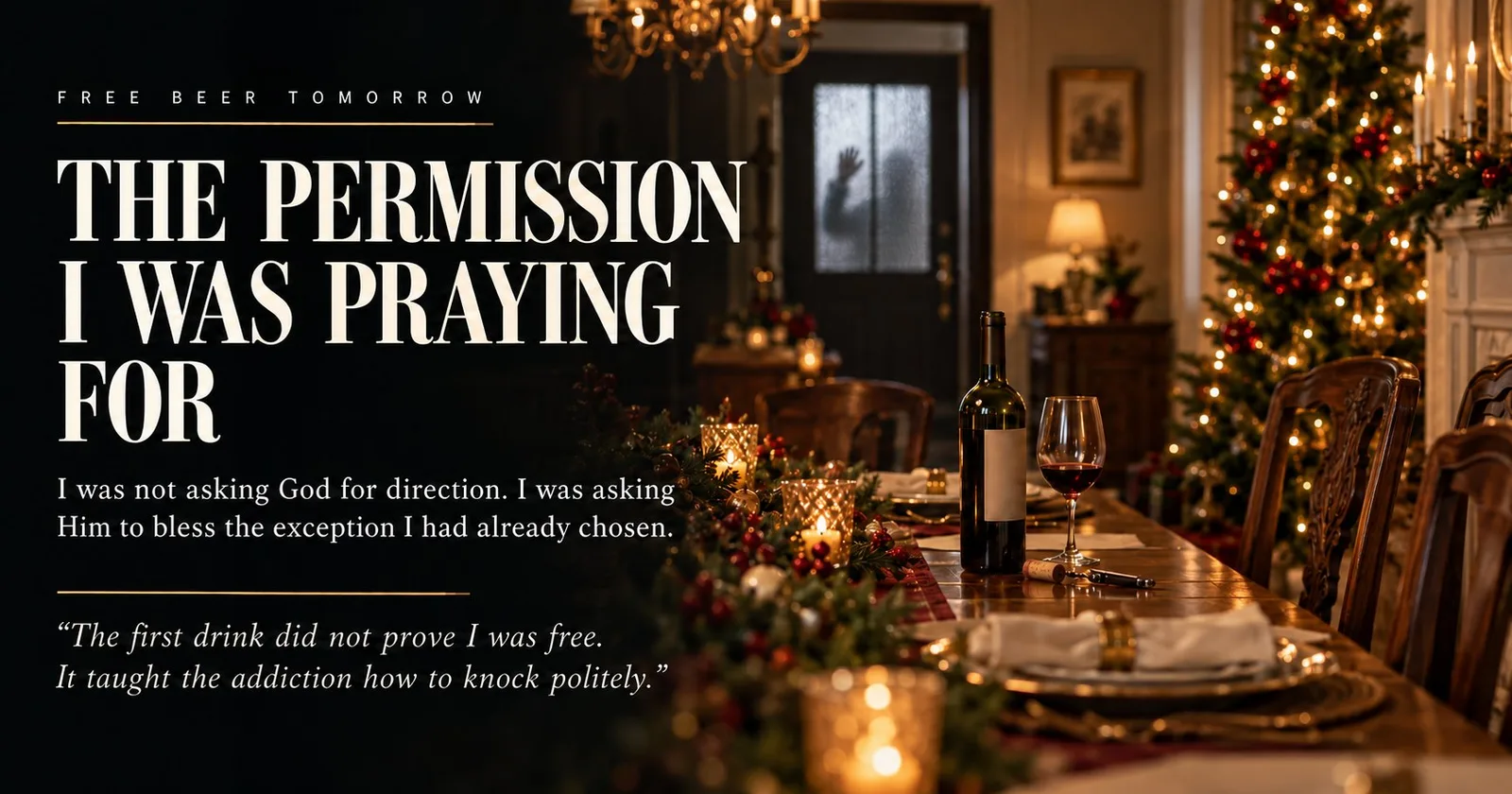
The first drink did not prove I was free. It taught the addiction how to knock politely.
AI-generated narration · Adjust playback speed in the player.
It was the holiday season.
The kind of evening where the house looked warmer than usual. Lights reflected off the glassware. Dinner felt special. A beautiful bottle of wine caught the light from the chandelier and seemed to be participating in the celebration.
I had not consumed alcohol in almost nine months.
Nine months of waking up early.
Nine months of clear mornings.
Nine months of feeling proud that I had stepped away from something that once occupied far too much of my life.
Nine months was long enough for me to begin rewriting the story.
Maybe alcohol had never really been the problem.
Maybe the problem had been stress.
Maybe it had been the chaotic season of life surrounding the drinking.
Maybe I had only used alcohol incorrectly because I was exhausted, overwhelmed, angry, or carrying too much.
Now I felt reset.
Cleansed.
Stable.
Healthy.
In control.
I began telling myself that I could finally drink like a normal person.
That sentence should have sounded ridiculous coming from someone who had spent nine months proving life was better without alcohol.
Instead, it sounded mature.
Sophisticated, even.
I was not planning to become a binge drinker again. I did not want to get drunk. I simply wanted to share a glass of good wine at a holiday dinner like a healthy adult with a refined palate and absolutely no unresolved relationship with alcohol.
Nothing says “I have completely mastered this” quite like preparing a closing argument for why you need to do it again.
The Prayer Beneath the Table
Before I poured the wine, I looked down at my hands beneath the edge of the table and prayed silently.
“God, can I just have a glass of wine?”
It sounded like surrender.
It was not.
I was not praying for the strength to say no.
I was praying for permission to say yes.
I wanted a spiritual hall pass.
I wanted a sudden peace, an internal green light, or a quiet word that said:
You have served your time.
You learned your lesson.
You are allowed to be normal now.
The answer I sensed was closer to this:
You can. You have free will.
At the time, I treated that as approval.
Looking back, I understand the difference more clearly.
God allowing me to choose something did not mean He was calling it wise.
Free will is not the same as freedom.
Permission is not always protection.
Silence is not always endorsement.
Sometimes we ask God a question after already deciding which answer we are willing to receive. Then, if the room does not shake and an angel does not slap the glass out of our hand, we call the absence of interruption confirmation.
I was not seeking direction.
I was seeking agreement.
When no warning alarm went off inside me, I looked up and asked for half a glass.
The first sip went down smoothly.
It tasted like inclusion.
It tasted like relief.
It tasted like the return of something familiar that I had convinced myself I no longer needed.
True to my word, I stopped after that glass.
That night.
I went to bed feeling victorious.
I thought I had cracked the code to moderation.
I believed the single glass was evidence that the addiction had lost.
It was actually evidence that the negotiation had reopened.
The Most Dangerous Success
The next evening, I was home after an exhausting workday.
The memory of my “success” arrived before the craving had to make a real argument.
You handled it perfectly yesterday.
You stopped after one.
A single beer tonight would be harmless.
That is what made the first glass so dangerous.
Nothing catastrophic had happened.
I had not embarrassed myself.
I had not started a fight.
I had not blacked out.
I had not broken anything, driven drunk, missed an obligation, or awakened with a house full of strangers and a tiger in the bathroom.
I drank one glass and went to sleep.
The absence of an immediate consequence became the addiction’s best evidence.
So I decided I would have one beer.
Think about the commitment involved in “just one beer.”
I got dressed.
I found my keys.
I drove to a store.
I walked inside.
I bought a six-pack.
I drove home.
I completed an entire supply-chain operation in service of one completely harmless beer.
Yeah, right.
By the next weekend, the boundaries had already begun bleeding.
One glass of wine with dinner became two.
Two became a nightcap because it was the weekend.
The weekend became Thursday because Thursday is basically Friday’s administrative assistant.
Then came the rules.
Only on weekends.
Only in public.
Never more than two.
Never when I was upset.
Never alone.
Never on consecutive days.
Rules can look like boundaries while secretly functioning as negotiations.
Within a month, the structure was gone.
I was drinking alone in the evenings to numb the day. I was hiding the real number of empty cans beneath the recycling where they would be harder to count. I was waking up beneath the familiar weight of anxiety, regret, and self-loathing.
The first drink had not satisfied the desire.
It had silenced the protector.
Once I proved I could drink once without an immediate disaster, my mind used that success as a blank check to finance the old pattern.
The addiction did not kick the door down.
It returned wearing nice clothes, carrying a holiday bottle, and asking whether I had finally become mature enough to let it back inside.
Freedom Does Not Mean I Can Manage the Chain
Galatians 5:1 says:
“It is for freedom that Christ has set us free. Stand firm, then, and do not let yourselves be burdened again by a yoke of slavery.”
For years, part of me defined freedom as the ability to drink without losing control.
I wanted freedom to mean I could return to the table, pour a glass, prove I was stronger than it, and walk away whenever I chose.
That definition still kept alcohol at the center of the story.
I was still measuring my freedom by my relationship with the thing that had enslaved me.
Real freedom was not learning how to wear the chain more comfortably.
It was no longer needing the chain to prove anything.
First Corinthians 6:12 says that not everything permissible is beneficial and that we should not be mastered by anything.
That verse helped me separate two questions:
Am I technically allowed to do this?
And:
What will this be allowed to do to me?
I may have been free to pour the glass.
But the glass was not free.
It carried a history. It carried agreements, habits, brain patterns, hiding, absence, and broken trust. It carried a price that was not printed on the bottle.
The Arrival That Exposed the Double Life
My later return to sobriety did not arrive as a cinematic breakthrough.
There was no thunder. No spotlight. No perfectly timed worship song playing while I poured every bottle down the drain in slow motion.
It was quieter than that.
Messier too.
The turning point came with the arrival of our sixth child, Emma.
She was born in April.
I remember looking at her tiny, untouched face while she slept. She had just entered the world. She carried no knowledge of my rationalizations, no understanding of the promises I had made and broken, and no idea that only weeks earlier I had been calculating how much I could drink in an evening without appearing impaired.
I felt a terrifying division inside myself.
I was a father welcoming a pure, brand-new life.
I was also a man disappearing from the lives already entrusted to him.
Before Emma’s arrival, Danielle had become exhausted by the drinking and the lies surrounding it. She was tired of being placed behind my desire to numb myself. She was tired of watching alcohol receive the attention, planning, and protection that should have belonged to our family.
She needed change.
Our future required change.
For the first time, I stopped seeing myself as a man who merely drank too much.
I saw a man repeatedly choosing to become unavailable to the people who needed him most. Alcohol did not only affect the moments when I was drinking. It occupied the hours before and after.
Before drinking, I planned.
During drinking, I withdrew or numbed.
After drinking, I recovered, regretted, hid, and tried to reconstruct what had happened.
My body might have remained in the house. My presence did not.
The First Drink I Chose Not to Take
I do not remember the exact final drink I swallowed. I vividly remember the first drink I chose to pass up. It was a Friday night at a dinner meeting with a client after a long day of planning and vision casting.
The bottle was there. The ritual was familiar. In another season, I would have accepted before anyone finished asking.
This time I looked at it and felt a physical aversion.
“No thanks,” I said. “I’m good tonight.”
The room kept moving. No one gasped. No one stood and applauded.
The restaurant did not dim the lights and award me a certificate.
The world did not end because I declined a drink.
But something shifted inside me.
Later that night, after the house had become quiet, I sat on the edge of our bed with Danielle. It could have been in the kitchen... I am still a bit fuzzy on that location of the event... but what happened I am clear on.
I did not give her another dramatic promise.
I had made those before.
“I am never drinking again.”
“I swear this time is different.”
“I can control it.”
“I just need a reset.”
Grand promises can become another part of the cycle. They create a powerful emotional moment without necessarily changing the structure that produced the behavior.
This time, my voice was smaller.
I told her, “I’m stopping. Not for a season. Not for a reset. I need to be entirely done.”
She did not cheer.
She looked at me like; “Okay.”
That response carried the truth of where we were.
She wanted to believe me.
She also had history.
I could not demand immediate trust as the reward for making another promise.
Trust would have to be rebuilt by ordinary evidence over time.
The Death of the Negotiation
What made this beginning different was not stronger language.
It was the death of the negotiation.
During earlier sober seasons, I had secretly preserved the future right to drink.
I was waiting for a vacation.
A celebration.
A milestone.
A business win.
A holiday dinner.
A day when I could prove I had finally become the person capable of moderation.
Sobriety had become a reset button, not a surrender.
I was using abstinence to improve my future relationship with alcohol.
This time, I stopped trying to save that relationship.
I admitted that moderation was a ghost I was tired of chasing.
The question was no longer, “How long must I wait before I can drink safely again?”
The question became, “Why am I fighting so hard to preserve access to something that keeps taking me away from my life?”
That question changed everything.
I did not need a more impressive rule.
I needed a final answer.
Not today.
And tomorrow, when it becomes today:
Not today.
That is the heart of Free Beer Tomorrow. The sign never says there will be no beer.
It simply keeps freedom inside the day I can actually live.
I do not have to defeat every future craving this morning.
I have to stop negotiating with this one today.
The Saturday Morning Sobriety Returned
About six weeks into that new beginning, I woke up at 6:30 on a random Saturday morning.
For years, waking at that hour could mean dragging myself out of bed with a dry mouth, a heavy head, and a blanket of guilt wrapped around me. The mental inventory began before my feet touched the floor.
How much had I consumed?
What had I said?
Had I sent any messages?
Was Danielle angry?
How much coffee would it take to create the appearance of a functioning human being?
But that morning, I simply opened my eyes.
Soft light came through the side of the shades.
The bedroom was still.
My mind was quiet.
There was no racing heart.
No desperate reconstruction of the night before.
No physical pain.
I felt rested.
Light.
Awake.
I slipped out of bed and walked into the kitchen to make coffee.
A few minutes later, Titus came downstairs rubbing his eyes. Charlotte followed him.
In the old pattern, I might have hidden behind the coffee mug and encouraged them to watch a movie while I tried to nurse myself through the emotional depression of the morning.
Instead, we began making breakfast for the family.
There was time for Titus to play with his cars before everyone else came down. Breakfast grew into an ordinary family morning, which eventually became a family movie day.
Nothing spectacular happened.
That was what made it spectacular.
No one needed to rescue the day from me.
I did not have to fake presence while waiting to feel human.
I did not lose the morning to the night before.
I was available.
What Sobriety Gave Back
Alcohol occupied an enormous amount of mental real estate.
There was the planning.
The purchase.
The hiding.
The counting.
The calculation of how much I could consume while appearing normal.
The management of the hangover.
The anxiety.
The regret.
The promise to stop.
The negotiation over when I could begin again.
When that structure came down, it left an incredible vacancy.
Recovery had to fill it with something.
Sobriety did not make me a perfect father. It made me a more available one.
It did not make me a flawless husband. It made me capable of being present for the conversations I had previously numbed or avoided.
It did not remove frustration, boredom, disappointment, stress, or conflict. It returned my opportunity to respond to those things without automatically abandoning myself and everyone around me.
Sobriety gave me back early mornings. It gave me back bedtime conversations.
It gave me back clear memories. It gave me back the ability to drive anywhere at any time without calculating whether I should.
It gave Danielle a husband who was no longer asking her to compete with a substance for his presence.
It gave my children a father who could make breakfast instead of spending the morning recovering behind a closed door.
The greatest gift was not merely a clear mind.
It was a usable life.
Not Every Addiction Works the Same Way
The word addiction gets used broadly.
We use it for alcohol, opioids, nicotine, gambling, pornography, food, shopping, phones, social media, work, and even television shows we watched for seven straight hours because the streaming service committed the violence of automatically playing the next episode.
These struggles can share features... compulsion, secrecy, escalating consequences, failed attempts to stop, and the use of a substance or behavior to escape what we feel.
But they are not mechanically identical.
Different substances reach the brain differently. Withdrawal risks vary. Some patterns can be addressed through complete abstinence. Other areas... such as food, technology, work, or money cannot always be eliminated and require new boundaries, support, and a reordered relationship.
Even with alcohol, one person’s recovery path may not look exactly like another person’s.
This Field Note is not a universal treatment plan.
It is my admission that moderation had become another door back into captivity for me.
I could not build freedom around proving I could drink normally. I needed to stop drinking.
That distinction matters because comparison can become another hiding place.
You may tell yourself your problem is not serious because someone else consumes more, loses more, hides more, or has suffered a consequence you have not yet experienced.
The question is not whether your addiction looks impressive enough to qualify for a documentary.
The question is whether it is mastering you.
Is it taking more space than you admit?
Is it causing you to lie?
Is it making you absent?
Is it repeatedly negotiating exceptions to boundaries you established while thinking clearly?
Is your family learning to arrange itself around it?
Is tomorrow continually paying for what you choose today?
The Exception You Keep Protecting
Your negotiation may not involve wine.
It may sound like:
I will only gamble on this trip.
I will only look at pornography one more time.
I will only take the pill when work becomes overwhelming.
I will only hide this purchase until the credit card is paid.
I will only download the app again to check one message.
I will only work through one more family dinner because this deadline is unusual.
The content changes.
The negotiation often sounds the same.
This situation is different.
I am stronger now.
I deserve relief.
I can control it this time.
No one will know.
Tomorrow I will return to the boundary.
Ask yourself:
What exception am I still protecting?
What future occasion am I using to keep the old relationship alive?
Am I asking God for direction... or asking Him to approve what I already decided?
What did the habit promise? What has it actually delivered?
Who has been forced to live with the difference?
The Life on the Other Side of No
For a long time, saying no to alcohol felt like deprivation.
It felt like losing celebration, sophistication, relief, connection, and fun.
That holiday glass seemed to offer all of those things.
What it eventually restored was the old machinery of hiding, anxiety, and absence.
The later no at the client dinner looked small.
It gave me access to something much larger.
A quiet mind on Saturday morning.
Breakfast with the family. Toys on the floor. A family movie.
The ability to remember the night before without conducting an investigation.
Those ordinary moments were not consolation prizes for giving up alcohol.
They were the life alcohol had been taking.
I once thought freedom would mean becoming powerful enough to drink again.
Freedom became no longer needing to.
The first drink did not prove I was free.
It taught the addiction how to knock politely.
The final surrender was not a louder promise.
It was the moment I stopped opening the door.
A Sober Prayer for Today
Father,
Thank You for the freedom available through Christ. Thank You that our worst pattern, deepest craving, and most repeated failure do not have to become our permanent identity.
Reveal every negotiation we have disguised as wisdom. Show us where we are asking You for direction while secretly demanding permission for the answer we already chose.
Give us courage to tell the truth about what is mastering us. Remove the shame that keeps us hidden without removing the conviction that calls us toward change.
Strengthen the person choosing sobriety today. Meet them in the first evening, the first weekend, the uncomfortable social moment, and the ordinary hour when the old pattern begins knocking again.
Surround us with people who will support freedom rather than protect our excuses. Give us humility to seek medical care, counseling, recovery support, accountability, and community when we need them.
Restore what addiction occupied.
Restore our mornings.
Restore our presence.
Restore trust through patient, consistent evidence.
Restore marriages, families, bodies, minds, responsibilities, and the ordinary moments we were too numb to receive.
Teach us not to worship the idea of being normal. Teach us to desire freedom more than permission.
Help us win today.
And when tomorrow arrives, help us choose freedom again.
In Jesus’ name,
Amen.
Join the conversation
Comments
Be the first to leave a comment.