Field Notes · September 28, 2026 · 24 min read
The Pillars of Forever
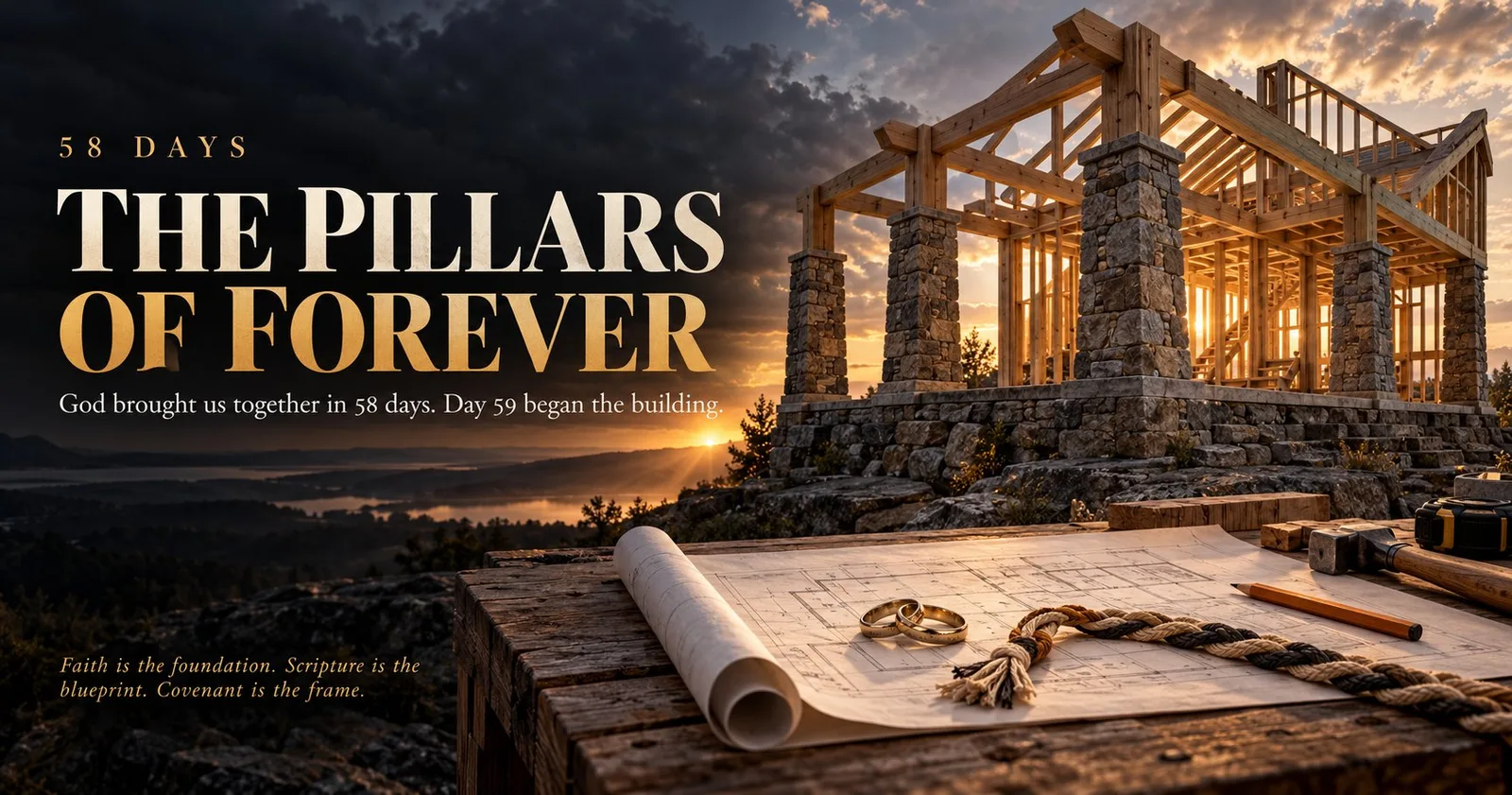
God brought us together in 58 days. Day 59 began the work of building a house strong enough to carry generations.
AI-generated narration · Adjust playback speed in the player.
I think people sometimes overlook God’s sense of humor.
Sometimes I imagine Him moving pieces around the board of life while already knowing exactly how the story will unfold.
Take a crazy, chaotic ranch kid from Wyoming. Send him through a colorful series of decisions, detours, victories, failures, and questionable ideas. Somehow lead him all the way to Orlando, Florida.
Then arrange an introduction to his wife.
Not another ranch kid.
Not someone from Wyoming.
Not someone who grew up around cows, dirt roads, rodeos, loud vehicles, and boys who occasionally treated common sense like an optional accessory.
No.
Introduce him to the founding member of the Finer Things Club... a fast-moving woman from Chicago who appreciated beauty, quality, order, intentionality, and things that did not arrive covered in mud.
Then take those two people, who appear to have almost nothing in common, and tell them they belong together.
I can imagine someone looking over God’s shoulder and asking, “Are You sure about this?”
God probably smiled and said, “Watch.”
From the outside, it should not have worked.
But God knew what He was doing.
He knew what would happen when we said hello. He knew what would happen during those first 58 days. He knew what would happen when we said, “I do.”
He also knew what would happen the next morning.
Because after the wedding, there were dishes.
There were schedules.
There were bills.
There were expectations neither of us knew we had until the other person failed to meet them.
There were habits that had been normal in one family and completely foreign in the other. There were different ways of communicating, resting, spending, cleaning, planning, celebrating, fighting, forgiving, and loading a dishwasher.
The title is not really about one particular sink full of dishes. It is about everything that arrives after the wedding photographs.
The first 58 days sound like a Hallmark movie.
We were young. We were wild. We were free—or however that song goes.
We both had colorful pasts. We both believed in brighter futures. Once God combined our flames, the future appeared even brighter.
But the magnetism of those first 58 days is only the opening scene.
It is the first page of the book.
It is the origin story.
Yes, there were countless details that had to align for us to move from hello to I do in 58 days. I will never diminish that part of our story. It matters. God moved. We listened. We took a risk. We made a covenant.
No one can take that beginning away from us.
But 58 days got us to the altar.
Day 59 began the work of becoming married.
The Story After the Story
People love the moment when the couple finally gets together.
That is usually where the movie ends.
The music swells. The couple kisses. The camera pulls back. Everyone assumes happily ever after has begun.
Roll credits.
But marriage does not roll credits after the wedding.
Marriage starts introducing characters you did not know were part of the story.
Meet Expectations.
Meet Money.
Meet Exhaustion.
Meet In-Laws.
Meet Miscommunication.
Meet the Person Your Spouse Becomes When They Are Hungry, Tired, Overwhelmed, Pregnant, Hurt, disappointed, or trying to assemble furniture with instructions written by someone who apparently hates families.
Then meet Yourself.
That character can be the biggest surprise of all.
Marriage introduced me to parts of myself I could not see while I was single. It revealed selfishness I had renamed independence. It revealed control I had disguised as leadership. It revealed avoidance I had called peacekeeping. It revealed pride I had mistaken for strength.
Marriage has a way of putting a mirror in front of you and refusing to move it.
You can blame the mirror.
You can criticize the lighting.
You can complain that your spouse is holding it at an unflattering angle.
But eventually, you have to look at the person in the reflection.
Danielle and I were not just learning how to live with each other. We were learning who we were when another person could see us every day.
There is nowhere to hide when someone knows your routines, your reactions, your weaknesses, your excuses, and the tone you use when you insist you are “fine.”
Apparently, “fine” does not always mean fine.
That was disappointing information.
The early years of our marriage required us to learn each other while simultaneously building a life together. We were trying to understand the person while also creating the partnership. We were reading the instruction manual while operating the machine—and sometimes we discovered that the manual had been written in two different languages.
We stepped on each other’s toes.
We misunderstood each other.
We brought expectations into the marriage that had never been discussed because we did not even know we had them.
Danielle had a way she believed life should function. I had a way I believed life should function.
Both of us assumed our way was normal.
Then we discovered that “normal” is often just what happened repeatedly in the house where you grew up.
Marriage brings two definitions of normal under the same roof and asks them to build something new.
God Arranged the Meeting, Not the Maintenance
I believe God arranged our meeting.
That does not mean we had a culturally arranged marriage. No family elder introduced us after comparing backgrounds. There was no professional matchmaker. No one negotiated the details between our families.
But I believe God moved the pieces.
I believe He placed us in the same location at the right time. I believe He gave us the faith to recognize something neither of us could completely explain. I believe He asked us to trust Him before we had enough history to trust our own understanding.
We married as two people who were still nearly strangers.
We knew enough to say yes.
We did not know enough to understand everything that yes would require.
But a marriage arranged by God still has to be maintained by people.
God can provide the blueprint, but someone still has to pick up the hammer.
God can lay the foundation, but the couple still has to build.
God can bring two people together, but those people must learn how to stay together, grow together, repair together, and keep choosing each other.
Psalm 127:1 says:
“Unless the Lord builds the house, the builders labor in vain.”
That verse does not say the builders stop laboring.
It says their labor must remain aligned with the Builder.
God being the architect does not remove our responsibility. It gives our responsibility direction.
There were seasons when I misunderstood this. I thought that because God brought us together, He would simply keep everything together.
As if marriage came with divine cruise control.
As if we could take our hands off the wheel, ignore the warning lights, stop maintaining the engine, and then blame the Manufacturer when something broke down.
That is not faith.
That is neglect wearing Christian clothing.
Our belief that God arranged our marriage was never supposed to become an excuse to stop working on it. It was supposed to become the reason we kept working when the work became difficult.
Removing a Word
From the beginning, Danielle and I removed the word divorce from our vocabulary.
If words are seeds, we were not going to plant that one every time we became angry, hurt, scared, or disappointed.
We were not going to use it as a threat.
We were not going to throw it across the room to gain power in an argument.
We were not going to place the future of our family on the table every time the present became uncomfortable.
Our wedding song was “I Won’t Give Up” by Jason Mraz.
Looking back, I am glad we did not choose a song called “I’ll Give It a Pretty Good Shot Until This Gets Inconvenient.”
It would have been honest for a lot of modern relationships, but it probably would not have looked as good on the wedding program.
We chose not to give up.
That decision has mattered.
There have been seasons when I joked that the reason we survived twice as long as the average marriage was that we were both too hardheaded to quit.
I laugh.
Danielle usually does not.
But buried underneath that joke is something real: neither of us is a quitter.
That stubbornness can create conflict when we turn it against each other. But when we stand beside one another and turn it against the forces trying to divide us, that same stubbornness becomes endurance.
Mark 10:9 says:
“Therefore what God has joined together, let no one separate.”
When people read that verse, they usually picture outside forces.
Friends should not separate us.
Family should not separate us.
Money should not separate us.
The world should not separate us.
But Danielle and I are also included in “no one.”
We do not get to destroy what God brought together merely because we are tired, hurt, frustrated, or temporarily unable to see the way forward.
That conviction does not mean ignoring abuse, concealing danger, or demanding that someone remain unprotected in a destructive environment. Covenant should never be weaponized to trap someone in violence or excuse continued harm. Safety, truth, accountability, wise counsel, and intervention are sometimes essential.
Removing divorce from our vocabulary did not mean removing accountability from our marriage.
It meant removing divorce as a weapon while increasing our commitment to truth, repentance, repair, boundaries, and change.
Covenant is not permission to keep hurting someone.
Covenant is a reason to become someone safer to love.
One Hundred and One Hundred
People often describe marriage as 50/50.
I understand what they mean.
Two people contribute. Two people compromise. Two people share the load.
But I do not believe a healthy marriage is 50/50.
If I enter marriage expecting to give 50 percent, I will spend the rest of my time measuring whether Danielle has delivered her half. I will keep a scoreboard. I will audit her effort. I will notice every moment when I believe I gave 51 and she gave 49.
A scoreboard may help determine who won a wrestling match.
It is a terrible way to determine who won a marriage.
Marriage is not 50/50.
It is 100/100.
That does not mean both people produce equal results every day. There are days when one person is sick, grieving, pregnant, exhausted, discouraged, or carrying a load the other person cannot fully understand.
Sometimes one person washes the dishes while the other barely has the strength to stand.
Sometimes one person carries more financially.
Sometimes one person carries more emotionally.
Sometimes one person is fighting for hope while the other cannot yet see it.
Giving 100 percent does not mean equal output. It means complete ownership of what I am capable of bringing today.
It means I do not withhold effort simply because I believe Danielle has not done enough.
It means I do not make love transactional.
It means I do not say, “I will become the husband I am supposed to be as soon as you become the wife I think you should be.”
It means I ask a different question:
Am I bringing my full responsibility to this covenant today?
Not yesterday.
Not someday.
Today.
The House We Are Building
Our God-arranged meeting became the foundation upon which we started building a legacy.
Faith is the foundation.
Scripture is the blueprint.
Covenant is the frame.
But a foundation by itself is not a finished home.
The house is built through the decisions we make every day—many of which will never become dramatic Field Notes.
It is built through conversations.
It is built through apologies.
It is built by telling the truth about money.
It is built by putting the phone down.
It is built by noticing when the other person is overwhelmed.
It is built by protecting time together.
It is built by refusing to humiliate each other in public.
It is built by honoring each other in private.
It is built by praying together when the future feels uncertain.
It is built through dishes.
The architecture of a strong marriage is formed through thousands of ordinary actions.
Proverbs 24:3–4 teaches that a house is built by wisdom, established through understanding, and filled through knowledge.
Wisdom helps us build.
Understanding helps the structure remain standing.
Knowledge fills the rooms.
That knowledge is not merely information. It is the lifelong process of learning the person God placed beside you.
I am still learning Danielle.
I am still learning what makes her feel safe. I am still learning what makes her feel unseen. I am still learning when she needs an answer and when she needs me to listen. I am still learning which wounds belong to the present conversation and which ones have been carried in from another season.
She is still learning me.
Marriage is not graduating from the study of your spouse.
It is committing to remain a student.
Some marriages start failing because one person believes they already know everything there is to know about the other. They stop asking questions. They stop paying attention. They stop noticing growth. They continue responding to the person their spouse was ten years ago while ignoring the person sitting in front of them today.
A living person will keep changing.
A living marriage must keep learning.
The Four Corner Pillars
As I have thought about the house Danielle and I are building, I keep returning to four primary pillars: love, respect, communication, and purpose.
These pillars do not replace faith. They stand on it.
Love: Unconditional Commitment
Love carries the heaviest weight.
I am not talking about an emotion that appears when everything is easy. I am talking about the daily decision to care, forgive, cherish, and remain present through changing seasons.
Feelings matter, but feelings are not qualified to run the entire house.
Some mornings you will feel deeply in love.
Some mornings you will feel deeply annoyed because the person you vowed to cherish is chewing too loudly.
A covenant cannot rise and fall according to the volume of breakfast.
Love says, “I am still here.”
Love does not mean approving every behavior. It does not avoid hard conversations. It does not call dysfunction peace.
Sometimes love comforts.
Sometimes love confronts.
Sometimes love holds close.
Sometimes love establishes a boundary.
Sometimes love says, “I forgive you.”
Sometimes love says, “This must change.”
Unconditional love does not mean unconditional permission.
It means the value of the person is not erased by the difficulty of the moment.
Respect: Dignity Inside Disagreement
Respect keeps the house balanced.
It means honoring each other’s voice, boundaries, contributions, needs, and God-given identity.
Respect becomes most visible when we disagree.
It is easy to respect someone who is agreeing with you.
The real test comes when you believe the other person is wrong.
Can I disagree without becoming cruel?
Can I explain what hurt without attacking Danielle’s character?
Can I listen without preparing my counterargument?
Can I resist using something vulnerable she once shared as ammunition in a future fight?
Respect means I do not need to destroy her in order to defend myself.
A marriage should be the safest place to tell the truth—not the place where truth becomes the most dangerous.
Communication: Air Through the House
Communication keeps air moving through the house.
Without it, the rooms become stale. Resentment builds behind closed doors. Assumptions fill the spaces where questions should have been asked.
For years, I believed communication meant explaining myself clearly enough that the other person finally understood why I was right.
That is not communication.
That is a closing argument.
Communication requires listening for understanding rather than listening for an opening.
It means Danielle can bring me something difficult without wondering whether I will shut down, walk away, explode, or punish her for telling me the truth.
It means I can bring her something difficult while trusting that honesty is meant to strengthen the house, not burn it down.
Communication does not eliminate conflict.
It prevents conflict from becoming a permanent wall.
Purpose: A Shared Direction
Purpose determines where the house is going.
A couple can love each other and still drift if they have no shared vision.
What are we building?
Who are we becoming?
What do we want our children to understand about faith, marriage, work, generosity, forgiveness, and family?
What kind of atmosphere should exist inside our home?
What will our family contribute to the world outside our walls?
Purpose gives meaning to sacrifice.
It reminds us that we are not merely trying to survive another week. We are building something our children may carry long after we are gone.
Our marriage is not only about Danielle and me.
It is creating the environment in which our children are learning what love looks like.
They are watching how we disagree.
They are watching whether we apologize.
They are watching how we recover after failure.
They are watching whether our faith is something we quote or something we practice.
We are not building a perfect house.
We are building a house where repair is possible.
The Supporting Pillars
The four corner pillars carry the structure, but other supports make the home resilient.
Provision matters.
Protection matters.
Humility matters.
Joy matters.
Provision is more than money. It includes creating physical, emotional, and spiritual stability. It means noticing needs and accepting responsibility for helping meet them.
Money can buy a house.
Provision helps create a home.
Protection is more than locking the doors. It means guarding the emotional and spiritual environment of the family. It means protecting time, trust, tenderness, and the private things that belong inside the covenant.
Protection also requires protecting the family from my own unresolved patterns.
If my anger makes the house unsafe, I cannot call myself the protector merely because I would fight an intruder.
If my secrecy destabilizes the family, I cannot claim to be providing security.
Sometimes the most important thing a man protects his family from is the version of himself he has refused to confront.
Humility is the shock absorber.
Every marriage encounters potholes, unexpected turns, and collisions. Humility absorbs pressure that pride would transfer directly into the structure.
Humility says:
“I was wrong.”
“You were right.”
“I did not understand.”
“I hurt you.”
“I am sorry.”
“What do you need from me now?”
Those sentences are not signs of weakness.
They are tools of reconstruction.
Pride would rather be right inside a collapsing house.
Humility would rather repair the house than win the argument.
Then there is joy.
Joy is the warmth and lighting of the home.
A house can be structurally strong and still feel miserable to live in.
Joy is laughter at the dinner table. It is celebrating progress. It is being ridiculous with the kids. It is remembering that marriage is not merely an endurance test.
We are allowed to enjoy the life we are working so hard to protect.
Maybe that is another reason God brought a Wyoming ranch kid and the founding member of the Finer Things Club together.
God knew the house would need both dirt and decoration.
Faith Is the Foundation, Not the Wallpaper
There is a version of Christian marriage where faith becomes decorative.
A Bible sits on the table.
Scripture appears on the wall.
The family attends church.
The couple knows the correct language.
But none of it reaches the foundation.
Faith becomes wallpaper covering cracks that no one wants to repair.
That is not the house I want.
Faith must be underneath everything.
It must affect how I speak when I am angry.
It must affect how we handle money.
It must affect how quickly I confess.
It must affect whether I keep promises when keeping them costs me something.
It must affect how we forgive without pretending the wound never occurred.
It must affect how we raise our children.
It must affect what we build and why we are building it.
Jesus described the person who hears His words and puts them into practice as someone who builds a house on rock. Rain falls. Water rises. Wind hits the house.
The storm still comes.
The difference is the foundation.
A marriage built on faith is not a marriage that avoids storms. It is a marriage that knows where to stand when the storm arrives.
Danielle and I have experienced storms.
There have been seasons when it felt as if we had already completed every level of hell available to a married couple.
Then life would say, “Congratulations. You have unlocked the bonus level.”
Here comes another hurdle.
Here comes another land mine.
And just to make things interesting, someone turned off the lights.
Good luck. Do not die.
That may not sound romantic, but neither is pretending.
Our testimony is not that storms never reached our house.
Our testimony is that the house is still standing.
Some boards had to be replaced.
Some walls had to be rebuilt.
Some rooms required more light.
Some damage was caused by outside forces.
Some of it was caused by me.
But God has continued teaching us how to repair what was damaged without abandoning what He asked us to build.
Winning Today
Winning a marriage does not happen at the 50th anniversary party.
It happens today.
The anniversary is the accumulated evidence of thousands of daily decisions.
Winning today may mean washing the dishes when you would rather sit down.
It may mean initiating a conversation you have been avoiding.
It may mean telling the truth about a purchase, a fear, a temptation, or a mistake.
It may mean apologizing without adding the word but.
“I am sorry, but you…”
That is not an apology.
That is an accusation wearing an apology costume.
Winning today may mean listening for ten more minutes.
It may mean putting your phone in another room.
It may mean choosing not to respond while you are angry.
It may mean returning to the conversation after you have calmed down instead of using “I needed space” as a permanent escape route.
It may mean praying together even when the prayer is awkward.
It may mean scheduling counseling before the cracks become structural.
It may mean laughing.
It may mean resting.
It may mean allowing your spouse to carry you without interpreting the need for help as personal failure.
Daily wins create generational outcomes.
You cannot transform a legacy in one afternoon, but you can improve one interaction.
You can repair one offense.
You can keep one promise.
You can leave one room better than you found it.
You can become 1 percent more patient, more honest, more present, or more humble.
Progress compounds.
Small acts repeated over time become culture.
Culture becomes legacy.
Our children may not remember every major event in our marriage, but they will remember the atmosphere of our home.
They will remember whether they felt safe.
They will remember whether laughter lived there.
They will remember whether mistakes could be confessed.
They will remember whether Mom and Dad repaired what they broke.
They will remember whether faith was alive on ordinary Tuesdays.
The generational handoff is happening now.
Your Day 59
You may not have married someone 58 days after meeting them.
That is probably statistically more normal.
Maybe you knew your spouse for years. Maybe you dated carefully. Maybe everyone approved. Maybe your story did not require an explanation every time someone asked how you met.
But every marriage eventually reaches Day 59.
Day 59 is the moment when the excitement of the beginning meets the responsibility of continuing.
It is when the wedding becomes a marriage.
It is when the prayer is answered and you become responsible for stewarding the answer.
Day 59 does not exist only in marriage.
It arrives after the business opens.
It arrives after the baby is born.
It arrives after the baptism.
It arrives after you get sober.
It arrives after the promotion.
It arrives after the breakthrough.
It arrives after the vision finally becomes real.
The beginning may be supernatural.
The continuation will usually become practical.
You prayed for the business. Now there are employees, customers, payroll, taxes, and difficult decisions.
You prayed for the child. Now there are sleepless nights, diapers, discipline, and a human being learning how to live by watching you.
You prayed for restoration. Now you must rebuild trust through consistent actions.
You prayed for freedom from addiction. Now you must establish routines, boundaries, relationships, and accountability that protect that freedom.
You prayed for the marriage. Now there are dishes.
We sometimes become disappointed when an answered prayer starts requiring maintenance.
But responsibility does not mean the blessing disappeared.
Responsibility is often what the blessing looks like after the celebration ends.
Do not despise Day 59.
Do not resent the ordinary work connected to what you once begged God to provide.
The dishes are evidence that people ate in your home.
The laundry is evidence that your family has clothing.
The difficult conversation is evidence that the relationship is still alive enough to repair.
The responsibility is evidence that something has been entrusted to you.
What Are You Building Today?
Look at the house you are building.
Not only the physical house.
Look at the marriage.
Look at the atmosphere.
Look at the habits.
Look at the words being planted.
Look at what your children are learning.
Where is the foundation strong?
Where has something shifted?
Which pillar has been carrying too much weight because another has been neglected?
Maybe love is present, but communication has closed.
Maybe provision is strong, but joy has disappeared.
Maybe protection has become control.
Maybe purpose has been replaced by survival.
Maybe respect is offered in public but withheld in private.
Maybe you have been working so hard to provide a better life that the people you love no longer experience your presence inside it.
You do not have to rebuild everything today.
Find one place to begin.
Ask one honest question.
Have one overdue conversation.
Offer one apology.
Keep one promise.
Wash one dish.
Pray one prayer.
Leave one interaction better than you found it.
Then get up tomorrow and build again.
Colossians 3 tells believers to clothe themselves with compassion, kindness, humility, gentleness, patience, forgiveness, and love.
Those qualities are not abstract Christian decorations.
They are construction materials.
They are how a covenant becomes a home.
A Prayer for the House
Father,
Thank You for the people You bring into our lives and for the covenants You ask us to steward.
Thank You for the beginnings that reveal Your hand, but also for the ordinary days that teach us how to build.
Be the foundation beneath our marriages, our families, and our homes. Give us wisdom to build, understanding to establish what we are building, and knowledge to fill every room with what is good.
Teach us to love without keeping score.
Teach us to respect one another, especially when we disagree.
Give us the courage to communicate honestly and the humility to listen without defending ourselves.
Unite us around a purpose greater than our temporary emotions.
Show us where our words, habits, pride, secrecy, anger, avoidance, or selfishness have weakened the structure. Give us the courage to repair what we have damaged and the patience to rebuild trust through consistent action.
Help us provide more than money. Help us provide presence, stability, wisdom, comfort, and truth.
Teach us to protect our families without becoming controlling. Protect our homes from outside attacks, and confront anything inside us that makes those homes unsafe.
Restore joy to the rooms where pressure has taken over.
Help us laugh again.
Help us notice the blessing hidden inside ordinary responsibilities.
When one of us falls, teach the other to reach down without judgment. When both of us are weak, remind us that You are the third strand holding the covenant together.
Keep divorce from becoming a threat, accountability from becoming optional, and faith from becoming decoration.
Make our homes places where truth can be spoken, repentance can be practiced, forgiveness can be received, and healing can continue.
Teach us to win today—not through perfection, but through one faithful decision after another.
Thank You for the altar. Thank You for Day 59. Thank You for the dishes, the children, the conversations, the storms, the repairs, the laughter, and the life being built inside these walls.
Unless You build the house, our labor is in vain. So build this house through us.
In Jesus’ name,
Amen.
Join the conversation
Comments
Be the first to leave a comment.