Field Notes · September 27, 2026 · 21 min read
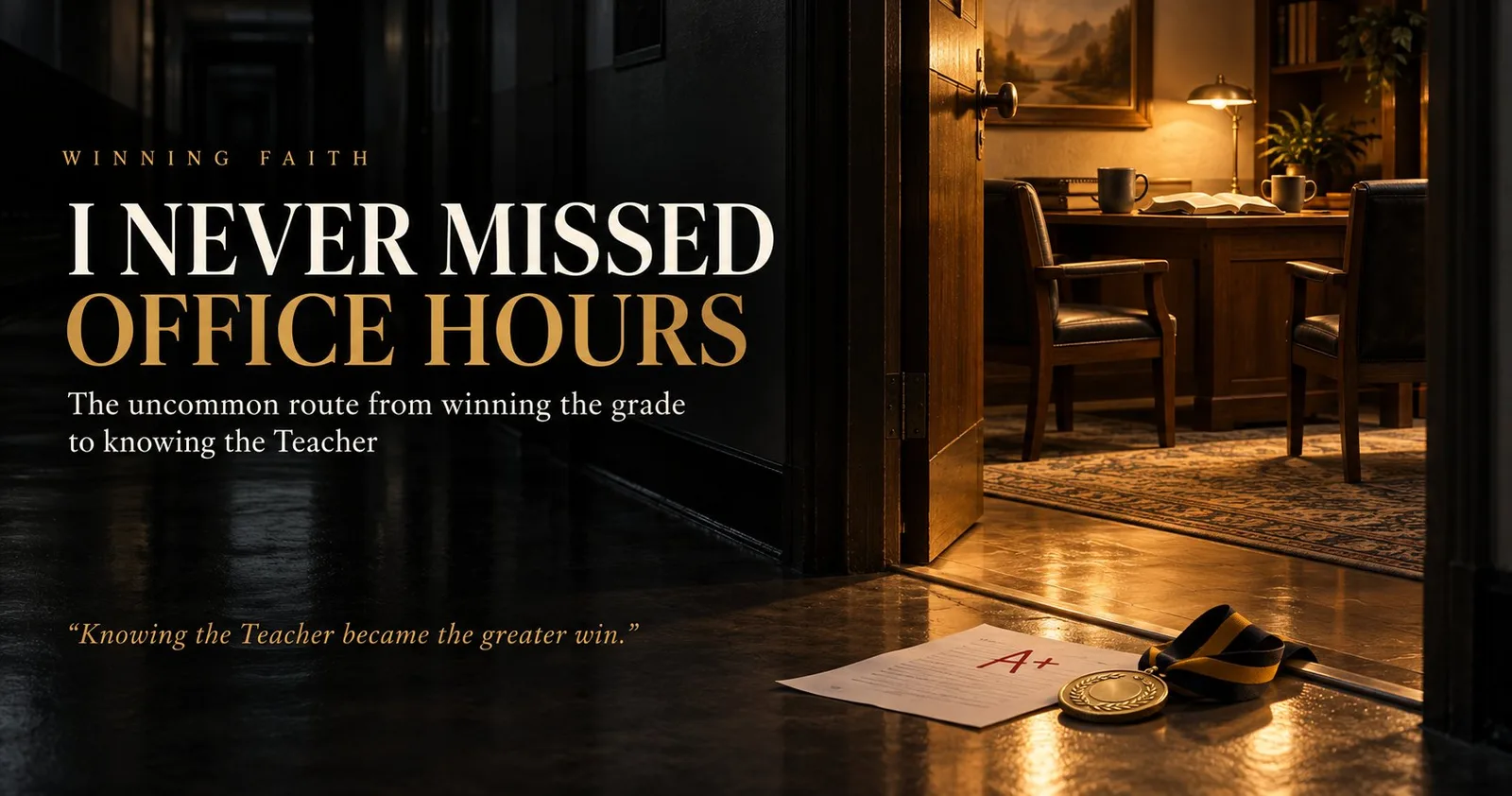
I Never Missed Office Hours
I started showing up to God’s office hours for a better grade. I stayed because knowing the Teacher became the greater win.
AI-generated narration · Adjust playback speed in the player.
The Boy Who Had to Win
I am going to say this in black and white—and boldly—because anyone who has known me for more than seven minutes already knows it anyway.
I do not like losing.
Taking an L is not something I naturally accept, frame, hang on the wall, and thank for participating. My first response is usually to outwork it, outlast it, out-pray it, study it, attack it from another angle, or keep going until the outcome changes. If one route closes, my brain begins building another before the dust from the first collapse has settled.
Sometimes that trait has served me well. It is the extra repetition in a workout when the person I may one day face has already gone home. It is the extra sale required to push through a revenue milestone or keep the lights on. It is the uncommon solution to a problem nobody else noticed yet. It is the willingness to invest more time, energy, prayer, relationships, and resources after a reasonable person might have decided the answer was no.
In a way, I refuse to lose.
That sentence sounds powerful until you realize refusing to lose can take you to destinations you never intended to visit.
When you grow up focused on becoming the best—no matter what—you learn how to find uncommon routes to the top of the mountain. You become creative. You develop grit. You see openings other people miss. You can remain in motion long after the crowd has decided the climb is too hard.
But an uncommon route can also deliver an uncommon destination.
Sometimes it takes you to the mountaintop.
Sometimes it takes you to a cliff you mistook for a summit.
Sometimes it takes you somewhere that looks like winning to everyone watching while quietly costing you the very thing the victory was supposed to provide.
I did not understand that as a boy. I understood scoreboards.
Earned, Not Given
Competition was everywhere growing up. It was in organized sports, sibling rivalries, backyard games, dinner-table challenges, and nearly anything else that could produce a winner and a loser. If the activity did not come with a scoreboard, there was a good chance my brother and I would invent one.
I learned early that a win mattered more when the other person had not pulled a punch.
Some parents let their children win. Some dads soften the throw, miss the shot, overlook the obvious move, or manufacture a final-second victory so their child can experience the feeling of being first.
That was not the world I came from.
At our dinner table, the day might end with cribbage or chess. The adults did not hand me the outcome. They played. I lost. I learned. We played again. I watched patterns, remembered traps, and put in the repetitions until the first real win arrived.
That first win meant something because I knew it had not been donated.
The same thing happened with foosball and other games. I became the kid who could embarrass adults—not because I possessed some magical foosball anointing, but because I had played enough to understand angles, timing, tendencies, and how quickly confidence leaves an adult when a child scores three goals in a row.
Once I learned how to win at something, my brain wanted to reproduce it.
The formula seemed simple:
Play long enough. Put in the reps. Learn the strategy. Identify the traps. Understand the person across from you. Then win more often than you lose.
Sports reinforced it. Wrestling may have been the clearest version because there was nowhere to hide. One person stood across from you. The whistle blew. Someone’s hand was raised at the end. Preparation, strength, conditioning, technique, will, and decision-making all entered the circle with you.
Football had a team to share the result. Wrestling made the result feel personal.
If I lost, there was no committee to blame.
So I put in more reps.
The boy who had to win was not created in one dramatic moment. He was trained one contest at a time.
Thirty-Five Thousand Feet
Then I married Danielle.
God, in His wisdom and apparent sense of humor, paired me with another competitive person.
Before kids—what I will call the BK years—we traveled often. We could be found on planes headed all over the world with fewer schedules, fewer bags, fewer car seats, and absolutely no understanding of the military-grade logistics that would eventually be required to move our family through an airport.
When it was just the two of us, we could get lost in card games. The main one was Rummy.
At thirty-five thousand feet, we would combine our tray tables and begin laying cards between drinks, snacks, elbows, and the constant threat of turbulence reorganizing the entire game. We slapped down cards, created long lines, and tried to bait the other person into picking up a pile large enough to require checked baggage.
People in our row would notice. Flight attendants would notice. At times it felt like most of the plane became aware that row whatever had turned into a championship arena.
Rummy was simple.
The outcome was not.
Danielle grew up playing the game. She had already put in the repetitions. She understood strategies I was still discovering, and I remain reasonably certain she was raised with an altered rule book designed to maintain a permanent competitive advantage over her future husband.
To this day, I can probably count the number of times I have beaten her on one hand.
She crushes me.
She crushes my ego, my pride, and my belief that persistence guarantees eventual domination. There have been seasons when I refused to play Rummy because I already knew where the flight was going, even if I did not know the destination printed on the ticket.
Clue is worse.
Danielle can solve the murder before I understand who was invited to the party. I am still checking the guest list while she is calmly explaining that Colonel Mustard did it in the conservatory with an object I did not realize was legally considered a weapon.
The strange thing is that I do not have to let her win.
She does that all by herself.
I used to struggle with the idea of letting a spouse or child win because the victory felt counterfeit. I grew up believing a win should be earned. I still believe there is value in preparing children for a world that will not rearrange every scoreboard to preserve their confidence.
But marriage began teaching me that the game can produce something more valuable than the result.
Even when I know I will probably fail the Rummy test, I will still play if Danielle asks. I may not recommend the ass-kicking, but I will come to office hours. I will bring the snacks.
That sentence makes sense only after college.
The Gold Medal Nobody Had Won
I entered college with one very clear goal: become the first person in my immediate family to earn a four-year bachelor’s degree.
My mom had earned an associate degree. My dad went directly to work. My brother, who was smarter than me on paper, intended to give college a shot. I had a two-year head start, which should have provided a comfortable lead.
Instead, I began drinking it away.
Middle school and high school had not prepared me for college—or, more accurately, I had not prepared myself to use what school offered. I was a terrible test taker. I was even worse at attending class. Sitting in a room all day listening to lectures felt unbearable to the twenty-year-old version of me.
The irony is that as I approach forty, I love listening to lectures. I love learning something new, pulling it apart, applying it, and seeing how it changes an outcome. I wish I could bottle that hunger and send it backward in time to the guy who treated an eight o’clock class like a human-rights violation.
He could have used it.
My head start disappeared. My brother eventually stopped pursuing his degree. I do not say that as a criticism of him; life takes people down different roads. But his decision activated something competitive in me.
The gold medal was still available.
I was not the smartest person in the race. I was not the best student. My attendance would not become the inspirational portion of a university recruitment brochure.
But I was persistent.
And I found an uncommon route.
I Never Missed Office Hours
I may have missed class, but I rarely missed an opportunity to sit with a professor during office hours.
If the professor was the person who understood the material, controlled the structure of the course, designed the assignments, and determined whether I had demonstrated enough knowledge to pass, then I wanted time with that person.
Not just from the back row of a crowded classroom.
I wanted the conversation.
I would show up at the office. I would sit there. I would ask questions. I would talk through concepts. I would listen as the professor explained the material in a way tailored to how my brain processed it.
Sometimes I brought a snack or an extra drink. That was not an attempt to purchase a grade. It was not a secret exchange in which a granola bar became three bonus points. It was how I treated people I had begun to know. If I was grabbing something and thought they might enjoy it, I brought an extra.
The uncommon route was relationship.
Most students did not use the office hours. At least, I do not remember many of them being there. In fairness, if they had walked in from my class, I might not have recognized them. That would have required me to attend often enough to learn their faces.
But inside those offices, the subject changed.
The material stopped being a speech delivered to a room full of people and became a conversation. The professor could see where I was confused. I could ask the question I might never have raised in a lecture hall. They could explain the concept differently, push back on my assumptions, and show me how the pieces fit together.
I still had to complete the work. I still had to demonstrate understanding. Relationship was not a substitute for responsibility.
Relationship made responsibility more personal.
The professors knew when I was trying. They knew when I was confused. They knew how I thought. I was no longer only a name attached to a weak test score. I was a person sitting across from them, asking for help and applying what they taught.
Somehow, the kid who failed more tests than he would ever care to count graduated with multiple degrees.
I even made the Dean’s List one semester.
I am sure several people assumed it was a typo—that my name belonged in the police report, not on the Dean’s List. Whoopsies.
But there it was.
The boy who had to win had found a route to the top of a mountain he was not academically designed to climb in the traditional way.
I learned something that would shape nearly every part of my adult life:
Relationships can teach you what performance alone never will.
The Strategy Followed Me
That lesson moved with me into business.
I learned that the right relationship could help reveal the real problem before I spent money solving the wrong one. Advisors could shorten learning curves. Partners could carry experience I did not possess. Clients could tell me what the spreadsheet could not. A conversation could unlock an uncommon solution that was invisible when everyone protected their own information.
Relationships helped me build businesses, serve clients, and enter rooms I could not have entered on a résumé alone.
They also created a risk.
A competitive person can begin treating relationships as routes instead of people.
Networking can become a polished form of using. Every person becomes a door, a connection, a resource, a referral, a source of money, or a possible answer to the next problem. You can become extremely good at building relationships while being terrible at loving the people inside them.
That is not relationship.
That is strategy wearing a name tag.
I have had to confront that in myself. I have had to ask whether I was showing up because I valued the person or because I valued what the person controlled. Was I listening because I cared, or because I was waiting for the information that would help me win? Was I generous because generosity was part of who I was becoming, or because I expected a return later?
Even professional relationships need that honesty. Good attorneys, advisors, and counselors have helped me understand systems, navigate difficult situations, and make more informed decisions. But no relationship should become a way to escape truth, lawful accountability, or the impact of my actions.
Relationships are powerful.
That is exactly why they must never become weapons.
The Professor Who Controlled the Outcome
This morning, all of these stories seemed to come together.
I began thinking about the boy who had to win, the young man chasing the first bachelor’s degree, the student who skipped lectures but never missed office hours, the entrepreneur who learned to find uncommon routes, and the husband who will still sit down at a Rummy table knowing defeat is probably already shuffling the cards.
Then I thought about God.
We are made in His image. He knows the entire course. He understands the assignment, the terrain, the test, the purpose, and the outcome in a way I never will.
For much of my life, I think I approached Him like the professor who controlled the grade.
If I prayed hard enough, maybe the outcome would change.
If I gave enough, maybe the door would open.
If I obeyed fast enough, worked long enough, believed loudly enough, or remained persistent after everyone else quit, maybe I could turn faith into a spiritual strategy for winning.
I began attending God’s office hours.
At first, I wanted a better grade.
I wanted Him to explain the test, change the result, reveal the shortcut, bless the business, rescue the plan, repair the damage, approve the risk, and help me reach the mountaintop I had selected.
The more time I spent with Him, the more the conversation changed.
I started showing up to God’s office hours for a better grade.
I stayed because I finally wanted to know the Teacher.
The Analogy Has a Limit
This is where the comparison needs a guardrail.
God is not a professor who can be bribed with snacks, offerings, perfect attendance, loud prayers, or visible acts of obedience. Grace is not extra credit. Salvation is not a grade we negotiate upward because the Teacher likes us.
We do not build a relationship with God to manipulate an outcome.
We build a relationship with God because knowing Him is the outcome.
That changes the meaning of prayer. Prayer is not merely the place where I submit my preferred answer. It is where my desires are examined, my motives are exposed, my understanding is corrected, and my will learns to surrender to His.
It changes the meaning of offering. I do not bring God time, money, worship, or obedience as payment for a future favor. I bring Him my life because it already belongs to Him.
It changes the meaning of Scripture. The Bible is not a strategy guide for forcing the scoreboard in my direction. It reveals God’s character, corrects my definition of victory, and teaches me how to remain faithful when the visible result looks like a loss.
It changes the meaning of winning.
Run to Win—But Know the Prize
The Bible does not condemn discipline or the desire to run well.
In 1 Corinthians 9:24–27, Paul uses the language of competition. He tells believers to run in a way that pursues the prize. He speaks of strict training and distinguishes a crown that does not last from one that does.
That passage makes sense to the wrestler in me.
Faith is not laziness baptized with spiritual vocabulary. Discipline matters. Training matters. Repetition matters. What I do with my body, attention, time, money, words, and opportunities matters.
But discipline needs the right prize.
If I train my entire life to win a crown that cannot survive eternity, I may become excellent at reaching the wrong destination.
Paul knew something about achievements, status, knowledge, discipline, and religious performance. Yet in Philippians 3:7–8, he says the things he once counted as gains became loss compared with the worth of knowing Christ.
Knowing Christ became the greater win.
Jeremiah delivers the same correction from another direction. Do not build your boast on wisdom, strength, or riches. If you are going to boast, boast that you understand and know the Lord.
That is a brutal verse for a man who knows how to measure intelligence, force, revenue, growth, property, influence, and visible wins.
God removes every scoreboard I naturally understand and replaces it with relationship.
Not: How much did you know?
But: Did you know Me?
Not: How strong did you appear?
But: Did you depend on Me?
Not: How much did you accumulate?
But: Did you become trustworthy with what I placed in your hands?
Not: Did everyone think you won?
But: Were you faithful?
Uncommon Routes
Proverbs says that a person may plan a course while the Lord establishes the steps.
That has been my life.
I planned direct routes. God allowed detours.
I planned trophies. God developed endurance.
I planned platforms. God exposed motives.
I planned businesses. God taught stewardship.
I planned escapes. God required accountability.
I planned visible victories. God kept inviting me into private relationship.
There were seasons when I assumed an uncommon route proved I was creative. Sometimes it did. Other times, the route was uncommon because God was taking me somewhere my definition of success never would have selected.
The unusual road was not always the obstacle.
Sometimes it was the classroom.
The failure taught something victory could not. The delayed answer revealed what I actually trusted. The relationship I could not control confronted the part of me that wanted every person to fit my plan. The consequence forced me to stop moving fast enough to avoid understanding what I had done.
I would not choose every mile again.
That does not mean God was absent from it.
It means He was capable of meeting me on routes containing both faith and failure and continuing the lesson without pretending every turn I made was right.
More Uncommon Destinations
The strangest destination for the boy who had to win is not a bigger trophy room.
It is peace after losing.
It is remaining at the table when someone else is better.
It is enjoying Danielle’s laughter when she destroys me at Rummy instead of allowing the result to ruin the moment.
It is celebrating someone else’s victory without making it evidence of my inadequacy.
It is asking for help before failure becomes catastrophic.
It is valuing the professor beyond the grade, the advisor beyond the answer, the client beyond the revenue, the spouse beyond what she provides, the child beyond their performance, and God beyond the miracle I want Him to produce.
Those are uncommon destinations because the world rarely puts them at the top of the mountain.
The world gives medals for being first, biggest, strongest, richest, loudest, and most visible. It does not always know what to do with the man who can lose a game without losing himself.
That man may have won something greater.
When Winning Becomes an Idol
The desire to win becomes dangerous when every relationship must serve it.
It becomes an idol when rest feels like weakness, correction feels like attack, another person’s success feels like theft, and any result short of first place feels like failure.
It becomes an idol when you will violate your values to preserve the appearance of victory.
It becomes an idol when you would rather hide the score than admit you lost.
It becomes an idol when the people closest to you experience your ambition as absence, pressure, manipulation, or punishment.
That kind of winning can build a business and empty a home. It can earn a degree and leave a person unteachable. It can create a platform and destroy the private life required to stand on it. It can make a man impressive to strangers and unsafe for his family.
The solution is not to become passive.
God did not remove my competitive nature. He has been teaching me to surrender its authority.
Competition can still create discipline. Persistence can still solve difficult problems. A refusal to quit can still carry people through conditions that would have stopped them otherwise.
But those strengths must serve love, truth, stewardship, and obedience.
They cannot become gods.
Your Uncommon Route
You may recognize yourself in this story even if you have never wrestled, played Rummy on an airplane, made the Dean’s List, or been accused of carrying a modified rule book.
Maybe your scoreboard is your bank account. Maybe it is your title, body, home, child’s achievements, social following, church attendance, relationship status, or ability to appear needed by everyone around you.
Maybe you believe that one more win will finally make you feel secure.
Maybe you have become so focused on reaching the destination that you have stopped seeing the people traveling beside you.
Maybe you have been treating prayer like a transaction: if you do the right things, God should produce the right result.
Maybe you are angry because you attended every spiritual office hour you knew how to attend and still received an outcome you did not want.
The invitation is not to stop running.
It is to examine the prize.
Keep the discipline. Keep the persistence. Keep the willingness to find an uncommon route when the obvious road closes. But release the belief that winning can tell you who you are.
Seek God before the answer. Know Him beyond the outcome. Let relationship correct ambition before ambition begins consuming relationships.
The next faithful action may look simple. Sit with God without presenting a business plan. Read Scripture without searching only for a verse that agrees with you. Call someone you once treated as a connection and listen without asking for anything. Play the game your spouse loves, even when you know your hand probably will not be raised.
You may discover that the time at the table was the victory.
The Hand That Was Never Raised
I still like winning.
I do not expect that confession to change soon. Put a scoreboard in front of me and part of my brain will immediately calculate the reps, strategy, relationships, and uncommon route required to move the numbers.
But I am learning that not every victory ends with my hand raised.
Some victories look like surrender.
Some look like an apology.
Some look like accountability.
Some look like staying in the room.
Some look like applauding Danielle while she gathers another Rummy win and I gather the cards.
The boy who had to win believed the medal would prove who he was.
The man I am becoming wants to know the One who was present before the contest began, remained after the crowd went home, and never confused my score with my value.
I spent years finding uncommon routes to the top of mountains.
God led me toward a more uncommon destination.
Relationship.
I started showing up to His office hours because I wanted help passing the test.
I stayed because knowing the Teacher became the greater win.
Prayer
Father,
Thank You for every gift You have placed in us—for discipline, persistence, creativity, courage, and the desire to run well. Forgive us for the moments when those gifts became rulers instead of servants, when winning became an idol, and when people became routes to outcomes instead of lives to love.
Correct the prize we are chasing. Teach us to value the crown that lasts rather than sacrificing our faith, families, integrity, health, or peace for one that cannot.
Draw us into relationship with You. Help us seek You without trying to manipulate the result. Teach us to pray honestly, listen humbly, receive correction, and obey without treating obedience as a transaction.
Show us where ambition has damaged relationship. Give us courage to apologize, repair, listen, and remain present. Teach us to celebrate another person’s victory without believing it diminishes our calling.
Establish our steps when our planned route is not Your route. Meet us in the detours, use the lessons we surrender, and protect us from calling every wrong turn Your will. Give us discernment to know when persistence is faithfulness and when surrender is the greater act of faith.
Above every achievement, let us know You. Above every grade, medal, title, number, and visible outcome, make faithfulness our measure of success.
Thank You for being more than the One who controls the outcome. Thank You for being the Father who invites us close.
In Jesus’ name,
Amen.
Join the conversation
Comments
Be the first to leave a comment.