Field Notes · September 26, 2026 · 26 min read
The Armor Was Made for Walking
The armor of God does not promise an easy road. It keeps the road from deciding who you become while you walk it.
AI-generated narration · Adjust playback speed in the player.
A Verse and a Word
Every morning I have been building a routine: wake up, work out, sit in the sauna, read, write, and pray. Some mornings I move with purpose. Other mornings I negotiate with the bed like it is holding me hostage. I keep returning because repetition has a way of turning intention into identity.
This morning, I read the Bible verse of the day... another small act meant to help govern the day before emotion, pressure, or somebody else’s emergency tries to take control.
The verse was Ephesians 6:11:
“Put on the full armor of God, so that you can take your stand against the devil’s schemes.”
Then for some other reasons... I felt led to look at the word of the day.
The word was peregrinate.
I will be honest: that is not a word I regularly use. I have never walked into a meeting, slapped a notebook on the table, and said, “All right, team, today we peregrinate.”
Most people would assume I had either learned Latin overnight or was having a medical event.
But the word caught me.
To peregrinate means to travel, especially on foot—to walk or journey over a place.
Its history reaches back to words connected to traveling in foreign lands, being a foreigner, and becoming a pilgrim. It is movement with the understanding that you are passing through territory that is not entirely your own.
On one side of the morning was a verse telling me to put on armor so I could stand.
On the other side was a word telling me to walk.
Stand.
Walk.
Stand.
Walk.
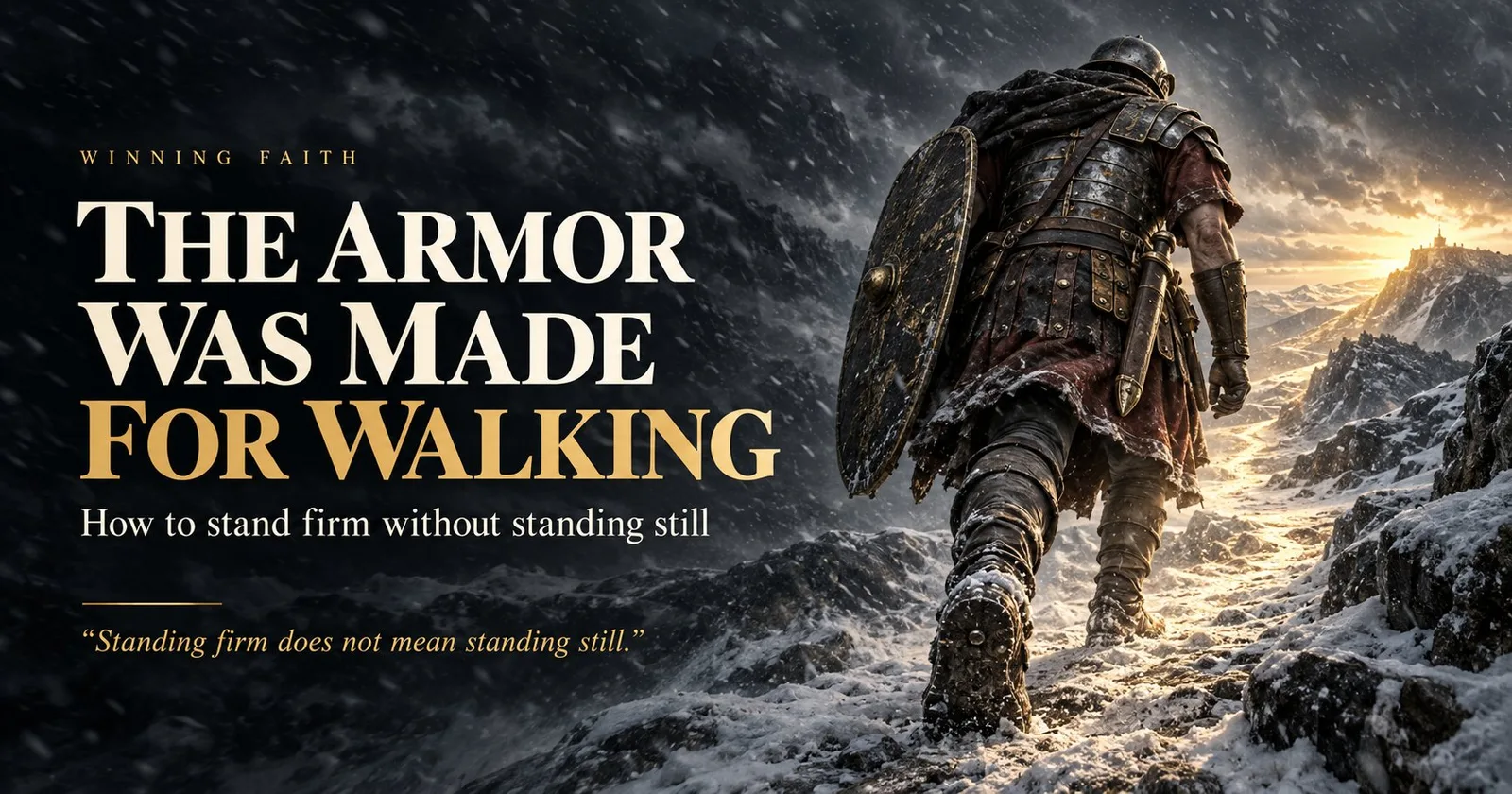
At first, those ideas seemed to pull in opposite directions. Then I saw the picture.
The armor was never meant for a man hiding forever behind the walls of a fortress. It was made for someone who would have to leave the safety of what he knew, enter uncertain terrain, and remain who God called him to be while he moved through it.
The command to stand firm is not a command to become motionless.
It is a command to refuse surrender while you keep walking.
Standing Firm Without Standing Still
Ephesians does not describe spiritual strength as frantic activity.
Paul does not tell believers to sprint in every direction, chase every opportunity, or attack every person who disagrees with them. In the armor passage, the repeated command is to stand—to hold the ground of truth when deception applies pressure.
That distinction matters.
Standing firm is not the same as standing still.
You can stand firm in your convictions while moving forward in obedience. You can remain anchored to truth while your circumstances change. You can refuse to be pushed backward into addiction, secrecy, rage, fear, pride, or despair while still taking the next step into a future you cannot completely see.
The same letter that tells us to stand in chapter six repeatedly teaches us how to walk in the chapters before it: walk worthy of the calling, walk in love, walk as children of light, and walk carefully with wisdom. Then, when that walk meets resistance, put on the full armor of God and refuse to surrender your position.
That was the picture I saw.
A pilgrim in armor.
Not polished armor displayed on a stand.
Not armor worn for a photograph.
Not armor used as a costume so everyone at church knows you own the matching set.
Armor that is scratched from the road. Boots covered in mud. A shield carrying marks from arrows it stopped. A sword that has been used to cut through lies, including the lies the person carrying it once told himself.
That is the kind of faith I understand.
It is not clean because the journey is not clean.
It is not comfortable because transformation rarely is. It is not always impressive from the outside because much of the battle happens in quiet places where no crowd is watching.
But it keeps moving.
The Foreigner
The root behind peregrinate carries the idea of a foreigner, stranger, or pilgrim. That connection took me directly to Hebrews 11, where people of faith are described as strangers and foreigners on earth. They saw promises from a distance. Some did not receive the complete fulfillment within their lifetime, yet they continued to live by faith.
That is a hard truth for a culture addicted to arrival.
We want the finish line and the before-and-after picture without the middle. We want the testimony after the pain has been edited out and the music swells behind the final paragraph. We want God to give us a route, an arrival time, a weather report, approved rest stops, and a guarantee that the hotel at the end has good Wi-Fi.
Then we call that faith.
But a pilgrim does not always know the entire route. A pilgrim knows who called him to walk.
There is a difference.
For much of my life, I measured movement by speed. Faster meant better. More revenue meant progress. More risk meant courage. More noise meant importance. More people recognizing my name meant I must be getting closer to the destination.
I knew how to move fast.
I did not always know how to move faithfully.
The journey has had to teach me the difference.
I have moved from Wyoming to Chicago, Kansas, Israel, and Texas. I have moved through businesses, courtrooms, casinos, hospital rooms, garages, highways, cornfields, and seasons I would never volunteer to repeat.
Some of those moves were directed by faith. Some were driven by fear. Some were me sprinting ahead of God. Some were God using the consequences of my choices to slow me down long enough to hear Him again.
When I zoom out, I can see that the most important part was rarely the location where I landed. It was the person I was becoming—or refusing to become—along the way.
The journey revealed what I carried and trusted. It showed me which parts of my identity were rooted in God and which parts depended on applause, money, substances, speed, or control.
The destination gave me a story.
The road changed the storyteller.
Head Down, Feet Moving
My dad had a way of reducing a complicated situation to one line.
When the weather turned, the work got hard, or somebody spent too much time talking about how miserable the conditions were, he would say:
“Just keep your head down and your feet moving forward.”
Growing up around cattle in Wyoming gave that sentence a picture.
When a blizzard came across the open ground, the cows did not waste energy arguing with the wind. They did not stand broadside to it and pretend the ice was not hitting them. They lowered their heads to shield their faces, narrowed what they could see, and kept their feet moving toward cover, shelter, or the barn.
Sometimes their heads were so low that their eyes seemed level with the snow.
From a distance, it could look like they were staring at the ground.
They were not confused about the destination.
They were surviving the next step toward it.
There are seasons of life when you cannot keep your eyes fixed on the beautiful horizon because the snow is coming sideways. You cannot see the whole field. You cannot see how far the barn is. You cannot even see much beyond the ground immediately in front of your face.
That does not mean you have lost faith.
It may mean you are using the posture required for the weather you are in.
You lower your head enough to protect what is vulnerable. You lean into the wind. You place one foot, then the other. You keep moving toward the last direction you knew was true.
That is not glamorous faith.
It is ranch faith.
It is the kind of faith that says, “I cannot stop the storm, but I can refuse to let the storm turn me around.”
The armor of God makes even more sense to me through that picture. The shield does not always remove the arrows. Sometimes it gives you enough cover to keep advancing. The helmet does not stop the storm. It protects your mind while visibility is low. The shoes of peace do not guarantee dry ground. They prepare your feet to keep their grip while you move toward shelter.
But my dad’s instruction also requires discernment.
Keeping your head down is useful when you still know which direction leads to the barn. It becomes dangerous when pride will not let you pause, look up, check the landmarks, or listen to someone who can see farther than you can.
Endurance is not blindly continuing in the wrong direction.
Sometimes you lower your head and move.
Sometimes you lift your head and realign.
Wisdom is knowing which moment you are in.
The goal is not to prove how much weather you can survive. The goal is to reach the shelter without allowing the storm to decide your direction.
The Road Through the Cave
One of the clearest examples of this was the season that became The Cave.
My body had become an emergency. The news I received about my health made the future feel short and uncertain. Businesses had to be shut down or released. Our family moved into a different kind of life in rural Kansas. The pace I had worshiped could not carry me through what was happening.
There was no shortcut through that season.
There was food I had to eat differently. There were habits I had to surrender. There were mornings when strength looked less like conquering a market and more like participating in the next ordinary act of life. Danielle and our family carried weight that my body and my fear could not carry alone.
I eventually traveled to Israel when part of me did not want to go. The journey led me into a cave that felt more like a cell. In that place, I received what I understood as a promise from God: healing, restoration, and a command to follow His voice and fulfill the dreams and visions He had given me.
That moment mattered.
But the promise did not teleport me home as a finished man.
I still had to walk out of the cave.
I still had to travel home.
I still had to return to a wife who had been carrying responsibility, children who needed their father, decisions that needed to be made, habits that needed to change, and a life that would test whether the promise became obedience or remained a dramatic story I liked to tell.
The cave was a destination on a map.
It was also the beginning of a much longer peregrination.
That is what we sometimes miss when we read the Bible. We notice the burning bush, but Moses still had to walk back to Egypt. We notice the promise to Abraham, but Abraham spent years moving through land he did not own. We notice Peter stepping onto the water, but the word “Come” only mattered because Peter moved one leg over the side of the boat.
An encounter can redirect the journey.
It cannot walk the journey for you.
What the Armor Looks Like While Moving
For years, I imagined the armor of God almost entirely as defense. Put it on. Take the hit. Survive another day. Hold your shield up until the attack is over.
There is truth in that picture. The passage repeatedly says to stand. The shield extinguishes flaming arrows. Armor protects vulnerable places.
But protection is not passivity.
Sometimes the most offensive move against darkness is continuing to obey after fear expected you to quit. It may mean telling the truth, apologizing without defending yourself, staying sober for one more day, or resting because striving has become an idol.
The armor becomes practical when it moves out of the illustration and into an actual day.
The Belt of Truth
Truth has looked like publishing Field Notes I once would have buried—putting my name next to stories about addiction, gambling, rage, failed decisions, and the ways I hurt the people closest to me. It has meant refusing to use a spiritual explanation to escape practical accountability.
The belt of truth is not only what I know about God. It is also the end of my ability to lie about myself.
Truth holds the rest together because a man cannot walk far while maintaining two versions of his life. Every secret becomes another item in a backpack no one else knows he is carrying.
I have been walking taller and sleeping better as I have shared honestly—not because consequences disappeared, but because concealment stopped determining my posture. What is surrendered can be carried by Christ. What remains hidden demands that I carry it alone.
The Breastplate of Righteousness
Righteousness is not reputation management.
It is not convincing the world I meant well or repeating, “God told me,” as if those words erase the impact of everything I did afterward.
On the road, righteousness means the right next action: repair what I can, repay what I owe, listen to correction, involve wise people, honor boundaries, and refuse to call impulsiveness obedience.
The breastplate protects the heart, but it also confronts the heart. It makes me ask whether I am becoming more trustworthy, not simply more persuasive.
Shoes Fitted With Readiness From the Gospel of Peace
This may be the most unexpected part of the armor.
The soldier’s feet are connected to peace.
I spent years believing peace belonged to weak people. I thought warriors were measured by how much conflict they could endure or create. I did not understand that peace was the outcome strength was supposed to protect.
In marriage, I used to walk away from difficult conversations. I told myself I was preventing an explosion. Sometimes I was. But I was also postponing pain, controlling the timing, and punishing Danielle with my absence. The day’s conflict became future Danielle’s problem because I refused to remain present in the discomfort.
Walking in peace has meant staying in the room, listening when the conversation hurts, and becoming someone my wife can bring hard truth to without calculating whether I will disappear.
Peace is not retreat.
Sometimes peace requires the courage to remain.
The Shield of Faith
Faith is what I lift when circumstances send a flaming question toward me:
What if none of this works?
What if the outcome is not what you prayed for?
What if people never forgive you?
What if the promise takes longer than you expected?
The shield does not answer every question with a timeline. It interrupts the question’s attempt to become my identity. Faith does not deny the fire; it keeps the fire from occupying places it was never authorized to enter.
The Helmet of Salvation
The mind can turn a difficult road into a death sentence long before the road ends.
I have lived through seasons when thoughts of death, shame, and hopelessness tried to set up camp—when an internal voice became loud enough to sound authoritative.
The helmet reminds me that my worst day is not my final name. My salvation is not a trophy I earned by performing perfectly. My identity is not waiting for the court, the market, the public, or my past to issue a verdict.
When the mind says, “This is who you are now,” salvation says, “God is still writing.”
The Sword of the Spirit
The sword is the word of God.
This morning it was Ephesians 6:11.
One verse met one unusual word and cut through an assumption I had carried for years. I had treated standing and walking as opposites. Scripture showed me that I could do both: stand in truth and walk in obedience.
The sword is not given to me so I can slash people who disagree with me. It cuts through deception. That includes the deception outside me and the rationalization inside me.
The word of God can expose a counterfeit thought without destroying the person who believed it.
Prayer
Paul finishes the picture by telling believers to pray on all occasions and remain alert.
Prayer keeps the traveler connected to the One who knows the route.
Without prayer, armor can become ego. Strength becomes self-sufficiency. Discernment becomes suspicion. Courage becomes aggression. A man can become so fascinated with spiritual warfare that he starts treating every person around him as the enemy.
But the passage makes the enemy clear: our struggle is not against flesh and blood.
People are not targets.
Your spouse is not the enemy. Your child is not the enemy. Your business partner is not the enemy. The person correcting you is not automatically the enemy. The person who hurt you may need a boundary, accountability, or distance—but armor is never permission to dehumanize them.
Feeling dangerous does not mean becoming dangerous to people.
It means becoming dangerous to the fear, lies, secrecy, addiction, pride, and disobedience that once controlled you.
Protection Is Not Permission
I learned that distinction in a very physical way through the story I called The Wreck.
I was driving a highly modified purple Mustang on a Texas Farm to Market road. The pavement was being prepared for resurfacing. The rear tires had received more horsepower than tread life. I attempted to pass a line of vehicles, encountered another car entering the road, downshifted, accelerated, and lost control.
The rear of the Mustang began trying to pass the front.
I moved across the road, through a ditch, into a harvested cornfield, back toward the pavement, back into the field, and eventually onto the road again. The car was torn apart underneath. Body pieces were missing. Systems were damaged.
I was alive. The people around me were alive.
I understood that survival through the lens of angelic protection. I believe James, the angel I had encountered earlier, was present. But the lesson could not end with protection because protection is not permission to keep manufacturing danger.
Armor is not a license for recklessness.
Faith is not permission to ignore bald tires.
An angelic rescue is not God endorsing the decision that required it.
I sold the car after it was repaired. That action mattered because a testimony that produces no change can become a trophy for the very behavior God’s mercy interrupted.
The road taught me something the destination could not:
Sometimes moving forward means slowing down.
Sometimes standing firm means refusing to become the man who needs the same rescue again.
The Ordinary Miles
Pilgrimage sounds dramatic until you realize most of it is walking.
The cave was dramatic. The wreck was dramatic. Courtrooms, diagnoses, births, losses, and supernatural encounters are easy to identify as major scenes.
But most transformation happens between those scenes.
It happens in the garage when I would rather stay in bed but begin the workout anyway.
It happens in the sauna when there is no applause, no finish-line banner, and no immediate evidence that one more ordinary morning matters.
It happens when I choose water instead of the drink that once promised relief.
It happens when I write the story instead of hiding it.
It happens when I sit through a conversation I once would have escaped.
It happens when I take care of the responsibility in front of me instead of sending another problem to future Waldon.
One of the phrases that changed the way I viewed my physical health was, “Your before picture is complete.” The sentence helped me stop waiting for a more dramatic failure before changing direction.
The after picture was not created that morning.
The after picture became a direction.
Every workout became a step toward it. Every meal became a step. Every decision not to transfer one addiction into another became part of the walk. The purpose was not to arrive at a perfect body and declare the pilgrimage complete. The work was forming discipline I could carry into marriage, business, faith, and fatherhood.
That is the less glamorous part of wearing armor.
Some days there is no visible battle.
You put it on anyway.
When You Are Going Through Hell
There is a phrase people like to repeat: If you are going through hell, keep going.
It sounds great on a poster.
It is much harder when the “hell” is your real life.
It is harder when your marriage is tense and home no longer feels restful. It is harder when your child is hurting and you cannot fix it. It is harder when the business is failing, the legal letter arrives, the test result changes the vocabulary of your future, or the addiction you thought you defeated whispers your name again.
It is harder when you obeyed what you believed God asked you to do and the outcome looks nothing like the picture you carried.
It is harder when you have taken responsibility and the consequences do not immediately disappear.
“Keep going” can sound insulting when the person saying it is standing on dry ground and you are swallowing water.
So let me be clear about what I mean.
Keeping going does not always mean maintaining speed.
It does not mean pretending you are fine.
It does not mean remaining in an abusive home, ignoring medical counsel, pushing through an injury, hiding suicidal thoughts, staying inside a corrupt business, or refusing the rest your body and mind require.
Sometimes forward movement is leaving danger.
Sometimes it is calling 911 or a crisis line.
Sometimes it is entering treatment.
Sometimes it is telling your spouse the truth.
Sometimes it is asking a pastor, counselor, doctor, sponsor, attorney, advisor, or trusted friend to walk beside you.
Sometimes it is putting the phone down and sleeping.
Sometimes the bravest mile of the pilgrimage is the one in which you admit that you cannot safely walk alone.
Keeping going means refusing to make the worst terrain your permanent identity. It means the valley may describe where you are, but it does not get to name who you are. It means you can move slowly, crawl, accept help, change routes, or stop long enough to heal without surrendering your life to the place where you fell.
There may be days when your head has to stay low because the wind is carrying ice. You may not be able to picture next year, next month, or even the end of the week. Do not confuse limited visibility with the absence of direction. Protect what is vulnerable, stay close to the people who know the way, and keep your feet moving toward the nearest place of truth and safety.
You do not have to feel powerful to take the next faithful step.
You only have to take it.
If you are grieving, the next step may be getting out of bed, taking a shower, and letting somebody sit with you without explaining the pain away.
If your marriage is struggling, the next step may be replacing “You always” with “Help me understand,” then remaining in the room long enough to hear the answer.
If you are addicted, the next step may be deleting the number, emptying the bottle, blocking the account, walking into a meeting, or telling one safe person the complete truth.
If your business is collapsing, the next step may not be another desperate risk. It may be opening the books, facing the numbers, protecting employees and customers, calling counsel, and accepting that stewardship sometimes looks like an orderly stop.
If you are facing consequences from your own actions, the next step may be surrendering the fantasy of instant rescue. You can receive grace and still make restitution. You can be forgiven and still repair. You can trust God and still be accountable for the impact you created.
If your health is failing, the next step may be following the treatment plan, asking better questions, eating the next meal, walking to the end of the driveway, or allowing your family to help.
If your faith feels empty, the next step may be one honest prayer:
God, I do not know where You are, but I am still here.
That counts as movement.
Your Armor May Not Look Dramatic
You may never start a company, survive a spectacular car wreck, travel to Israel, or walk into a literal cave.
You do not need a cinematic testimony to become dangerous to darkness.
Your road may run through a quiet house where you are breaking the habit of yelling.
Your armor may look like refusing to repeat a piece of gossip.
Your shield may be the faith required to apply for one more job after another rejection.
Your sword may be one verse written on an index card beside a hospital bed.
Your shoes of peace may carry you across the room to apologize to your child.
Your breastplate may be the right decision nobody will ever post about.
Your belt of truth may be the sentence, “I need help.”
Your helmet may be the reminder that failure is an event, not your identity.
Your prayer may be four words long: “Jesus, walk with me.”
The size of the step does not determine the faithfulness of the step.
The world celebrates distance. God also watches direction.
A Trailblazer Is Still a Traveler
I have always been drawn to trailblazing.
I like creating what did not exist. I like walking into complicated situations and seeing possibility. I like being told something cannot be done because, for better or worse, part of me hears that as a personal invitation.
That trait has helped me build. It has also helped me break things.
Trailblazers can become so addicted to making a new path that they stop asking whether the path should exist.
We can confuse being first with being faithful.
We can confuse resistance with confirmation.
We can confuse speed with courage.
We can become so certain that God called us toward a destination that we ignore what the journey is exposing in us.
The road has taught me that a trailblazer still needs a compass. He still needs community. He still needs accountability. He still needs permission to turn around when discernment reveals he has been cutting a path in the wrong direction.
Peregrinating is not wandering without wisdom. It is traveling with the humility of someone who knows he is not the owner of the land, the author of the weather, or the final authority on the route.
The pilgrim moves.
But he also listens.
The Journey Is Doing Something to You
We ask God, “When will I get there?”
Sometimes I think God is asking, “Who are you becoming while you travel?”
The journey is not wasted time between promise and fulfillment. It is where capacity is built.
The difficult conversation builds the ability to remain present.
The sober day builds evidence that the next sober day is possible.
The public confession weakens secrecy.
The restitution payment retrains stewardship.
The ordinary workout rebuilds trust with your body.
The unanswered prayer exposes whether you love God or only the outcome you want Him to produce.
The delayed promise develops the muscles required to carry it without letting it destroy you.
I used to think the destination would prove the journey had been worth it.
Now I can see that the journey is part of the gift.
Not because every painful event was good. Not because every decision I made was ordained. Not because harm becomes holy when I add spiritual language to it.
The gift is that God can meet me on a road containing both obedience and failure and still form something true in me. He can redeem what I surrender without calling every choice righteous. He can use the consequences as a classroom without pretending the damage was necessary.
That is grace with accountability.
That is movement without denial.
That is how a pilgrim keeps walking without lying about the miles behind him.
The Next Mile
Maybe you have been waiting for the full map.
Maybe you want God to explain the diagnosis, restore the relationship, resolve the case, fund the vision, reveal the destination, silence the opposition, and guarantee the ending before you take another step.
I understand that desire.
But most of my life has not been lived with a full map.
It has been lived with enough light for the next step.
Psalm 119 does not describe God’s word as stadium lighting that reveals the entire countryside. It calls His word a lamp for our feet and a light for our path. A lamp gives you enough light to place your foot without pretending you can see every mile ahead.
That is frustrating when you want control.
It is freeing when you finally accept that you were never asked to carry tomorrow’s visibility.
Put on the belt of truth.
Protect your heart with righteousness.
Fit your feet with the readiness of peace.
Lift the shield of faith.
Guard your mind with salvation.
Carry the word of God.
Pray. Stay alert. Ask for help. Take responsibility. Rest when rest is the obedient move. Then take the next faithful step.
You can stand firm without standing still.
You can be pressed without being crushed.
You can be confused without surrendering to despair.
You can be knocked down without agreeing to remain there.
You can walk through hell without letting hell move into you.
The armor does not promise that the road will be easy.
It keeps the road from deciding who you become.
So stand.
And when it is time—walk.
The Prayer for Today.
Father,
Thank You for meeting us on roads we did not expect to travel. Thank You for being present in the distance between the promise and its fulfillment, in the miles where we are tired, uncertain, and tempted to quit.
Teach us to put on the full armor of God—not as a costume, not as permission to attack people, and not as an excuse for reckless choices. Buckle truth around us so secrecy loses its grip. Guard our hearts with righteousness so good intentions never replace right action. Fit our feet with the readiness of peace so we carry Your presence into conflict instead of adding more harm.
Strengthen our faith when the outcome is still hidden. Guard our minds when shame, fear, and despair try to rename us. Put Your word in our mouths and teach us to use it against lies rather than against people. Keep us prayerful, alert, humble, and connected to wise community.
Show us when to move, when to wait, when to rest, when to leave danger, when to ask for help, and when to stand our ground. Give us enough light for the next faithful step and enough courage to take it.
For the person walking through hell today, provide real help, safe people, endurance, and hope. Do not let pain become identity. Do not let isolation become agreement. Remind them that moving slowly is still movement and that receiving help is not failure.
Use every surrendered mile to form us into people who look more like Christ. Let the road deepen our love, sharpen our discernment, strengthen our obedience, and expand our capacity to serve.
Help us stand firm without standing still.
In Jesus’ name,
Amen.
Join the conversation
Comments
Be the first to leave a comment.