Field Notes · September 25, 2026 · 26 min read
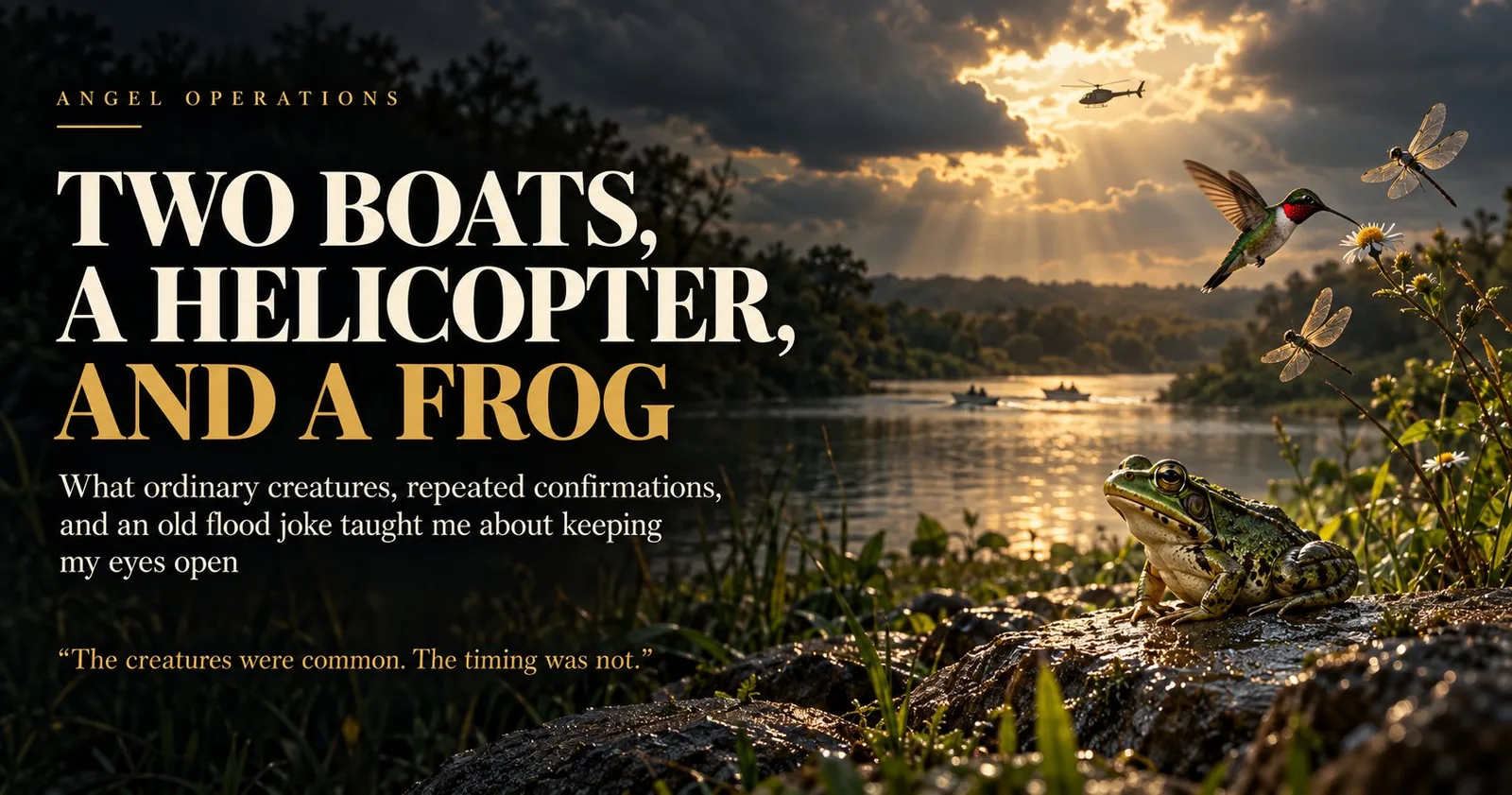
Two Boats, a Helicopter, and a Frog
The signs were ordinary... a frog, hummingbirds, and dragonflies. Their timing taught me to keep my eyes open.
AI-generated narration · Adjust playback speed in the player.
Recently, I have been observing something.
It does not seem to matter what time of day it is, what day of the week it is, or even where I happen to be. Almost daily, I see one of three things: dragonflies, hummingbirds, or frogs. On certain days, especially when I am questioning the love surrounding me or allowing my mind to wander toward rejection, a cardinal will appear too.
Now, before we turn my backyard into a prophetic petting zoo, let me acknowledge the obvious.
I live in North Texas.
Frogs live here.
Dragonflies live here.
Hummingbirds live here.
Cardinals live here
None of them had to clear customs, cross an ocean, or violate the known laws of migration to reach my property. If I told an ornithologist that a hummingbird in Texas had to be a supernatural event, I imagine that conversation would become uncomfortable fairly quickly.
The creatures are common.
The timing is what has my attention.
They seem to arrive at the exact moments when I am praying through a decision, fighting an old habit, questioning my direction, or thanking God for what He is rebuilding.
I will be wrestling with something internally, lift my head, and one of them will be there.
It may be a frog hopping through my garage, a hummingbird hovering outside my office window, or a swarm of dragonflies surrounding the next tee box after I chose water instead of vodka.
I am not saying every frog carries a prophecy.
I am not suggesting you should refuse to make a decision until a cardinal lands on your mailbox and submits the proper paperwork.
What I am saying is that I have started paying attention to the ordinary things that repeatedly interrupt me at meaningful moments. They cause me to pause. They remind me to pray. They bring a truth back to the front of my mind when fear, frustration, or habit is trying to pull it somewhere else.
Sometimes the miracle is not that God created something rare for you to see.
Sometimes the miracle is that He got you to look up.
The Frog in the Garage
My mornings have changed.
I have been getting out of bed, working out, sitting in the sauna, writing honestly, and taking the next physical step toward becoming healthier and stronger.
Some mornings I feel focused before my feet hit the floor. Other mornings the bed develops what can only be described as a demonic level of comfort. The blankets begin presenting a very convincing theological argument for rest, recovery, and starting again tomorrow.
Those are the mornings when I have to remember the after picture.
I have to think about restoration instead of immediate comfort. I have to remember that the body I am building will not be assembled by the intentions I had while lying in bed. It will be built by the decisions I make after the alarm goes off.
There is a crack between our garage door and the wall. It is apparently wide enough to function as a private entrance for one big frog that has decided my garage is included in his morning route.
I will be in the middle of a set, catching my breath between exercises, or sitting in the sauna when here he comes.
Hip hop. Hip hop. Good morning, Waldon.
I do not know if the frog is checking my form, looking for moisture, or wondering why a grown man is voluntarily lifting heavy things before sunrise.
But he arrives often enough that I began wondering why I noticed him so strongly on the mornings when I needed encouragement most.
So I did what any disciplined theologian would do. I consulted a few spiritually mature friends, some advisors, Rabbi Google, and JesusGPT. That last group may not yet be accredited by a seminary, but they are available twenty-four hours a day.
The explanations were surprisingly similar.
Across different traditions, frogs are associated with cleansing, transition, renewal, and healing.
They begin in water, change form, and eventually move between water and land. Their development tells a visible story of transformation.
The Bible does not hand us a universal chart that says, “Frog equals physical healing.”
In fact, the best-known biblical frogs are part of the plagues in Egypt—not exactly the inspirational coffee-mug interpretation I was hoping to find. But an ordinary frog can still become a useful reminder.
When I see him, I remember what I have already been praying about: cleansing, healing, transformation, and learning to function in a new environment. I am living through changes in my body, habits, family, work, faith, and future.
I am learning how to move through emotional depths without drowning in them and how to stand on new ground without running back to the water simply because it feels familiar.
The frog does not create the message. The frog interrupts me long enough to remember it.
On hard mornings, that matters. When progress feels slow or I am tempted to negotiate with discipline, the frog becomes a moment of recognition. Transformation rarely looks impressive while it is happening. Sometimes it looks like sweat on a garage floor and another workout nobody applauds.
Maybe the frog simply found a good crack in the garage.
I am comfortable admitting that possibility.
God does not become less present because there is a reasonable explanation for how the creature got inside. The physical explanation and the spiritual reminder do not have to fight each other. Rain can be weather and provision. Bread can be lunch and communion. A frog can be a frog and still become the moment God uses to turn my attention back toward what He has already asked me to do.
The Hummingbirds Outside the Office
After the workout, the day usually moves toward work.
I spend hours on calls, solving problems, building strategies, helping clients, writing, reviewing, and trying to make sense of situations that were messy before they reached me. I have windows in my office, which helps turn a work jail into a cell with a view.
I am kidding. Mostly.
Some days the work fits my skill set perfectly. Other days calls stack up, projects stall, people resist the advice they hired me to give, and I wonder whether I should find a different collection of problems to solve.
Is this endurance, or am I staying because I do not know how to quit? The difference can be difficult to see from inside the office.
Then—bam—here comes a hummingbird.
Sometimes there is one. One day I saw five or six hovering around the window, levitating in place and appearing to stare at me as if instructed not to leave until I acknowledged the meeting.
Fine. I see you.
Back I went to my highly credentialed research department: friends, advisors, spiritual leaders, Rabbi Google, and JesusGPT. Then I read an article called The Hummingbird... Gods tiny miracle, which focused on the remarkable design required for a creature that small to move the way it does.
The more I learned, the more the picture expanded.
Depending on the species, a hummingbird may beat its wings around 50 times per second. It can remain suspended in one place, move forward, backward and change direction with an agility few creatures possess. Its daytime life demands enormous energy. Yet when night comes, a hummingbird can enter a calm state, dramatically lowering its metabolism and body temperature to conserve what it needs for tomorrow.
That last detail challenged my original interpretation.
I had associated the hummingbird only with endless energy.
But the bird survives because it knows how to move intensely and how to become still.
Its design holds exertion and conservation together.
It does not confuse constant movement with faithfulness.
It spends energy when the moment requires it and preserves energy when rest is necessary.
People commonly associate hummingbirds with joy, resilience, lightness, and the search for sweetness. Those ideas connect with what I was already asking about my work, but the biology adds a needed correction: purposeful energy requires wise recovery.
I do not let a bird approve a business deal.
I have made enough decisions based on excitement, urgency, and promised rewards to know that a good feeling is not the same thing as God’s direction.
A hummingbird outside my window does not eliminate due diligence, wise counsel, financial responsibility, or the need to ask whether an opportunity is actually an assignment.
What it can do is remind me to examine the fruit. I still find joy in solving problems, and entrepreneurship activates energy in me. I believe God has repeatedly used business and advisory work as a field of service. I also know that strength becomes unhealthy when work consumes everything else.
The hummingbird does not tell me, “Say yes to every project.”
It reminds me to look for life in the work and to remember that movement is not the same thing as progress. A hummingbird burns enormous energy, but it still knows what it is seeking. Activity without purpose is just exhaustion with better branding.
Some days the reminder is to continue; other days it is to simplify, close the laptop, and be present with Danielle and the kids. If I decide every sign means “do more,” I am not discerning anything. I am recruiting creation to agree with my addiction to movement.
Joy is not always found by pushing harder.
Sometimes joy is found by noticing that enough has already been done for today.
The Dragonflies at the Next Tee Box
Between the morning workout and the hours in the office, I have been reclaiming parts of the afternoon.
Those time blocks used to disappear into happy hours, meetings that turned into dinner and drinks, casino runs, or whatever form of numbing I could justify that day.
Now they are more likely to hold client work, errands for the family, time in the pool with the kids, a conversation with Danielle, or a round of golf with friends.
I wish I could say that every healthier choice immediately feels more rewarding than the old habit. It does not.
Sometimes you remove the substance and discover the frustration was still waiting underneath it. Sobriety lets you experience the emotion you used to interrupt. That is part of healing, but nobody should pretend it is always comfortable.
Recently, I was playing golf with a group of friends. The round had reached the point where I was beginning to regret paying money to lose golf balls.
Nothing was working.
The swing that had been available on the driving range had apparently made other plans.
Every bad shot increased the irritation, and the old solution entered my mind with perfect clarity.
Find the cart girl. Order a double vodka lemonade. Kill the frustration before the next hole.
For years, that would have felt like golf. The drink would soften the edge and turn frustration into a buzz. I could call it relaxing, even though I was refusing to sit inside an emotion I did not like.
This time, I let the thought arrive without obeying it. I sat with it long enough to recognize the old agreement underneath it: discomfort must be removed immediately. Frustration must be numbed. If the round is not going well, I deserve something that changes how I feel.
That belief no longer serves the life I am building.
I reached for water instead.
We drove to the next tee box, and there were more dragonflies than I had ever seen in one place. Hundreds of them, maybe thousands, moved through the air around us. They filled the space. I had been thinking about transformation, growth, and shedding old habits, and suddenly I was surrounded by creatures that people have associated with those ideas for generations.
Dragonflies, symbolize transformation, growth, and breaking through illusions. They remind you to adapt to change and shed old habits that no longer serve you.
Could the dragonflies have been swarming because of weather, water, food, migration, or whatever else makes dragonflies gather? Of course. That does not insult my faith. God created an ordered world. I do not need nature to stop behaving naturally before I can receive a reminder through it.
What stood out was the timing. The thought came. I recognized it. I chose not to obey it. Then I lifted my head and saw a living picture of movement and transformation surrounding the next place I had to stand.
The dragonflies did not keep me sober. God’s grace, a stronger reason, the truth about what alcohol had cost, and my decision to reach for water all mattered in that moment. The swarm did not remove my responsibility or make the choice for me. It gave me a picture I could carry with the decision: the old response was not my only response anymore.
That is how a life changes. Transformation is often built from the next refusal, the next honest choice, and another moment when the old pattern discovers it no longer has automatic authority.
The dragonflies helped me see the moment. The water helped me live it.
The Cardinal and the Question of Love
The cardinals have been quieter reminders.
They seem to appear on days when I question whether my family can still see me beyond the past or whether the weight of what I have put people through has changed how they hold me in their hearts.
Some people associate cardinals with loved ones who have died, but I am not claiming Scripture teaches that.
For me, the reminder is more immediate: stop allowing fear to answer a question that love has already answered through actions.
Danielle’s love is not hidden in the feathers of a bird.
It is visible in the covenant she has continued to honor, the truth she has been willing to speak, the boundaries she has had the courage to establish, and the life we continue to build together.
My children’s love is visible in their voices, their questions, their hugs, their desire for my attention, and the fact that they still invite me into their worlds.
The cardinal does not manufacture love that is missing. It reminds me to notice the love that fear was making invisible.
That is the larger pattern beneath all four creatures. The frog does not heal my body; it reminds me to participate in healing. The hummingbird does not approve my business decisions; it reminds me to look for purposeful joy. The dragonflies do not break an addiction; they help me recognize a moment of transformation. The cardinal does not prove my family loves me; it turns my attention toward evidence that was already there.
The signs are not the source.
They are reminders to look back toward the Source.
Creation Can Point, but It Does Not Get to Lead
Psalm 19 says that the heavens declare the glory of God and that creation pours forth knowledge without using ordinary speech. That gives me permission to believe the created world can direct my attention toward its Creator. Scripture repeatedly invites people to observe creation. Jesus tells His listeners to consider the ravens and the lilies in Luke 12. He uses ordinary things people could see to expose fear, reveal provision, and teach trust.
But there is a difference between learning through creation and turning creation into a codebook.
If I decide every dragonfly means “go,” every closed door means “the enemy is attacking,” every open door means “God approved it,” and every repeating number means I should make a major decision, I can create a spiritual system that never has to disagree with me. I can assign meaning after the fact, keep the interpretations that support what I want, and ignore everything that challenges me.
That is not discernment. That is confirmation bias wearing church clothes.
I have lived enough life to know I can hear a true word and still apply the wrong interpretation. I can receive encouragement and turn it into permission. I can see resistance and call it proof that I must push harder, when the resistance may actually be a warning about my execution, my timing, or the damage I am causing. I can notice a pattern and then build a conclusion far larger than the evidence allows.
That is why 1 Thessalonians 5:19–21 matters here. Paul does not tell believers to become cynical about everything spiritual. He also does not tell them to accept everything that feels spiritual. He holds openness and examination together: do not quench the Spirit, test everything, and hold on to what is good.
I need both halves. If I refuse to notice anything God may be showing me, I can become so skeptical that I miss the boat. If I treat every unusual feeling as a command, I can become so impressionable that I climb into the wrong boat simply because somebody painted a Bible verse on the side.
A sign worth receiving should survive discernment. It should not contradict Scripture. It should not require secrecy, manipulation, dishonesty, or harm. Its interpretation should be able to enter a conversation with Danielle, wise friends, pastors, advisors, or people who are willing to tell me no. It should produce fruit that looks more like love, joy, peace, patience, faithfulness, and self-control—not pride, panic, obsession, or the belief that normal accountability no longer applies to me.
Most importantly, a reminder should lead me back to a faithful next action. The frog reminds me to finish the workout. The hummingbird reminds me to seek joy without worshiping activity. The dragonflies remind me that I can choose water and remain present inside discomfort. The cardinal reminds me to receive love through the people actually giving it.
None of those actions require me to predict the future.
They require me to be faithful in the present.
Two Boats and a Helicopter
I keep thinking about the old flood joke. A devout man is trapped on the roof of his house while the water rises. He is praying for God to rescue him.
A neighbor arrives in a rowboat and offers to take him to safety. The man refuses because he believes God will save him.
The water rises. A second boat arrives. The driver tells him to get in. Again, he refuses. God will save him.
Eventually, the man is standing on the chimney, and a helicopter lowers a rescue ladder. He waves it away. He has faith. He is waiting for God.
The man drowns. When he reaches heaven, he confronts God and asks why He did not answer the prayer. God replies, “I sent you two boats and a helicopter. What more did you want?”
Depending on who tells the joke, God may include a word that is not normally printed in red letters. I understand the frustration.
From dry land, the lesson is obvious. The man was so committed to the form he expected the rescue to take that he rejected the rescue God provided. He wanted supernatural intervention but refused ordinary provision. He was looking toward heaven while waving away the help floating directly in front of him.
It is funny because it is uncomfortably familiar.
How many times have I prayed for direction while ignoring the person God placed in the room?
How many times have I asked for provision while refusing to change the habits draining the account?
How many times have I prayed for healing while resisting the workout, doctor, rest, or difficult conversation?
How many times have I asked God to restore a relationship while defending the behavior that keeps injuring it?
Sometimes we miss the answer because it does not look spiritual enough.
We expect thunder. God sends a conversation.
We expect an angel. God sends a therapist, an advisor, a spouse, a friend, or a child who says the one sentence we cannot shake.
We expect the entire path to light up. God places enough light in front of us to take one honest step.
Sometimes we miss the answer because it asks us to participate.
The boat requires us to climb in.
The rope requires us to grab it.
The appointment requires us to show up.
The apology requires us to stop explaining.
Grace is a gift, but receiving it can look like taking hold of what God sent before the water rises again.
And sometimes the boat is not confirmation to keep going. Sometimes the boat is the way out.
That may be the hardest sign for a driven person to recognize. I can interpret every opportunity as territory, every resistance as warfare, and every impulse to continue as perseverance. But rescue may look like stopping. It may look like closing the business, leaving the casino, ending the conversation before anger becomes cruelty, going home, taking the medication, entering treatment, or letting someone else hold the keys for a while.
If I have already decided God can only confirm acceleration, I may drive directly past the exit He provided.
Your Signs May Look Different
You may never see a frog in your garage.
You may live somewhere hummingbirds rarely visit.
You may actively dislike dragonflies, golf, Texas, or every other detail in this story.
The invitation is not to adopt my symbols. It is to examine the repeated moments in your own life that keep asking for your attention.
Your boat may be a spouse who has tried to tell you the same painful truth in three different ways. You keep praying for your marriage, but the answer may begin with listening to the person sitting across from you. The sign may not be a cardinal. It may be the change in their voice when they no longer believe another promise. It may be the counselor whose name has been sent to you twice, the book both of you keep hearing about, or the quiet evening when someone finally asks, “Are we going to keep living like this?”
Your boat may be a child whose behavior changes whenever work consumes you. You may be praying for them to become less angry or distant while missing what they are revealing about the home. The answer may begin when you put down the phone, attend the game, keep the promise, or apologize without attaching a lesson.
Your boat may be a medical result you keep minimizing, pain that returns, sleep you never get, or breath you cannot catch. You can pray for healing and still accept the appointment. Faith does not become stronger when it refuses help available through trained hands.
Your boat may be the friend who keeps asking whether you are okay, the recovery meeting you pass, or the number someone placed in your phone. You may be waiting for the desire to disappear before asking for help. Help may be the boat that carries you while the desire still screams from the roof.
Your boat may be a business warning. The numbers reveal a problem your optimism keeps renaming. An employee or mentor raises the same concern. Your spouse asks why the family is carrying risk they never agreed to carry. You may be praying for breakthrough when the repeated sign is a call to slow down, accept accountability, change the plan, or admit a good opportunity was never your assignment.
Your boat may be rest. The meeting cancels, the deadline moves, or your body refuses the pace your ego promised. You keep filling the opening because an empty hour feels unproductive. But perhaps the provision is the space itself—a chance to discover the world can continue turning while you sit still long enough to be loved without producing.
Your boat may be an opportunity to serve. A name keeps coming to mind. A person tells you more than they intended. You notice the same need in your church, neighborhood, business, or community. The faithful response may not be launching a nonprofit, building a brand, or announcing a calling. It may be buying a meal, making a call, praying with consent, giving quietly, or showing up again next week.
Your boat may even be a closed door. Not every refusal is rejection, and not every delay is an attack. A position, deal, invitation, or relationship may end before you understand why. That does not mean every disappointment was arranged by God. It means faith can remain open to redirection.
The point is not to become suspicious of every coincidence or obsessed with decoding your environment. The point is to become attentive. What keeps repeating? What truth keeps returning through different trustworthy people? What practical help have you been dismissing because it did not arrive in the form you requested? What responsibility keeps standing in front of you while you pray for a more dramatic assignment?
Look for patterns, but do not worship them. Receive encouragement, but test the interpretation. Ask God for confirmation, but remain willing for the confirmation to correct you instead of congratulate you.
Aligning Faith With Confirmation
I have come to expect that God will provide guidance. John 10:27 says that Jesus’ sheep listen to His voice and follow Him. Proverbs 3:5–6 tells us not to lean entirely on our own understanding but to acknowledge God in all our ways. Those verses invite relationship, attention, trust, and movement.
They do not promise that every impression will be self-interpreting.
Faith around confirmation begins with surrendering the outcome. If I only accept signs that support the future I already selected, I am not asking for direction. I am asking God to endorse my plan. Real guidance must be allowed to redirect me, slow me down, tell me no, expose my motive, or send me back to repair something I wanted to leave behind.
Then I test what I believe I am seeing. Does the interpretation agree with the character and Word of God? Does it move me toward truth, love, humility, stewardship, and self-control? Can it survive the questions of wise people? Does it honor the people who will carry the consequences? Am I still willing to own the result, or am I preparing to blame God if my interpretation proves wrong?
I also look for proportion. A frog may be enough to remind me to finish a workout. It is not enough to justify selling everything, moving the family, and launching Frog Ministries International before lunch. A hummingbird may remind me of joy in my work. It does not replace the contract, the budget, or the conversation with Danielle. A swarm of dragonflies may mark a meaningful sobriety decision. It does not make me immune to cravings or remove the need for boundaries.
Small signs are often sufficient for small steps. I do not need to inflate the message to prove the moment mattered.
Finally, I respond.
Attention without obedience becomes another form of entertainment.
If the reminder is to call someone, I make the call.
If it is to drink the water, I drink the water.
If it is to rest, I stop.
If it is to tell the truth, I try not to spend three weeks asking for a second helicopter.
The next faithful action is usually less dramatic than the sign I wanted. It is also where the change becomes real.
Keep Your Head Up
I have spent seasons of my life moving too fast to notice anything that was not directly in front of me. I focused on the next result, the next problem, the next opportunity, the next risk, or the next way to escape what I felt. When you live that way, the world becomes a tunnel. You see what can be chased, won, fixed, or numbed. Everything else becomes scenery.
I do not want to live that way anymore.
I want to keep my head up and my eyes open.
I want to notice the frog that enters through the crack, the hummingbirds outside the window, the dragonflies around the tee box, the cardinal on the difficult day, the person offering help, and the ordinary door that has been standing open while I demanded a miracle.
I want enough faith to believe God can move supernaturally and enough humility to accept that His answer may arrive naturally. I want enough discernment to recognize that a repeated observation can be meaningful without pretending I possess a secret code. I want enough trust to receive confirmation and enough accountability to test my interpretation.
Most of all, I do not want to become the man on the roof... praying loudly, believing sincerely, and refusing every answer because none of them looks like the rescue I imagined.
Maybe God will send an angel.
Maybe He will send two boats and a helicopter.
Or maybe, before sunrise tomorrow, He will send a big ol’ frog through the crack in my garage door and remind me to finish the work already in front of me.
Either way, I plan to be watching.
A Prayer for Today.
Father, thank You for being present in ordinary moments—for the world You created, the people You send, the truth You repeat, and the practical help I have overlooked. Open my eyes without allowing me to turn every observation into something You never said.
Give me a heart that is attentive but not superstitious, expectant but not demanding, spiritually open but grounded in Your Word. Teach me to test what I believe I hear, and use wise people to challenge interpretations shaped by fear, pride, urgency, or desire.
Forgive me for asking You for rescue while rejecting the boats You sent, and for praying for change while resisting the action, boundary, conversation, apology, or surrender it required. Give me humility to receive help in whatever faithful form You provide.
Help me recognize the reminders You place in my path. When I see transformation, strengthen me to release the habit that no longer belongs in my future. When I see joy, remind me to receive the sweetness of the life You have already given me. When I question whether I am loved, turn my attention toward the people whose actions have continued to answer that fear.
Give me courage for the next faithful action. If the answer is to continue, strengthen me. If the answer is to stop, humble me. If the answer is to wait, settle me. If the answer is to ask for help, remove my pride. If the answer is to climb into the boat, help me stop arguing about how I expected You to arrive.
Keep my head up, my eyes open, and my heart surrendered. Let creation point me toward You, but let Your Spirit, Your Word, wise counsel, and the fruit of my actions guide my steps. Make me faithful with the light I have today.
In Jesus’ name, amen.
Join the conversation
Comments
Be the first to leave a comment.